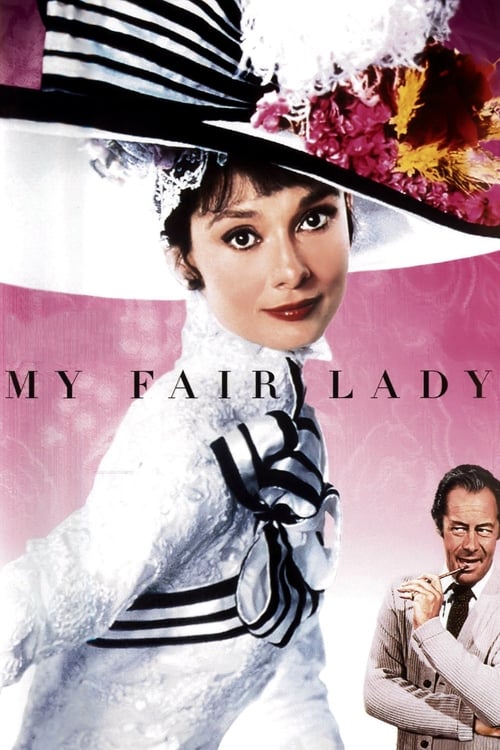
My Fair Lady (1964)
Directed by George Cukor
No · Ultra Based
How we score movies →Consciousness Markers
The narrative centers on a man reshaping a woman to his specifications through behavioral conditioning. While Eliza demonstrates agency in the final act, the power dynamic remains fundamentally patriarchal and the ending leaves her dependent on male approval.
While Audrey Hepburn carries the film as its lead, this reflects 1960s casting practices rather than deliberate progressive representation. The supporting cast is uniformly white and reflects the era's narrow casting conventions.
Scenes of Higgins instructing Eliza are presented as entertainment within the musical narrative rather than as overt social justice messaging or preachy commentary.
While the film engages with class dynamics, it ultimately endorses the existing class hierarchy by celebrating Eliza's assimilation into upper-class society rather than critiquing systemic inequality.
No LGBTQ+ themes or characters present. Despite George Cukor's own identity as a gay director, the film contains no queer content of any kind.
Set in London with an entirely white cast. The film exhibits no engagement with race or racial representation whatsoever.
A romantic musical set in the Edwardian era contains no environmental themes or climate-related content of any kind.
A 1964 Hollywood production reflecting conventional beauty standards of its era. No representation of body diversity or body-positive messaging.
No representation of neurodivergent characters or engagement with neurodivergence as a theme.
The film makes no attempt to revise historical narratives. It adapts a period play without recontextualizing its source material.


Synopsis
A snobbish phonetics professor agrees to a wager that he can take a flower girl and make her presentable in high society.
Why it received this score
My Fair Lady stands as a perfectly preserved artifact of 1960s filmmaking, which is to say it exhibits virtually no markers of contemporary progressive sensibility. The film's central narrative operates on a premise that would invite immediate scrutiny today: a man of superior social standing undertakes to remake a working-class woman into an acceptable companion through rigorous behavioral conditioning. Professor Higgins does not so much fall in love with Eliza as he falls in love with his own pedagogical achievement, a distinction the film treats as romantic rather than troubling.
The movie's relationship to class is particularly instructive in its unwokeness. Rather than critiquing the rigid stratification of Edwardian society, the narrative celebrates Eliza's successful assimilation into the upper classes. Her transformation is presented as purely positive, a reward for her linguistic discipline and social conformity. The film never suggests that perhaps the system itself is absurd or unjust, only that Eliza has been clever enough to navigate it. This is conservatism in its purest form, dressed in Cole Porter melodies.
Viewed through the lens of contemporary cultural consciousness, the film's most glaring absence is any meaningful consideration of Eliza's personhood beyond her utility as a vehicle for Higgins' ambitions. The ending, deliberately ambiguous in Shaw's original play, becomes almost willfully obtuse here, leaving us to contemplate whether Eliza will remain with a man who has shown her no genuine affection. The film treats this uncertainty as the stuff of romance rather than recognizing it as the central tragedy of its own narrative. It is, quite simply, a film from another era.
Analysis generated by our Consciousness Algorithm
Critic Reviews
“Cukor doesn't try to hide the stage origins of his material; rather, he celebrates the falseness of his sets, placing his characters in a perfectly designed artificial world. Every frame of this 1964 film bespeaks Cukor's grace and commitment—it's an adaptation that becomes completely personal through the force of its mise-en-scene. ”
“Audrey Hepburn is a physical wonder; Rex Harrison defines his role; and production designer Gene Allen is the hidden star. A big screen production for the entire family. ”
“The picture is exquisite, extraordinary, a unique gem of filmmaking.”
“The film seems to go on for about 45 minutes after the story is finished. Audrey Hepburn is an affecting Eliza, though she is totally unconvincing as a guttersnipe, and is made to sing with that dreadfully impersonal Marni Nixon voice that has issued from so many other screen stars.”