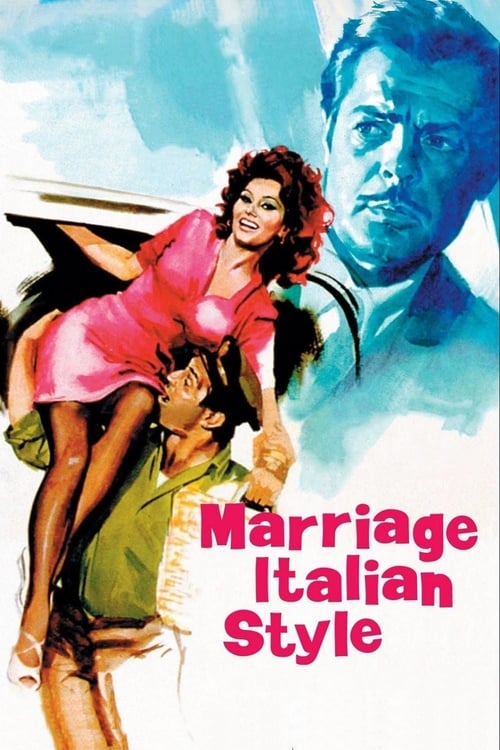
Marriage Italian Style (1964)
Directed by Vittorio De Sica
No — Marriage Italian Style is not woke, scoring 8 out of 100 on our wokeness meter.
Vittorio De Sica's 1964 Neapolitan romance concerns a prostitute, Filumena, who feigns death to marry her longtime employer, Domenico, a cynical businessman.
Consciousness Markers
Filumena is a shrewd, resourceful woman who outmaneuvers Domenico to secure her children's future, but her agency is framed through maternal devotion and romantic reconciliation rather than any modern feminist critique of patriarchy.
Domenico is portrayed as a cynical businessman who treats Filumena as a possession, but this is character drama rather than a systemic indictment of wealth.
The cast is entirely Italian, as befits a 1964 Neapolitan production; there is no casting made with modern representational intent.
No LGBTQ+ characters or themes appear anywhere in the narrative.
Race plays no role in the film's themes or conflicts.
No environmental or climate concerns are present.
No body positivity themes are present.
No neurodivergence is depicted or addressed.
The WWII-era Naples setting is atmospheric backdrop, not a revisionist reinterpretation of history.
The film is a warm, humanistic comedy-drama that never stops to deliver a social lesson.
Why it received this score
Vittorio De Sica's 1964 Neapolitan romance concerns a prostitute, Filumena, who feigns death to marry her longtime employer, Domenico, a cynical businessman. Sophia Loren brings a shrewd resourcefulness to Filumena, outmaneuvering her man to secure legitimacy for her three sons. This is genuine agency, but it operates entirely within the confines of maternal devotion and romantic reconciliation. No modern feminist critique of patriarchy disturbs the proceedings. The film's social consciousness extends to a mild suspicion of Domenico's wealth, which is portrayed as a character flaw rather than a systemic indictment. He treats Filumena as a possession, and the narrative gently chides him for it, but the critique remains personal, not political.
The remaining markers of contemporary progressive sensibility are absent. The cast is uniformly Italian, as befits a 1964 Neapolitan production, with no representational intent. Race, climate, body positivity, neurodivergence, and LGBTQ+ themes are nowhere to be found. The World War II setting serves as atmospheric backdrop, not as a revisionist reinterpretation of history. And the film never pauses to deliver a social lesson. It is a warm, humanistic comedy-drama that trusts its characters to carry the weight of its themes. There is no lecture energy, no sermonizing, no moment where the director steps out from behind the camera to instruct the audience on correct thinking.
What we have, then, is a relic of an earlier era, when stories about love and family could unfold without the obligation to educate. The film was nominated for two Academy Awards and remains a charming, well-acted piece of Italian cinema. But those seeking the modern cultural signifiers will find the cupboard bare. A score of near zero on most markers is not a criticism of the film's quality. It is simply an observation that the film's concerns are timeless and human, not timely and ideological. We classify it accordingly, with the solemnity such a task demands.
Analysis generated by our Consciousness Algorithm


Synopsis
During the bombing of Naples in World War II, a cynical businessman helps a naive prostitute, who spends the next two decades desperate to have him reciprocate her feelings.
Questions about Marriage Italian Style
Is Marriage Italian Style woke?
No — Marriage Italian Style is not woke, scoring 8 out of 100 on our wokeness meter. That earns it a verdict of Ultra Based.
Does Marriage Italian Style have any woke elements?
Very few. None of the 10 markers reaches 30, the level where a marker counts as present; the highest is Feminist Agenda at 18.
How does Marriage Italian Style compare to other 1964 movies?
It ranks #4 of the 17 films from 1964 we've scored; their average is 5. The wokest is Mary Poppins (17).
How is the Woke Score calculated?
An AI-assisted process researches the film and its reception, scores it 0–100 on ten markers, then combines those into one 0–100 Woke Score. It measures a specific set of 2020s cultural themes, not film quality.