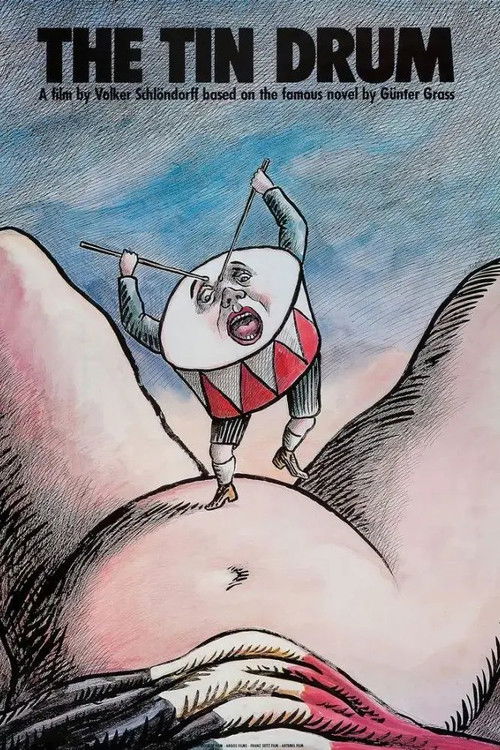
The Tin Drum (1979)
Directed by Volker Schlöndorff
No — The Tin Drum is not woke, scoring 8 out of 100 on our wokeness meter.
The Tin Drum arrives on the ledger as a 1979 West German production, a Palme d'Or co-winner and an Academy Award recipient for Best Foreign Language Film, and it is a serious film about serious things.
Consciousness Markers
The lead role of Oskar is played by David Bennent, a child with a growth condition, and the film features other dwarf performers, providing authentic representation of little people.
No LGBTQ+ themes or characters are present; the film's sexual content involves heterosexual and abusive situations.
The film does not advance a feminist agenda; female characters are largely defined by their relationships to men and are often victims or objects of desire.
While the film depicts Nazi persecution of Jews and Poles, it does so as historical drama rather than through a modern racial-consciousness lens.
No environmental or climate-related themes are present.
The film contains no critique of capitalism or wealth inequality.
The film does not promote body positivity; its portrayal of atypical bodies is dark and controversial rather than affirming.
No neurodivergent themes or characters are present.
The film is a historical fiction adaptation, not a revisionist take on history.
The film is anti-war but conveys its themes through absurdist drama and satire rather than preachy lecturing.
Why it received this score
The Tin Drum arrives on the ledger as a 1979 West German production, a Palme d'Or co-winner and an Academy Award recipient for Best Foreign Language Film, and it is a serious film about serious things. It follows Oskar Matzerath through Danzig across the rise of the Nazi Party and the wreckage of the war, and it holds the adults around him in open contempt. We should be clear about the accounting here. A film can stare into genocide and still register almost nothing on the modern social consciousness meter, because the meter measures a specific recent vocabulary, not moral weight. This one is an anti-war film told through magical realism and dark comedy, and it does its work through absurdity.
One marker does flicker. David Bennent, a child with a growth condition, carries the lead, and the production casts dwarf performers as Bebra and Roswitha. That is authentic representation of little people, arrived at honestly, and it earns a modest note. It earns nothing more, because the film's use of atypical bodies is grim and provocative, not affirming. The navel sherbet and the sexual scenes involving an eleven-year-old actor drew child pornography bans in Ontario and Oklahoma, and the resulting court battles are their own strange chapter in film history. Nobody involved was promoting self-love.
The remaining markers sit at zero, and they sit there honestly. The women here are defined by their husbands, cousins, and lovers, and they are victims or objects of desire. There is no LGBTQ content. There is no climate concern, no critique of capital, no neurodivergent framing, no revisionist reading of the historical record. The film does not lecture. It drums. Oskar bangs on his tin drum whenever displeased, and the film does something similar, hammering at the audience with imagery instead of argument. Ebert found the symbolism inert. Others found it shattering. The classification stands either way, and the ledger closes.
Analysis generated by our Consciousness Algorithm


Synopsis
In 1924, Oskar Matzerath is born in the Free City of Danzig. At age three, he falls down a flight of stairs and stops growing. In 1939, World War II breaks out.
Questions about The Tin Drum
Is The Tin Drum woke?
No — The Tin Drum is not woke, scoring 8 out of 100 on our wokeness meter. That earns it a verdict of Ultra Based.
Does The Tin Drum have any woke elements?
Very few. None of the 10 markers reaches 30, the level where a marker counts as present; the highest is Representation Casting at 20.
How does The Tin Drum compare to other 1979 movies?
It ranks #9 of the 33 films from 1979 we've scored; their average is 6. The wokest is Hair (30).
How is the Woke Score calculated?
An AI-assisted process researches the film and its reception, scores it 0–100 on ten markers, then combines those into one 0–100 Woke Score. It measures a specific set of 2020s cultural themes, not film quality.