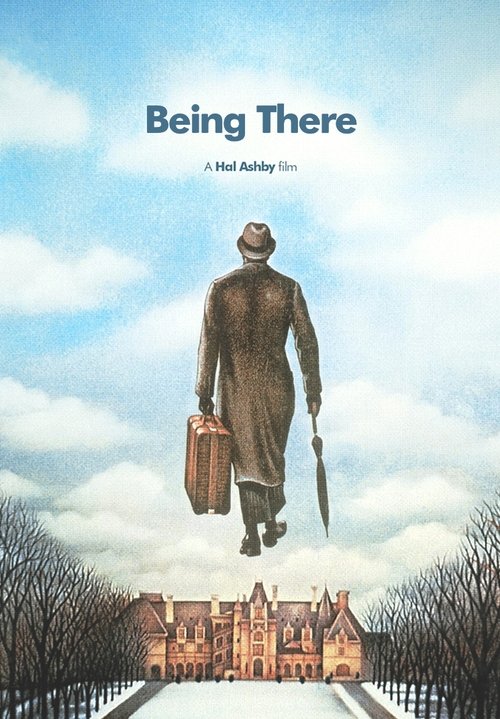
Being There (1979)
Directed by Hal Ashby
No — Being There is not woke, scoring 12 out of 100 on our wokeness meter.
Hal Ashby's Being There (1979) opens with a man who has never left the house and closes with him walking across a lake.
Consciousness Markers
Louise's remark that whiteness is all that is needed to succeed in America offers a pointed racial critique. However, it is a brief satirical aside rather than a sustained modern racial-consciousness theme.
The film satirizes wealthy business moguls, political elites, and media-driven image-making. Its critique is absurdist and philosophical rather than an explicit eat-the-rich program.
Chance is a simple-minded, TV-raised gardener whose cognitive difference is central to the story, and TMDB keywords tag autism. The film treats this as satirical blankness rather than modern neurodivergence advocacy.
The cast is overwhelmingly white, with Black characters appearing only as naturalistic supporting figures such as the maid Louise and a brief youth. There is no modern representation-casting agenda at work.
The film contains no LGBTQ+ themes, characters, or subtext.
Eve Rand is largely defined by her attraction to Chance and a voyeuristic sexual scene, with no feminist critique or agenda present.
Gardening and seasonal metaphors are used for political satire, not environmental advocacy or climate crisis messaging.
There is no body-positivity theme or body-diverse representation agenda in the film.
The film is a contemporary satire based on a novel, not a historical revision or reimagining of real events.
Being There is subtle, ironic, and philosophical rather than preachy or lecture-driven. It does not deliver modern social-justice messaging.
Why it received this score
Hal Ashby's Being There (1979) opens with a man who has never left the house and closes with him walking across a lake. In between, the film performs a quiet autopsy on American political culture. Chance, the gardener, is played by Peter Sellers with a blankness so total it reads as wisdom to everyone he meets. He says nothing about seasons and soil, and Washington hears economic policy. It is a satire of projection, of a country so hungry for reassurance that a man reciting gardening tips becomes a presidential contender. This is not the sort of satire that arrives with a thesis statement and a stack of index cards. It simply watches.
The film's small supply of social commentary is distributed sparingly. Chance's cognitive difference sits at the center of the story, though it is treated as an absurdist blank slate, not a condition to be celebrated or defended. Ruth Attaway's Louise gets one sharp line, telling her friends that whiteness is all a person needs to succeed here, and the film lets it land without comment. The wealthy Rand household and the media that manufacture Chance's reputation take their lumps, but the target is vanity and appetite, not an economic system.
What the film refuses to do is explain itself or instruct us. Ashby and Kosiński keep the sermons off screen. The ending, a submerged platform and a man strolling on water, has been argued over for four decades, and the argument is the point. Melvyn Douglas won an Oscar for his dying patriarch. Nobody in the cast lectures. It remains a rare artifact from a period when a film could be political without being preachy, and could be gentle without being soft. We are unlikely to see its like again.
Analysis generated by our Consciousness Algorithm


Synopsis
A simple-minded gardener named Chance has spent all his life in the Washington D.C. house of an old man. When the man dies, Chance is put out on the street with no knowledge of the world except what he has learned from television.
Questions about Being There
Is Being There woke?
No — Being There is not woke, scoring 12 out of 100 on our wokeness meter. That earns it a verdict of Ultra Based.
Does Being There have any woke elements?
Very few. None of the 10 markers reaches 30, the level where a marker counts as present; the highest is Racial Consciousness at 25.
How does Being There compare to other 1979 movies?
It ranks #5 of the 33 films from 1979 we've scored; their average is 6. The wokest is Hair (30).
How is the Woke Score calculated?
An AI-assisted process researches the film and its reception, scores it 0–100 on ten markers, then combines those into one 0–100 Woke Score. It measures a specific set of 2020s cultural themes, not film quality.