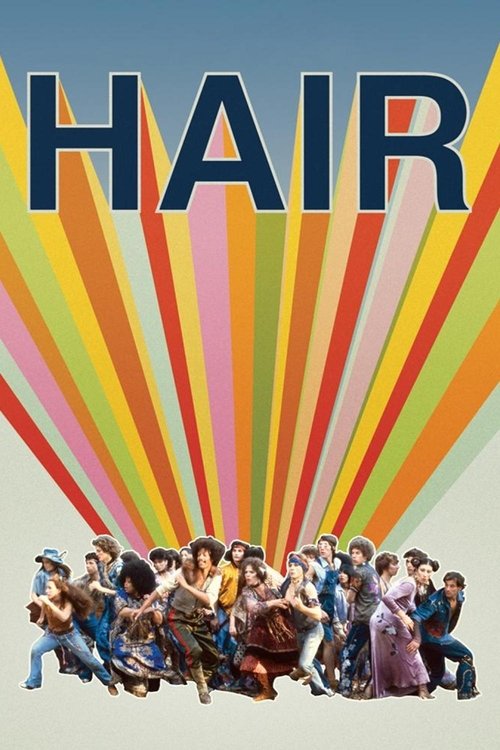
Hair (1979)
Directed by Miloš Forman
No — Hair is not especially woke, scoring 30 out of 100 on our wokeness meter.
Milos Forman's 1979 adaptation of the Broadway tribal love-rock musical arrives with the earnestness of a peace rally and the pacing of a revue.
Consciousness Markers
The film explicitly stages 1960s racial themes through Hud's storyline and songs like 'Colored Spade' and 'Black Boys/White Boys,' engaging race as a lived social issue rather than a modern DEI framework.
The ensemble includes Black performers Dorsey Wright (Hud), Cheryl Barnes, Ronnie Dyson, and Melba Moore, and the film stages race-conscious numbers like 'Colored Spade' and 'I'm Black/Ain't Got No' — but this is 1979 naturalistic casting rather than a modern representation mandate.
The anti-war message is delivered earnestly and repeatedly, culminating in a peace protest and a KIA grave, though it is channeled through song and drama rather than direct sermonizing.
The source material's gay undertones (notably the character Woof) survive in muted form, and the film's free-love counterculture milieu touches on non-normative sexuality, though without any explicit modern LGBTQ+ advocacy.
The hippie tribe's anti-establishment, anti-war, communal ethos carries a mild anti-authority and anti-materialist charge, but it targets the military-industrial draft rather than wealth or capitalism per se.
The stage musical's feminist firebrand Sheila was rewritten into a high-society debutante, largely defanging the feminist content; Jeannie's marriage-for-draft-exemption proposal is the closest remnant.
No environmental or climate content whatsoever; the film's concerns are war, draft, and counterculture.
Free love and skinny-dipping appear as period counterculture texture, not as any body-acceptance or body-positivity statement.
No neurodivergence themes or characters are present.
A fictional narrative set against the Vietnam era; it does not reframe or revise historical record.
Why it received this score
Milos Forman's 1979 adaptation of the Broadway tribal love-rock musical arrives with the earnestness of a peace rally and the pacing of a revue. Claude, a draftee from Oklahoma, wanders into a New York tribe of long-haired panhandlers and spends two hours negotiating between the farm, the commune, and the debutante ball. The film wants us to feel the Vietnam era in our bones. It mostly succeeds, though the bones in question belong to 1968, and the film knows it.
The racial material is the most substantial thing on offer. Dorsey Wright's Hud carries a genuine ache, and the staging of "Colored Spade" and "I'm Black/Ain't Got No" treats race as a lived American problem instead of a slogan. The casting of Black performers in the ensemble reads as naturalistic for 1979, not as a modern mandate. Elsewhere the counterculture's looser sexual arrangements survive in muted form. Woof's inclinations are present but unremarked, which is how the era handled such things on screen.
Where the film thins out is in its politics. The stage Sheila was an outspoken feminist; the screen Sheila is a New Jersey debutante, and with her goes most of the show's gender argument. What remains is Jeannie's marriage-for-exemption proposal, played for plot. The anti-war sentiment lands hard and often, building to a peace march and a grave at Arlington, though it travels by song instead of sermon. There is no environmental content, no body-acceptance framing, no neurodivergent character, and no revision of the historical record. The tribe's anti-establishment posture targets the draft, not the bank. A period piece, then, wearing its period honestly.
Analysis generated by our Consciousness Algorithm


Synopsis
Upon receiving his draft notice and leaving his family ranch in Oklahoma, Claude heads to New York and befriends a tribe of long-haired hippies on his way to boot camp.
Questions about Hair
Is Hair woke?
No — Hair is not especially woke, scoring 30 out of 100 on our wokeness meter. That earns it a verdict of Based.
Does Hair have any woke elements?
3 of the 10 markers register at 30 or above, led by Racial Consciousness (45), Representation Casting (35) and Lecture Energy (30). On Racial Consciousness: The film explicitly stages 1960s racial themes through Hud's storyline and songs like 'Colored Spade' and 'Black Boys/White Boys,' engaging race as a lived social issue rather than a modern DEI framework.
How does Hair compare to other 1979 movies?
It is the wokest of the 33 films from 1979 we've scored; their average is 6.
How is the Woke Score calculated?
An AI-assisted process researches the film and its reception, scores it 0–100 on ten markers, then combines those into one 0–100 Woke Score. It measures a specific set of 2020s cultural themes, not film quality.