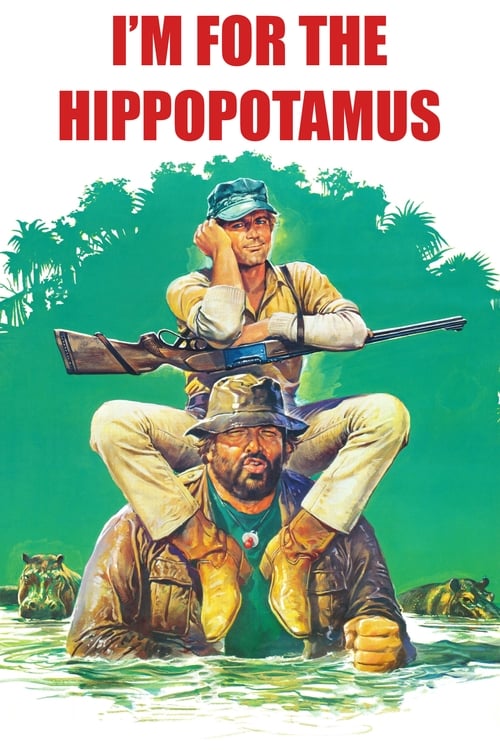
I'm for the Hippopotamus (1979)
Directed by Italo Zingarelli
No — I'm for the Hippopotamus is not woke, scoring 10 out of 100 on our wokeness meter.
I'm for the Hippopotamus arrives from 1979 with the easy confidence of a Terence Hill and Bud Spencer vehicle, which is to say it is less a film than a delivery system for punches, saxophone, and dust.
Consciousness Markers
The cast includes several Black African actors (May Dlamini, Ben Masinga, Sandy Nkomo) in supporting roles, but this reflects the film's African setting rather than any deliberate diversity initiative.
The film's animal-lover hero and anti-poaching plot carry a conservationist streak, but this is animal welfare, not a climate-change crusade.
The villain is a greedy ivory-and-animal trafficker motivated by profit, giving a mild anti-exploitation flavor, though it targets a criminal rather than capitalism itself.
A doctor publicly denounces animal exploitation in a newspaper, providing a faint moralizing note, but the film is overwhelmingly slapstick comedy.
No LGBTQ+ characters, themes, or subtext of any kind.
Female characters exist only as a love interest and a maternal figure; no feminist themes or commentary.
Despite its African setting and Black supporting cast, the film engages in no racial consciousness or commentary; race is simply the backdrop.
No body-positivity themes or messaging present.
No neurodivergent characters or themes.
Set in 1950 Rhodesia but makes no attempt to revise or reinterpret history; the period is mere window dressing.
Why it received this score
I'm for the Hippopotamus arrives from 1979 with the easy confidence of a Terence Hill and Bud Spencer vehicle, which is to say it is less a film than a delivery system for punches, saxophone, and dust. The plot deposits the duo in 1950 Rhodesia, where Tom runs safaris with rifles loaded with blanks and Slim, his cousin, drifts in to complicate the enterprise. A villain named Ormond traffics ivory and animals, the cousins brawl, a doctor writes an angry newspaper piece, and the ship sails off with the cages open. The machinery is familiar and efficient. The cultural weather, however, is mostly clear.
On the representation front, the film employs several Black South African performers in supporting roles, including May Dlamini as Mama Leone and Ben Masinga as Jason. This is the African setting doing the casting, not a diversity initiative, and the film makes no racial commentary beyond using the landscape as a backdrop. The women are a love interest and a maternal figure, and the screenplay asks nothing more of them. There is no LGBTQ presence, no body-positivity message, no neurodivergent character, and no attempt to revise the history of Rhodesia. The period is furniture. The animal-rights thread is present but modest, since Tom's blank cartridges and the anti-poaching plot amount to conservationist sentiment, not a climate crusade.
The villain is a trafficker motivated by profit, which gives the story a faint anti-exploitation flavor, though it points at a criminal instead of an economic system. A doctor denounces animal exploitation in the newspaper, supplying a brief sermonizing note before the punching resumes. The result is a broad comedy with a few progressive scruples tucked into its safari jacket. It means well, in the way of a man who frees the animals and sails to the Maldives.
Analysis generated by our Consciousness Algorithm
Synopsis
In 1950, in Africa. Tom organizes safaris for tourists, secretly equipping them with guns loaded with blanks. When Slim, Tom’s cousin—a sly slacker and staunch environmentalist—arrives, the two men come into conflict with Jack Ormond, a local animal trafficker. A doctor, a friend of the duo, denounces Mr. Ormond’s exploitation of animals in a newspaper, prompting Ormond to send his henchmen to destroy the clinic where the good doctor practices. But at the medical facility, Ormond’s henchmen find Tom and Slim waiting for them, and in the blink of an eye, the two cousins wipe out these thugs in a brawl. Ormond then tries to bribe the two cousins, and when that fails, has them imprisoned for a theft they never committed. After escaping from prison, the two men rush toward Ormond’s ship, beating the merchant’s men to a pulp...
Questions about I'm for the Hippopotamus
Is I'm for the Hippopotamus woke?
No — I'm for the Hippopotamus is not woke, scoring 10 out of 100 on our wokeness meter. That earns it a verdict of Ultra Based.
Does I'm for the Hippopotamus have any woke elements?
Very few. None of the 10 markers reaches 30, the level where a marker counts as present; the highest is Eat the Rich at 15.
How does I'm for the Hippopotamus compare to other 1979 movies?
It ranks #6 of the 33 films from 1979 we've scored; their average is 6. The wokest is Hair (30).
How is the Woke Score calculated?
An AI-assisted process researches the film and its reception, scores it 0–100 on ten markers, then combines those into one 0–100 Woke Score. It measures a specific set of 2020s cultural themes, not film quality.