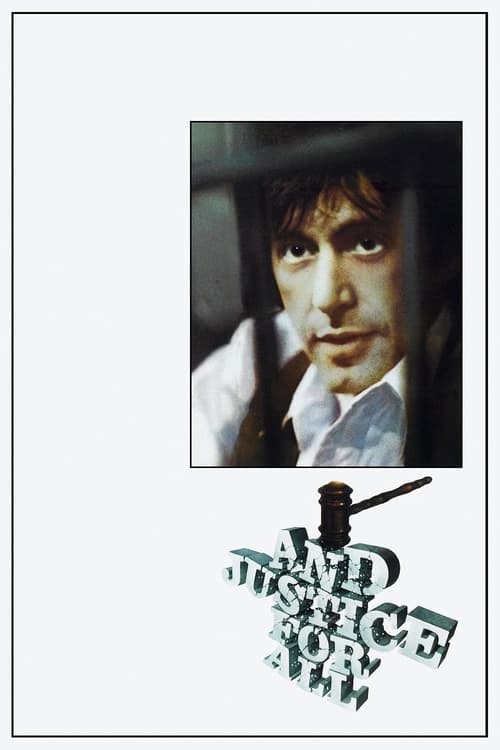
...And Justice for All (1979)
Directed by Norman Jewison
No — ...And Justice for All is not woke, scoring 14 out of 100 on our wokeness meter.
Norman Jewison's 1979 legal drama arrives with the weary authority of a film that has seen the courthouse from every angle and trusts none of them.
Consciousness Markers
The climactic 'You're out of order!' monologue and the film's broad indictment of the legal system carry a sermonizing, message-driven quality, though Jewison deliberately avoided making it a 'message picture.'
The cast is overwhelmingly white, with Robert Christian as Ralph Agee, a young black cross-dresser, the lone notable minority role; he exists as a character rather than a statement.
Agee's harsh sentencing and suicide carry an implicit racial dimension, and the McCullaugh mistaken-identity case touches on systemic failure, but race is never explicitly interrogated.
Christine Lahti's Gail Packer is a legal ethics committee member and the rape trial centers on a woman's assault, but the film frames these through the male protagonist's moral crisis rather than any feminist argument.
Jay Porter's psychological breakdown and Sam's senility are depicted as mental deterioration and instability rather than any affirmative neurodivergence framing.
Agee's cross-dressing is present but treated as a plot detail tied to his vulnerability in the system, not as an LGBTQ+ identity theme in any modern sense.
The film indicts legal corruption and institutional rot, but its target is the justice system, not capitalism or class economics.
No environmental or climate content whatsoever.
No body-positivity themes present.
No historical revisionism; the film is a contemporary fictional drama.
Why it received this score
Norman Jewison's 1979 legal drama arrives with the weary authority of a film that has seen the courthouse from every angle and trusts none of them. Al Pacino plays Arthur Kirkland, a Baltimore defense attorney who throws a punch at a judge in the opening minutes and spends the rest of the runtime discovering that the system he serves is a stage set with a rotten floor. Jewison said he wanted to avoid a message picture, and for long stretches he succeeds, substituting absurdity and hysteria for sermon. The result plays like an anthology of grievances stapled to one very loud performance.
The film's social consciousness is present but thin, and mostly incidental. Robert Christian's Ralph Agee, a young black cross-dresser, is the lone minority figure of note, and his fate carries an unspoken racial weight that the screenplay never bothers to name. Christine Lahti's Gail Packer sits on a legal ethics committee, and the central trial concerns the assault of a woman, yet both are filtered through Kirkland's moral collapse instead of any argument about gender. The film's real target is institutional corruption, not class or capital, and its angriest energies are reserved for judges and prosecutors. Jay Porter's psychiatric unraveling and Sam's senility are offered as breakdown, never as identity.
Where the picture does lean forward is in its closing sermon, the famous outburst that has been parodied so often it now plays as self-parody. Kirkland's indictment of the whole proceeding is rousing and blunt, and it wants the audience to cheer. That is the film's truest instinct: not a thesis, but a cathartic yell. Everything else, the senility, the breakdowns, the cross-dressing, the rape trial, exists as texture around the shout. It is a well-acted tantrum about justice, and tantrums rarely organize themselves into ideology.
Analysis generated by our Consciousness Algorithm


Synopsis
An ethical Baltimore defense lawyer disgusted with rampant legal corruption is forced to defend a judge he despises in a rape trial under the threat of being disbarred.
Questions about ...And Justice for All
Is ...And Justice for All woke?
No — ...And Justice for All is not woke, scoring 14 out of 100 on our wokeness meter. That earns it a verdict of Ultra Based.
Does ...And Justice for All have any woke elements?
1 of the 10 markers register at 30 or above, led by Lecture Energy (30). On Lecture Energy: The climactic 'You're out of order!' monologue and the film's broad indictment of the legal system carry a sermonizing, message-driven quality, though Jewison deliberately avoided making it a 'message picture.'
How does ...And Justice for All compare to other 1979 movies?
It ranks #3 of the 33 films from 1979 we've scored; their average is 6. The wokest is Hair (30).
How is the Woke Score calculated?
An AI-assisted process researches the film and its reception, scores it 0–100 on ten markers, then combines those into one 0–100 Woke Score. It measures a specific set of 2020s cultural themes, not film quality.