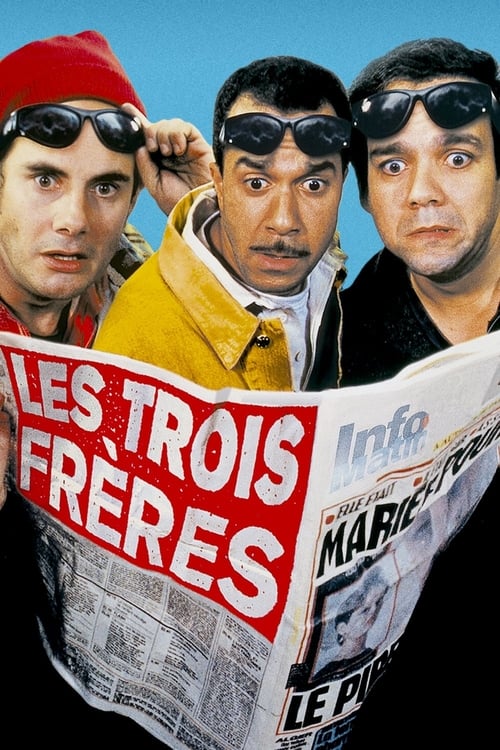
The Three Brothers (1995)
Directed by Bernard Campan
No — The Three Brothers is not woke, scoring 0 out of 100 on our wokeness meter.
The Three Brothers arrives in 1995 with a premise so plain it could be carved on a headstone: three half-brothers meet at their mother's funeral, learn of an inheritance, spend the money before receiving it, and discover the money is not coming.
Consciousness Markers
The cast consists of three white French comedians (Les Inconnus) and supporting players with no notable diverse or inclusive casting choices made for representation purposes.
No LGBTQ+ characters, themes, or subtext appear anywhere in this 1995 French inheritance comedy.
The plot centers on three men and their inheritance; women appear only in peripheral roles with no feminist framing or commentary.
Race is entirely absent as a subject; the film concerns a white French family's squabble over money.
No environmental or climate themes are present in the film.
Money and inheritance drive the plot, but the film treats them as farcical comedic devices rather than mounting any critique of wealth or capitalism.
No body positivity themes or messaging are present.
No neurodivergent characters or themes are depicted.
The film is a contemporary fictional comedy with no historical subject matter to revise.
This is a broad 1990s French comedy aimed at laughs, with no preachy or didactic messaging.
Why it received this score
The Three Brothers arrives in 1995 with a premise so plain it could be carved on a headstone: three half-brothers meet at their mother's funeral, learn of an inheritance, spend the money before receiving it, and discover the money is not coming. The result is a series of escalating schemes and a gradual thaw between three men who share a mother and very little else. The film treats money as a farce engine, not a moral indictment. The squandered fortune is a plot device, never a thesis about wealth.
Bernard Campan and Didier Bourdon co-write, co-direct and star alongside Pascal Légitimus, all three drawn from the comedy troupe Les Inconnus. The cast is uniformly white, uniformly French, and uniformly uninterested in making a statement about anything. Women appear at the edges, largely as wives, girlfriends, and administrative obstacles. Nobody in the frame is asked to represent a community, and nobody seems to mind. The film won the César for Best Debut and became the highest-grossing French release of its year, which suggests audiences of the time found the absence of sermonizing entirely agreeable.
The picture belongs to a category we might call the unreconstructed inheritance farce. Its energies go into physical comedy, sibling resentment, and the reliable spectacle of grown men behaving badly in expensive restaurants. There is no environmental conscience, no critique of capital, no revisionist account of history, no lecture, no casting gesture, no cause. It is a comedy that wants to be funny and mostly is. Our assessment finds nothing to flag in any direction, which is itself a kind of distinction. A clean sheet, filed with the appropriate archival solemnity.
Analysis generated by our Consciousness Algorithm
Synopsis
Three half-brothers are reunited at their mother's funeral. After being told of their inheritance they quickly spend the money, only to find out that they will not receive it after all. The men grow closer while deciding how to proceed.
Questions about The Three Brothers
Is The Three Brothers woke?
No — The Three Brothers is not woke, scoring 0 out of 100 on our wokeness meter. That earns it a verdict of Ultra Based.
Does The Three Brothers have any woke elements?
No. All 10 markers score zero.
How does The Three Brothers compare to other 1995 movies?
It ranks #98 of the 108 films from 1995 we've scored; their average is 12. The wokest is Total Eclipse (60).
How is the Woke Score calculated?
An AI-assisted process researches the film and its reception, scores it 0–100 on ten markers, then combines those into one 0–100 Woke Score. It measures a specific set of 2020s cultural themes, not film quality.