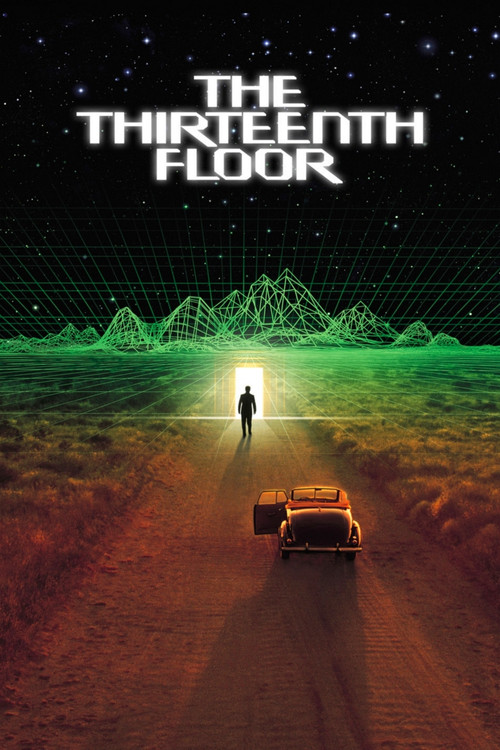
The Thirteenth Floor (1999)
Directed by Josef Rusnak
No — The Thirteenth Floor is not woke, scoring 7 out of 100 on our wokeness meter.
The year is 1999, and a science fiction thriller arrives about nested simulations: a 1937 Los Angeles built inside a 1999 Los Angeles, which is itself built inside something else.
Consciousness Markers
The cast includes Dennis Haysbert and Janet MacLachlan in supporting roles, but their presence is unremarked and incidental to the plot; no deliberate diversity agenda is evident.
The film gestures at existential questions about simulated reality, but it dramatizes them through plot and suspense rather than preaching them at the audience.
Gretchen Mol's Jane Fuller is a scheming, active figure who drives the plot, but the film makes no feminist argument and treats her primarily as a romantic and conspiratorial device.
No LGBTQ+ characters, themes, or subtext appear anywhere in the film.
The film features a Black detective and other minority performers, but race is never a subject of commentary or thematic weight.
No environmental or climate themes are present in this virtual-reality thriller.
The villainy of a multibillion-dollar computer enterprise is a plot mechanism, not a critique of capitalism; the film has no economic message.
No body-positive themes or messaging appear in the film.
No neurodivergent characters or themes are depicted.
The 1937 Los Angeles setting is a period backdrop for the simulation, not a revisionist re-reading of history.
Why it received this score
The year is 1999, and a science fiction thriller arrives about nested simulations: a 1937 Los Angeles built inside a 1999 Los Angeles, which is itself built inside something else. The Thirteenth Floor stars Craig Bierko as Douglas Hall, a man who learns he is software, and Gretchen Mol as the woman who may or may not exist. It was nominated for a Saturn Award and lost to The Matrix, a defeat that has defined it ever since. Slavoj Zizek liked it more than The Matrix. That is the entire cultural footprint.
On the ledger of social concern, the film is nearly barren, and it seems content to be. Dennis Haysbert plays a detective, and Janet MacLachlan appears in support, both without a word of commentary; the casting shows a mild openness and nothing resembling an agenda. Race is never a subject. Neither is queerness, the climate, the body, or the mind. The villainy of a multibillion-dollar software empire registers as a plot mechanic, not an indictment of capital. The 1937 setting is period dressing. Mol's Jane Fuller schemes, lies, and steers the narrative, which gives the picture a faint pull toward feminist agency, though she is ultimately a romantic obstacle and a conspiracy with legs.
The film does raise the big questions about reality. It raises them through suspense and men arguing in parking structures, trusting the audience to keep up instead of stopping to instruct. That is a form of respect, and it dates the film to a gentler era. The result is a thriller with almost no social program, a rarity in any decade and something close to a museum piece now. It ends with the image collapsing to a thin line of light, as if a monitor were switching off. A fitting close for a movie that never quite worked up the nerve to lecture anyone.
Analysis generated by our Consciousness Algorithm


Synopsis
In Los Angeles, a wealthy man, known as Mr. Fuller, discovers a shocking secret about the world he lives in. Fearing for his life, he leaves a desperate message for a friend of his in the most unexpected place.
Questions about The Thirteenth Floor
Is The Thirteenth Floor woke?
No — The Thirteenth Floor is not woke, scoring 7 out of 100 on our wokeness meter. That earns it a verdict of Ultra Based.
Does The Thirteenth Floor have any woke elements?
Very few. None of the 10 markers reaches 30, the level where a marker counts as present; the highest is Representation Casting at 15.
How does The Thirteenth Floor compare to other 1999 movies?
It ranks #64 of the 103 films from 1999 we've scored; their average is 14. The wokest is Boys Don't Cry (60).
How is the Woke Score calculated?
An AI-assisted process researches the film and its reception, scores it 0–100 on ten markers, then combines those into one 0–100 Woke Score. It measures a specific set of 2020s cultural themes, not film quality.