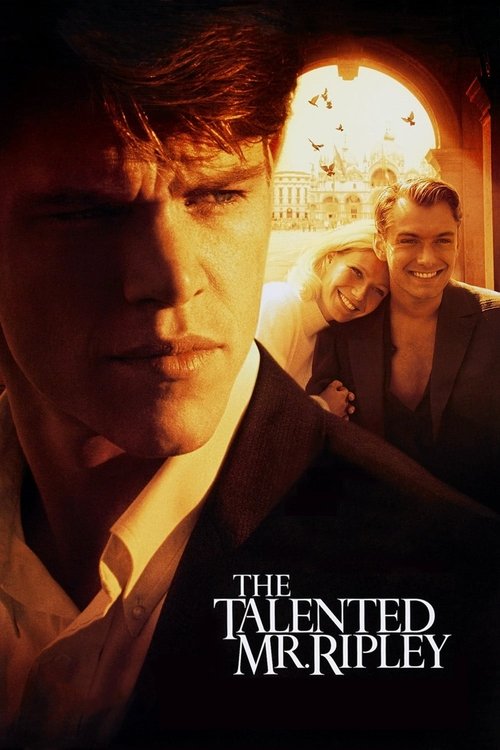
The Talented Mr. Ripley (1999)
Directed by Anthony Minghella
No — The Talented Mr. Ripley is not woke, scoring 16 out of 100 on our wokeness meter.
Anthony Minghella's 1999 adaptation of Patricia Highsmith's novel arrives dressed in linen and Mediterranean sunlight, then spends two and a half hours quietly ruining both.
Consciousness Markers
Ripley's obsession with Dickie and his implied relationship with Peter Smith-Kingsley give the film a genuine, if coded, gay subtext drawn from Highsmith's source material.
The film critiques the idle rich and Ripley's envy of their lifestyle, but it is a character study of amorality rather than an economic polemic.
Marge and Meredith are largely reactive supporting figures orbiting the male protagonist; the film makes no feminist argument.
The cast is overwhelmingly white and Anglo, with Italian locals serving as scenery rather than representation; no deliberate diverse casting agenda is present.
A chilly, ambiguous thriller that observes rather than preaches; it offers no moral instruction to the audience.
Race is entirely absent as a theme; the story concerns class and identity among white American expatriates.
No environmental themes whatsoever.
No body-positivity themes; the film's physical concerns are about Damon's transformation to resemble Law, not body acceptance.
Ripley is a sociopathic con artist, a moral category rather than a neurodivergence narrative.
A period adaptation faithful to its 1955 source; no historical revisionism.
Why it received this score
Anthony Minghella's 1999 adaptation of Patricia Highsmith's novel arrives dressed in linen and Mediterranean sunlight, then spends two and a half hours quietly ruining both. Tom Ripley, played by Matt Damon with a smile held a beat too long, is a con artist who wants to be a rich man more than he wants anything else. The film observes him. It does not explain him, forgive him, or instruct us about him. In an era that increasingly treats the screen as a pulpit, this restraint reads almost as an artifact.
The homoerotic charge is the film's most interesting piece of cultural business. Ripley's fixation on Dickie Greenleaf comes straight from the source and stays largely unspoken, a matter of lingering glances, borrowed cufflinks, and the final, terrible intimacy with Peter Smith-Kingsley. The movie grants that desire real weight without ever naming it, which is a strategy of its moment as much as its craft. Marge and Meredith orbit the men and react to them; the picture makes no argument on their behalf and shows no interest in doing so. The cast is uniformly pale and Anglo, Italian faces appearing chiefly as scenery for the tourists to admire and exploit.
As social commentary, the film offers a muted critique of inherited wealth. Dickie's money is unearned, his leisure is parasitic, and Ripley's envy of it drives every murder. This is observation, not polemic. There is no lesson about capital, no engagement with the environment, no reckoning with race, and no therapeutic vocabulary of neurodivergence to explain the sociopath at its center. What remains is a cold, well-tailored thriller that trusts its audience to sit with ambiguity until the credits roll. The ledger of contemporary cultural markers comes up nearly empty, and the film is the better for it.
Analysis generated by our Consciousness Algorithm


Synopsis
Tom Ripley is a calculating young man who believes it's better to be a fake somebody than a real nobody. Opportunity knocks in the form of a wealthy U.S. shipbuilder who hires Tom to travel to Italy to bring back his playboy son, Dickie. Ripley worms his way into the idyllic lives of Dickie and his girlfriend, plunging into a daring scheme of duplicity, lies and murder.
Questions about The Talented Mr. Ripley
Is The Talented Mr. Ripley woke?
No — The Talented Mr. Ripley is not woke, scoring 16 out of 100 on our wokeness meter. That earns it a verdict of Ultra Based.
Does The Talented Mr. Ripley have any woke elements?
1 of the 10 markers register at 30 or above, led by LGBTQ+ Themes (50). On LGBTQ+ Themes: Ripley's obsession with Dickie and his implied relationship with Peter Smith-Kingsley give the film a genuine, if coded, gay subtext drawn from Highsmith's source material.
How does The Talented Mr. Ripley compare to other 1999 movies?
It ranks #32 of the 103 films from 1999 we've scored; their average is 14. The wokest is Boys Don't Cry (60).
How is the Woke Score calculated?
An AI-assisted process researches the film and its reception, scores it 0–100 on ten markers, then combines those into one 0–100 Woke Score. It measures a specific set of 2020s cultural themes, not film quality.