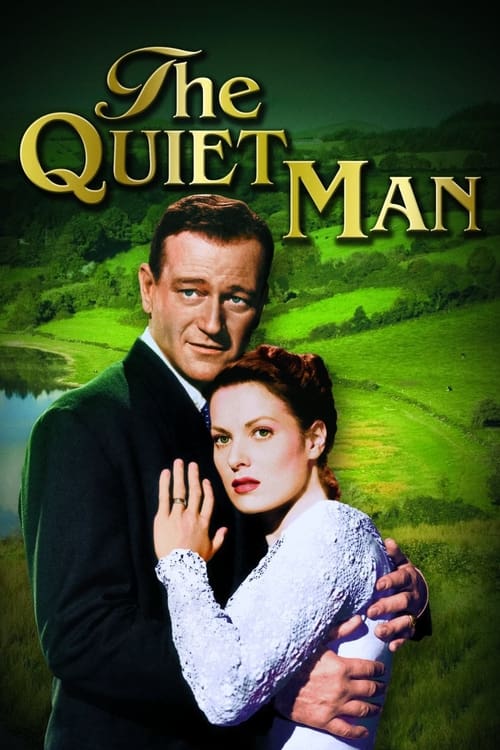
The Quiet Man (1952)
Directed by John Ford
No — The Quiet Man is not woke, scoring 0 out of 100 on our wokeness meter.
John Ford's 1952 romance concerns Sean Thornton, an American boxer who returns to the village of his birth, courts the formidable Mary Kate Danaher, and spends two hours negotiating a dowry with her brother before settling the matter with a fistfight that crosses several miles of countryside.
Consciousness Markers
The cast is entirely white, with no modern diverse casting or representation agenda; Irish actors and locals appear but not as a racial or minority representation statement.
No LGBTQ+ characters, themes, or subtext.
Mary Kate is spirited and asserts her dowry rights, but the film upholds traditional patriarchal marriage customs and does not advance a feminist critique.
The film includes Irish-English political allusions and IRA references, but these are historical/cultural, not modern racial consciousness or anti-racist commentary.
No environmental or climate themes.
No critique of capitalism or wealth inequality; the dowry and land disputes are personal and customary, not anti-capitalist.
No body positivity themes or diverse body representation.
No neurodivergent characters or themes.
The film presents an idealized Irish society but does not revise history in the modern woke sense; it is nostalgic and romanticized rather than a corrective historical narrative.
The film is a romantic comedy with no preachy or lecture-like messaging.
Why it received this score
John Ford's 1952 romance concerns Sean Thornton, an American boxer who returns to the village of his birth, courts the formidable Mary Kate Danaher, and spends two hours negotiating a dowry with her brother before settling the matter with a fistfight that crosses several miles of countryside. The photography is lush. The score quotes Irish airs. The whole enterprise is a postcard mailed from a country that may never have existed. Our classification apparatus, calibrated for the anxieties of a later century, finds almost nothing to grip.
The cast is uniformly white, which is unremarkable for a film set in the west of Ireland in the 1920s and unremarkable for the exercise at hand. Mary Kate has spirit and a legitimate grievance about her own property, yet the story's resolution affirms the custom that priced her in the first place, and no feminist reading survives contact with the final reel. The IRA reference is local color, a line of dialogue about scorched stones. There is no environmental lament, no interrogation of wealth, no interest in bodies beyond the ones that can throw a punch, and no suggestion that any mind in Inisfree works differently from any other.
Ford presents an idealized Ireland where the priest and the minister are friends and the class divisions stay politely implied. This is nostalgia, not corrective history. Nothing here lectures. Nobody explains the moral to the audience. The film simply wants to be liked, and largely succeeds, which leaves the classifier with a clean sheet and a mild sense of professional idleness. A pleasant afternoon. No further action required.
Analysis generated by our Consciousness Algorithm


Synopsis
An American man returns to the village of his birth in Ireland, where he finds love and conflict.
Questions about The Quiet Man
Is The Quiet Man woke?
No — The Quiet Man is not woke, scoring 0 out of 100 on our wokeness meter. That earns it a verdict of Ultra Based.
Does The Quiet Man have any woke elements?
No. All 10 markers score zero.
How does The Quiet Man compare to other 1952 movies?
It ranks #8 of the 8 films from 1952 we've scored; their average is 5. The wokest is Umberto D. (12).
How is the Woke Score calculated?
An AI-assisted process researches the film and its reception, scores it 0–100 on ten markers, then combines those into one 0–100 Woke Score. It measures a specific set of 2020s cultural themes, not film quality.