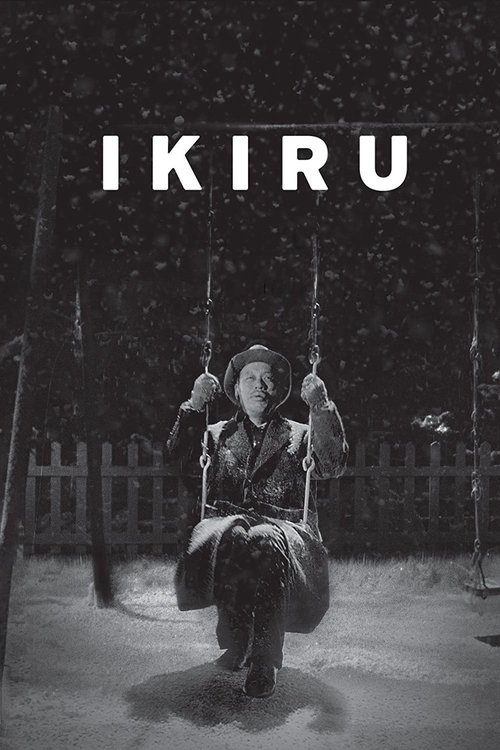
Ikiru (1952)
Directed by Akira Kurosawa
No · Ultra Based
How we score movies →Consciousness Markers
Female characters exist primarily in relation to the protagonist's emotional and spiritual journey. The film does not interrogate gender hierarchies, though it treats women with dignity within its patriarchal framework.
The film critiques bureaucratic dehumanization and meaningless work, but this critique stems from existential rather than economic concerns. There is no systematic interrogation of capitalism or class structures.
The cast reflects the film's Japanese setting without conscious attention to representation as a modern value. Casting appears driven by narrative requirements rather than equity considerations.
While the film contains philosophical substance, it conveys meaning through narrative and visual storytelling rather than preachy exposition. The minimal lecture energy reflects Kurosawa's sophisticated directorial approach.
The film contains no LGBTQ+ themes or representation. Romantic and familial relationships are entirely heteronormative, reflecting the film's historical moment.
The film contains no exploration of race or racial dynamics. All characters are Japanese, and race is not a thematic concern in the narrative.
There is no engagement with environmental or climate themes. The film's focus is entirely on individual mortality and the search for meaning.
Body positivity as a modern concept is entirely absent. The protagonist's cancer represents universal human vulnerability rather than a vehicle for contemporary body acceptance messaging.
The film contains no representation or discussion of neurodiversity. Characters are treated as neurotypical without comment or exploration of alternative cognitive frameworks.
The film accepts its post-war Japanese setting as given fact and does not reinterpret historical events through contemporary political lenses.


Synopsis
Kanji Watanabe is a middle-aged man who has worked in the same monotonous bureaucratic position for decades. Learning he has cancer, he starts to look for the meaning of his life.
Why it received this score
Ikiru stands as one of cinema's most profound explorations of mortality and meaning, yet it remains almost entirely untouched by the identity markers that define contemporary progressive sensibility. Kurosawa's protagonist is an aging male bureaucrat whose spiritual crisis unfolds within the patriarchal structures of post-war Japan, which the film treats not as systems to be interrogated but as facts of existence. The work concerns itself with universal suffering and the search for purpose, concerns that predate modern identity consciousness by centuries and thus cannot be retrofitted into current frameworks of social analysis. To evaluate this film against 2020s cultural markers is to attempt measuring a classical symphony by the standards of electronic music production. The film remains morally serious and humanistically profound, but these qualities do not constitute the specific form of contemporary social consciousness we are tasked with measuring.
The narrative accepts its historical moment without interrogation or revision. Female characters exist primarily in relation to the male protagonist's journey. The film contains no exploration of systemic inequality as a concept. Its critique of bureaucracy is not motivated by anti-capitalist sentiment but rather by a timeless observation about institutional dehumanization. The cast is uniformly Japanese, reflecting the film's setting, but this reflects historical reality rather than any commitment to representation as a modern value. Ikiru locates human meaning in acts of service and connection. This is admirable as philosophy and masterful as cinema. It is simply not the cultural product we have come to call woke.
The score of 8 reflects minimal engagement with any contemporary progressive markers, with the marginal points awarded only for the film's implicit humanism and its gentle critique of institutional structures that might, in a different era, have been framed as systemic. This is not a criticism. Some of the greatest art ever made exists largely outside the frameworks of contemporary political discourse, and Ikiru belongs firmly in that category.
Analysis generated by our Consciousness Algorithm
Critic Reviews
“Over the years I have seen "Ikiru" every five years or so, and each time it has moved me, and made me think.”
“Like “Stray Dog” and “Drunken Angel,” it illuminates a reeling society while telling a story of deep human emotion.”
“A thoughtful, existential meditation about the meaning of life and what constitutes a life well-lived, Ikiru is almost guaranteed to prod the viewer to examine his or her own mortality and ponder how, in the end, the scales will tip.”
“Everything we're meant to feel here is bluntly dictated by the script and delivered with unambiguous, button-pushing direction - it's impossible to miss. [06 Aug 2016]”