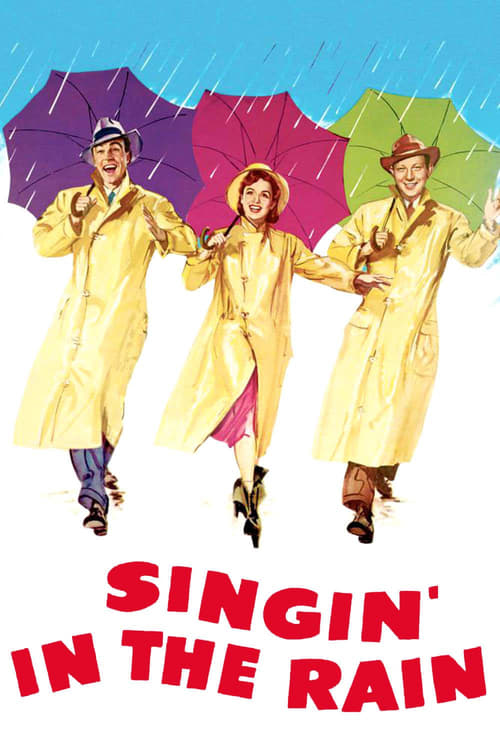
Singin' in the Rain (1952)
Directed by Gene Kelly
No · Ultra Based
How we score movies →Consciousness Markers
The film is primarily concerned with entertainment and spectacle rather than preachy messaging. However, brief moments address the challenges of artistic transition, though these are integrated into the narrative rather than delivered as sermons.
The cast is predominantly white, reflecting the exclusionary practices of 1952 Hollywood. Rita Moreno appears in an uncredited role as a dancer, exemplifying the tokenistic approach to non-white performers of the era.
Female characters exist primarily as romantic interests or obstacles. Lina Lamont is portrayed as narcissistic and villainous, while Debbie Reynolds' character serves as the love interest. The film offers no critique of gender dynamics in the entertainment industry.
The film celebrates Hollywood's entertainment industry and the success of its protagonist within the capitalist system. The narrative presents showbiz ambition as virtuous rather than problematic.
The film contains no acknowledgment of racial issues. Non-white performers are relegated to background roles, reflecting the uncritical acceptance of segregation-era Hollywood practices.
No LGBTQ+ themes or representation present. The film presents heterosexual romance as the sole narrative focus without any progressive exploration of alternative identities.
No environmental themes or climate consciousness. The film is a period musical set in 1920s Hollywood with no environmental commentary whatsoever.
No body positivity messaging. The film features conventionally attractive performers in a context that valorizes physical beauty and dance ability without any progressive commentary on body diversity.
No representation or exploration of neurodivergence. The film contains no characters with disabilities or neurodivergent conditions, nor does it address such topics.
While set during the transition to sound in 1927, the film does not attempt to rewrite historical narratives. It presents a fictional story set in that era without revisionist historical framing.


Synopsis
In 1927 Hollywood, a silent film star falls for a chorus girl just as he and his paranoid screen partner struggle to make the difficult transition to talking pictures.
Why it received this score
Singin' in the Rain arrives as a curious artifact from an earlier moment in American cinema, one that predates the modern preoccupations we now deploy to measure cultural consciousness. The film is, by any traditional standard, a masterpiece of musical theater. Gene Kelly's choreography remains astonishing. Donald O'Connor's physical comedy transcends the decades with a kind of weightless precision. Debbie Reynolds, though the victim of a famously brutal production experience, delivers charm and vitality. These are not subjects for contemporary analysis, however. They are merely facts about a film made in 1952.
What we observe instead is a work entirely unconcerned with the social consciousness that would later become a defining feature of American cinema. The film presents a Hollywood that is, without apology or irony, aggressively white. Rita Moreno appears in the background, a decorative element in her own moment on screen. The female characters exist to be admired or to create romantic complications. Lina Lamont is not a complex figure struggling against industry constraints but rather a villain whose primary crime is her vanity. The film's universe contains no acknowledgment of the racial hierarchies that actually governed Hollywood in 1927, nor in 1952. It simply ignores them, which in a sense is more honest than later films that would attempt to retrofit progressive sensibilities onto historical narratives.
The production is fundamentally a celebration of its own industry and the capitalist machinery that sustains it. Success in show business is presented as the natural reward for talent and determination. There is no critique lurking beneath the spectacle, no subversive commentary on the entertainment apparatus. The film simply wants us to enjoy the dancing and the music, and for most viewers, this remains sufficient. In our current moment, where we have trained ourselves to locate and measure progressive consciousness in every frame, Singin' in the Rain presents a kind of pre-guilt cinema, innocent not of wrongdoing but of the very concept that wrongdoing could be embedded in what appears on screen. It is a film that does not know it should apologize, and perhaps that is the most interesting thing about it.
Analysis generated by our Consciousness Algorithm
Critic Reviews
“Singin' in the Rain is a transcendent experience, and no one who loves movies can afford to miss it.”
“With so many films dedicated to the agonies of filmmaking, Singin’ overflows with the pleasure of movie creation, stitching together references to Hollywood history with more alacrity than Tarantino. One of the highpoints of hoofin’ history but, more importantly, an unadulterated joy.”
“With the names and versatile talents of Gene Kelly, Donald O'Connor and Debbie Reynolds, supported by lilting melodies, wonderful dancing and some very funny comedy, the show just can't miss being another MGM top-grosser.”
“The nonsense is generally good and at times it reaches the level of first-class satiric burlesque. Adolph Green and Betty Comden may have tossed off the script with their left hands, but occasionally they come through with powerful and hilarious round-house rights.”