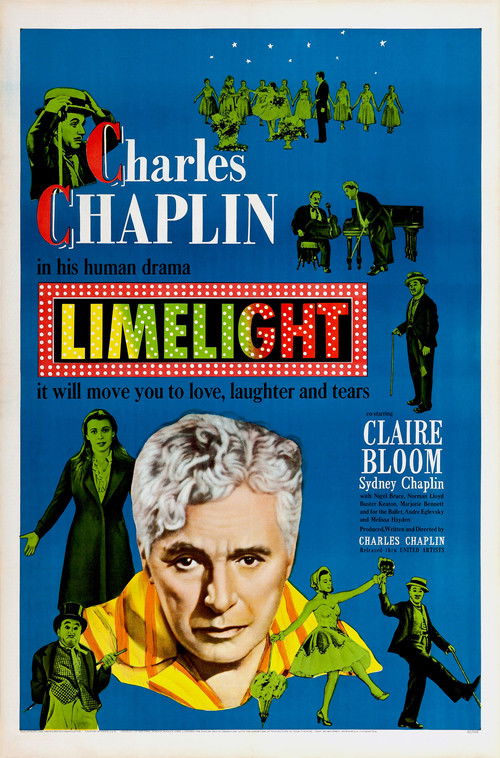
Limelight (1952)
Directed by Charlie Chaplin
No — Limelight is not woke, scoring 2 out of 100 on our wokeness meter.
Limelight arrives from 1952, a year in which the vocabulary of contemporary cultural grievance had not yet been assembled, and Chaplin's film shows no interest in assembling it.
Consciousness Markers
Contemporary critics faulted the film for excessive talk, preaching, and moralizing about human foibles and life philosophy, giving it a didactic streak.
The cast is entirely white, with no racial or ethnic diversity in significant roles and no commentary on representation.
No LGBTQ+ characters, themes, or subtext are present in the film.
The film centers on a male savior figure and a female dancer whose agency is limited to romantic attachment; no feminist agenda is articulated.
No engagement with racial consciousness, systemic racism, or racial identity appears in the narrative.
No environmental or climate-related themes are present.
The film is a personal, humanist drama about art and companionship; it contains no critique of capitalism or wealth inequality.
No body-positive messaging or challenge to conventional beauty standards is present.
No neurodivergent characters or themes are depicted.
The film is not a historical revision or counter-narrative; it is a fictional, semi-autobiographical drama.
Why it received this score
Limelight arrives from 1952, a year in which the vocabulary of contemporary cultural grievance had not yet been assembled, and Chaplin's film shows no interest in assembling it. Calvero, a washed-up music hall clown, rescues a suicidal ballerina named Terry from her own despair and spends two hours nursing her back toward the stage. The arrangement is entirely his: a man of fading stature restoring a woman's will to live, then stepping aside so a younger composer can have her. The film regards this as noble. By the standards of its own moment it is a tender and generous gesture, and the picture never pauses to interrogate the gender politics of a savior who decides what is best for the woman he saved.
Where the film does exert pressure is in its talk. Contemporary reviewers, even the admiring ones, converged on a single complaint: Calvero will not stop explaining life. The New York Times conceded a brilliant weaving of comic and tragic strands while noting the garrulous discussion of human foibles. Variety found the role called for too much talk. Harrison's Reports, warmly disposed, still flagged the preaching and moralizing. Chaplin, nearing the end of his American welcome, had apparently decided the film should carry his personal philosophy in dialogue, and it does, at length.
The rest of the ledger is quiet. The cast is white, the themes are romantic and humanist, and no argument about capital, climate, identity, or representation intrudes on the melancholy. What remains is a personal summing-up, semi-autobiographical, with Buster Keaton appearing for one historic duet and Claire Bloom doubled in the dance sequences by Melissa Hayden. It won Chaplin his only competitive Oscar two decades after release, once Los Angeles finally permitted it. A sommelier would call this vintage honest but over-decanted.
Analysis generated by our Consciousness Algorithm


Synopsis
A fading music hall comedian tries to help a despondent ballet dancer learn to walk and to again feel confident about life.
Questions about Limelight
Is Limelight woke?
No — Limelight is not woke, scoring 2 out of 100 on our wokeness meter. That earns it a verdict of Ultra Based.
Does Limelight have any woke elements?
1 of the 10 markers register at 30 or above, led by Lecture Energy (30). On Lecture Energy: Contemporary critics faulted the film for excessive talk, preaching, and moralizing about human foibles and life philosophy, giving it a didactic streak.
How does Limelight compare to other 1952 movies?
It ranks #7 of the 8 films from 1952 we've scored; their average is 5. The wokest is Umberto D. (12).
How is the Woke Score calculated?
An AI-assisted process researches the film and its reception, scores it 0–100 on ten markers, then combines those into one 0–100 Woke Score. It measures a specific set of 2020s cultural themes, not film quality.