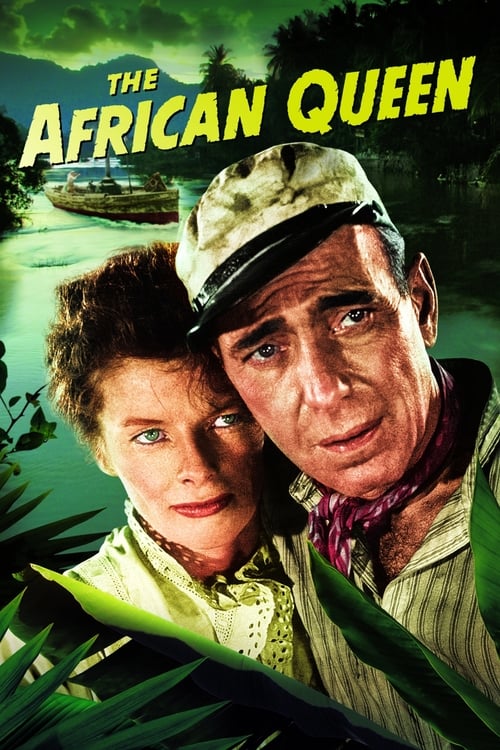
The African Queen (1952)
Directed by John Huston
No · Ultra Based
How we score movies →Consciousness Markers
Katharine Hepburn plays an active, determined woman, but African characters serve primarily as background. Casting reflects 1952 Hollywood conventions rather than any intentional diversity.
Hepburn's character displays agency and determination, but the narrative ultimately resolves into conventional romantic conclusion. This is character strength, not feminist ideology.
The narrative involves resistance to German imperialism during wartime, but this reflects geopolitical conflict rather than any critique of economic systems.
The film contains no preachy energy or sense of lecturing the audience about social issues. It is entertainment without agenda.
The film is unconscious of race except as visual exoticism. African setting and characters serve the narrative of white protagonists without critical examination.
No LGBTQ themes, representation, or subtext of any kind. The film is entirely heteronormative in its romantic framing.
No climate themes present. Environmental concerns are not part of the film's ideological framework.
No body positivity themes. The film operates within conventional 1950s beauty standards without commentary.
No representation of or engagement with neurodivergence or disability of any kind.
The film presents World War I history in conventional terms without attempting to reframe or reexamine historical narratives.


Synopsis
At the start of the First World War, in the middle of Africa's nowhere, a gin soaked riverboat captain is persuaded by a strong-willed missionary to go down river and face-off a German warship.
Why it received this score
John Huston's "The African Queen" remains a masterwork of adventure cinema, though its cultural moment was 1952, which is to say it carries all the baggage of that particular historical juncture with no self-awareness whatsoever. The film is set in Africa during the First World War, a setting that functioned primarily as exotic backdrop rather than as a place with its own complexity or dignity. Humphrey Bogart and Katharine Hepburn carry the narrative as two very white people navigating a landscape populated by Africans who exist largely as incidental scenery. The film's perspective is entirely colonial in its assumptions, presenting the African setting as a neutral stage for European drama.
What the film does possess, almost accidentally, is Katharine Hepburn as a missionary woman of considerable agency and determination. She is not a passive figure, though the film's ultimate trajectory remains thoroughly conventional. She persuades, she acts, she demonstrates physical and moral courage. Yet this representation emerges from the conventions of 1950s cinema rather than from any deliberate commitment to depicting women as complex protagonists. By contemporary standards, she is a strong character; by contemporary standards for what such representation might mean, she is merely a woman doing things.
The film contains no material addressing climate, economic systems, disability, LGBTQ identity, or revisionist history. Its racial consciousness is entirely absent, which is to say it is unconscious of race itself except as a matter of visual exoticism. There is no lecture energy because there is no awareness that a lecture might be necessary. This is a film that does not know what the modern conception of social consciousness means, which grants it a certain innocence but also ensures it sits comfortably at the very bottom of any contemporary scale.
Analysis generated by our Consciousness Algorithm
Critic Reviews
“This was a movie that respected its audience and respected its genuine desire to be well and intelligently entertained.”
“A ripping, gripping yarn, a surprisingly erotic love story and, as it happens, a premonition of Herzog's Fitzcarraldo.”
“As charming as the C.S. Forester novel on which it is based, The African Queen is top flight entertainment, delightful, different, always interesting. It is filled with excitement and adventure and sparked by superlative performances from Katharine Hepburn and Humphrey Bogart.”
“The direction is often questionable, but the screenplay (by James Agee, John Collier, Huston, and Peter Viertel from C.S. Forester's novel) is a model of tight construction.”