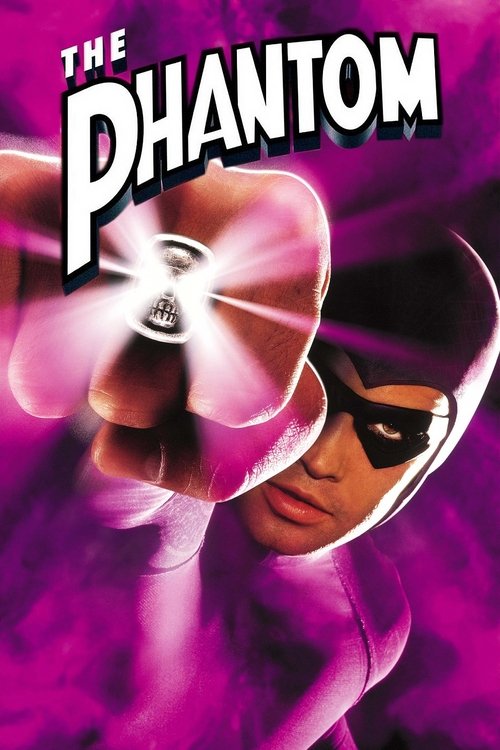
The Phantom (1996)
Directed by Simon Wincer
No — The Phantom is not woke, scoring 7 out of 100 on our wokeness meter.
The Phantom arrives from 1996 as a pulp adventure preserved in amber, a masked avenger from Lee Falk's comic strip who swings through Bengalla and 1938 New York with a skull ring and a straight face.
Consciousness Markers
The central cast is overwhelmingly white, adhering strictly to traditional Hollywood archetypes for a masked hero and his supporting cast.
The conflict pits the hero against a 'rich madman,' which is a standard, low-stakes good versus evil trope rather than a critique of modern global capitalism.
While characters like Diana Palmer and Sala are active, they function primarily as romantic interests or plot facilitators rather than driving a feminist agenda.
There is no evidence of LGBTQ+ themes, characters, or representation within the narrative or cast.
The film utilizes exoticized jungle settings and characters from Bengalla without any modern critical engagement with race or systemic issues.
The volcanic eruption is a plot device for the climax, not a thematic commentary on environmental degradation or climate change.
The Phantom is presented as a buff, idealized action hero, offering no commentary on diverse body types or body image.
No characters exhibit traits or are discussed in relation to neurodivergence.
The film is a pulp adventure fantasy and does not engage with any real historical events that would require revision.
The film is a straightforward action-adventure piece and does not employ didactic storytelling or social commentary.
Why it received this score
The Phantom arrives from 1996 as a pulp adventure preserved in amber, a masked avenger from Lee Falk's comic strip who swings through Bengalla and 1938 New York with a skull ring and a straight face. The cast is almost entirely white, led by Billy Zane's square-jawed Kit Walker, with supporting players who fit traditional Hollywood archetypes. Cary-Hiroyuki Tagawa and Radmar Agana Jao appear in exoticized jungle roles, but the film never turns a critical eye on race, colonialism, or systemic power. It simply uses Bengalla as a backdrop for rope bridges and treasure caves. There is no LGBTQ presence, no climate anxiety, no body-positive messaging, and no neurodivergent characters. The Phantom himself is a muscular ideal, a comic-book physique rendered in flesh, offering nothing in the way of body image commentary.
That leaves only faint traces of social consciousness. Diana Palmer and Sala are capable women, yet they function as romantic reward and femme fatale, not as vehicles for a feminist argument. The villain, Xander Drax, is a rich madman chasing magic skulls, which gestures at greed without ever indicting capitalism as a system. It is good versus evil, with a checkbook. The film has no lecture energy. It does not preach, it does not sermonize, and it does not ask the audience to reconsider history. The 1938 setting is pure fantasy, untouched by real events that might require revision. What remains is a nostalgic exercise, gently self-mocking in tone, played straight by a director who wanted to honor the source.
The result is a low-yield vintage for anyone cataloging modern progressive sensibilities. The Phantom is harmless, sunny, and almost aggressively old-fashioned. It wants to entertain with air pirates, ghost fathers, and a horse named Hero. It succeeds at that modest goal, and it fails at nothing else because it never attempts anything else. The cultural sommelier finds no complex notes here, only a clean, simple pulp. It is a curio, a cult item, and a reminder that not every artifact from the nineties was wrestling with the questions of the present. Some just wanted to swing from a rope and punch a pirate.
Analysis generated by our Consciousness Algorithm
Part of


Synopsis
The 21st successor to the role of Bengalla's resident superhero must travel to New York to prevent a rich madman from obtaining three magic skulls that would give him the secret to ultimate power.
Questions about The Phantom
Is The Phantom woke?
No — The Phantom is not woke, scoring 7 out of 100 on our wokeness meter. That earns it a verdict of Ultra Based.
Does The Phantom have any woke elements?
Very few. None of the 10 markers reaches 30, the level where a marker counts as present; the highest is Eat the Rich at 15.
How does The Phantom compare to other 1996 movies?
It ranks #46 of the 93 films from 1996 we've scored; their average is 11. The wokest is Bound (60).
How is the Woke Score calculated?
An AI-assisted process researches the film and its reception, scores it 0–100 on ten markers, then combines those into one 0–100 Woke Score. It measures a specific set of 2020s cultural themes, not film quality.