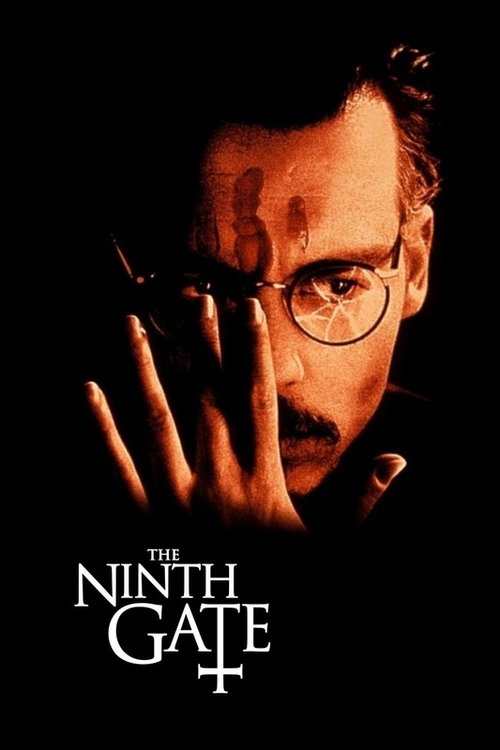
The Ninth Gate (1999)
Directed by Roman Polanski
No — The Ninth Gate is not woke, scoring 6 out of 100 on our wokeness meter.
Roman Polanski's The Ninth Gate arrives at the end of the twentieth century with a suitcase of rare books, a dead collector, and no interest whatsoever in improving anyone.
Consciousness Markers
Wealthy collectors Balkan, Kessler, and Telfer are portrayed as obsessive and corrupt, and the plot turns on the acquisitive vanity of the rich. This is genre color rather than an explicit anti-capitalist critique, but a faint current of contempt for the moneyed class runs through it.
Green Eyes is a potent supernatural femme figure who rescues Corso, wields uncanny powers, and is ultimately revealed as the diabolical icon of the ninth engraving, while Liana Telfer is a scheming femme fatale. Both are genre archetypes rather than vehicles for a feminist argument.
The cast is overwhelmingly white European, with Johnny Depp, Frank Langella, Lena Olin, and Emmanuelle Seigner in the leads; Spanish and Portuguese supporting players appear only as local color in location shooting. No deliberate diversity casting effort is evident in this 1999 production.
Polanski explicitly approached the material with ironic detachment and refused to preach; the film is a languid neo-noir mystery that unfolds its esoteric clues without moralizing or instructing the audience.
The film contains no LGBTQ+ characters, relationships, or subtext whatsoever; its eroticism is entirely heterosexual, from Corso's encounter with Liana Telfer to the climactic tryst with Green Eyes.
Race is never a subject of the film; the narrative concerns rare books, Satanism, and European collectors, with no engagement with racial identity or history.
No environmental or climate theme appears; the film's concerns are entirely occult and bibliophilic.
No body-positivity themes or messaging are present; the film's physicality is limited to occult ritual and sexualized imagery.
No neurodivergent characters or themes are depicted or implied.
The film dabbles in Gnostic and Luciferian lore and a fictional heretical text, but it presents this as occult fiction rather than reinterpreting actual history for ideological ends.
Why it received this score
Roman Polanski's The Ninth Gate arrives at the end of the twentieth century with a suitcase of rare books, a dead collector, and no interest whatsoever in improving anyone. Johnny Depp plays Dean Corso, a mercenary bibliophile hired by a wealthy Satanist to authenticate a volume capable of summoning the Devil, and the film proceeds through Toledo, Sintra, and Paris at the pace of a man reading a catalogue. Polanski has said he does not believe in the occult, and the picture bears him out. It is a neo-noir with incense, more interested in the forgery of engravings than the salvation of souls. The moral ledger here is essentially blank.
On the matter of representation, the cast is a solid wall of European faces: Depp, Frank Langella, Lena Olin, Emmanuelle Seigner, Barbara Jefford. Spanish and Portuguese performers appear as booksellers and street furniture, which is to say they appear as locals in a film shot on location. The eroticism is entirely heterosexual and largely joyless, and no queer thread runs through the proceedings. Race is never raised as a subject, and neither is the climate. The villains are rich men and one rich widow whose appetite for a book exceeds their judgment, giving the film a thin, incidental disdain for collectors. That is not a thesis. It is atmosphere.
The women are genre furniture: a femme fatale who gets strangled, and a mysterious guardian who may be the Devil's own engraving made flesh. Neither is offered as an argument about anything. Polanski declined to lecture, and the refusal shows. The remainder is a languid, beautifully photographed curiosity that critics dismissed and devotees later adopted. It asks nothing of us and teaches nothing, which is, in its quiet way, a kind of integrity.
Analysis generated by our Consciousness Algorithm


Synopsis
A rare book dealer finds himself at the heart of a string of paranormal events when he is hired to find the last two copies of a text, The Nine Gates of the Kingdom of Shadows, capable of summoning the Devil.
Questions about The Ninth Gate
Is The Ninth Gate woke?
No — The Ninth Gate is not woke, scoring 6 out of 100 on our wokeness meter. That earns it a verdict of Ultra Based.
Does The Ninth Gate have any woke elements?
Very few. None of the 10 markers reaches 30, the level where a marker counts as present; the highest is Eat the Rich at 15.
How does The Ninth Gate compare to other 1999 movies?
It ranks #72 of the 103 films from 1999 we've scored; their average is 14. The wokest is Boys Don't Cry (60).
How is the Woke Score calculated?
An AI-assisted process researches the film and its reception, scores it 0–100 on ten markers, then combines those into one 0–100 Woke Score. It measures a specific set of 2020s cultural themes, not film quality.