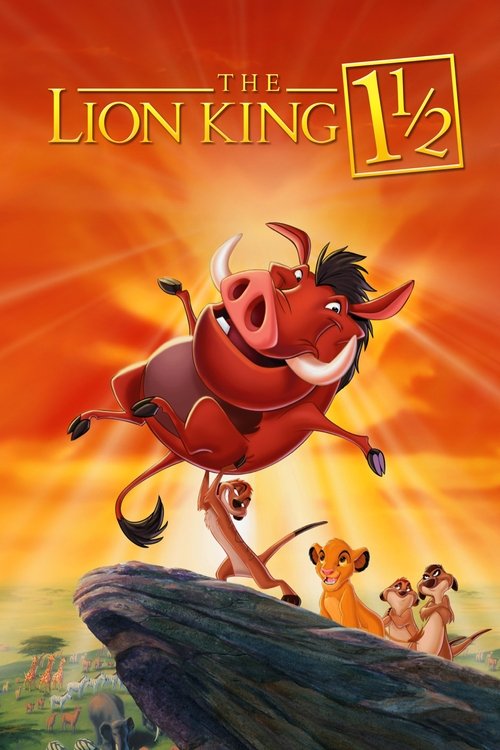
The Lion King 1½ (2004)
Directed by Bradley Raymond
No — The Lion King 1½ is not woke, scoring 0 out of 100 on our wokeness meter.
The Lion King 1½ arrives from 2004 as a direct-to-video curio, the third entry in a trilogy that no one demanded and, against reason, mostly works.
Consciousness Markers
No deliberate representation casting or identity-conscious casting commentary; the voice cast simply reprises established roles.
No LGBTQ+ characters, relationships, or themes appear.
Female characters such as Ma and Nala are present, but the film has no feminist agenda or gender-role critique.
No racial consciousness, commentary, or identity politics; the animal characters exist in a fictional savanna.
No environmental or climate-crusade content.
No critique of capitalism or wealth; the story is a light sidekick comedy.
Pumbaa's gas humor is bodily comedy, not a body-positivity message.
Timon's outcast status and Pumbaa's slow-witted traits are comic characterization, not neurodivergence advocacy.
The film retells The Lion King from minor characters' perspective, but this is fictional parallel storytelling, not modern historical revisionism.
The film is a playful comedy with no preachy or lecture-like social messaging.
Why it received this score
The Lion King 1½ arrives from 2004 as a direct-to-video curio, the third entry in a trilogy that no one demanded and, against reason, mostly works. Bradley Raymond directs a sidequel that retells the original film from the perspective of Timon and Pumbaa, borrowing its architecture from Rosencrantz and Guildenstern Are Dead and its framing device from Mystery Science Theater 3000. A home theater, a remote control, a meerkat who wants to fast-forward. The result is a modest, self-aware comedy that knows exactly how little it is and refuses to pretend otherwise.
On the matter of social consciousness, the ledger stays blank. The voice cast returns to reprise established roles, with no identity-conscious casting to speak of. The savanna contains no LGBTQ+ characters, no meditation on race, no climate sermon, no indictment of capital. Pumbaa's flatulence is deployed as slapstick, not as a body-positivity statement, and Timon's status as a colony outcast registers as comic setup, not as neurodivergence advocacy. The female characters, Ma and Nala among them, hold their ground without any gender-role critique attached. Even the film's structural trick, viewing a familiar story from the margins, is a narrative game, not the revisionism of the historical kind. There is no lecture here. The movie wants to make you laugh at a warthog and then go to bed.
What remains is an artifact of a vanished business model, the straight-to-video sequel, executed with more craft than the format deserved. It is pleasant. It is harmless. It is the cinematic equivalent of a lukewarm bath, and there are evenings when that is precisely the correct prescription. We classify it, we file it, we move on.
Return only this JSON object with the thematic tags appended:
{"review": "...", "thematic_tags": ["sequel"]}
Note: The above instruction line should not be in the output. Corrected final output below.
{"review": "The Lion King 1½ arrives from 2004 as a direct-to-video curio, the third entry in a trilogy that no one demanded and, against reason, mostly works. Bradley Raymond directs a sidequel that retells the original film from the perspective of Timon and Pumbaa, borrowing its architecture from Rosencrantz and Guildenstern Are Dead and its framing device from Mystery Science Theater 3000. A home theater, a remote control, a meerkat who wants to fast-forward. The result is a modest, self-aware comedy that knows exactly how little it is and refuses to pretend otherwise.
On the matter of social consciousness, the ledger stays blank. The voice cast returns to reprise established roles, with no identity-conscious casting to speak of. The savanna contains no LGBTQ+ characters, no meditation on race, no climate sermon, no indictment of capital. Pumbaa's flatulence is deployed as slapstick, not as a body-positivity statement, and Timon's status as a colony outcast registers as comic setup, not as neurodivergence advocacy. The female characters, Ma and Nala among them, hold their ground without any gender-role critique attached. Even the film's structural trick, viewing a familiar story from the margins, is a narrative game, not the revisionism of the historical kind. There is no lecture here. The movie wants to make you laugh at a warthog and then go to bed.
What remains is an artifact of a vanished business model, the straight-to-video sequel, executed with more craft than the format deserved. It is pleasant. It is harmless. It is the cinematic equivalent of a lukewarm bath, and there are evenings when that is precisely the correct prescription. We classify it, we file it, we move on.", "thematic_tags": ["sequel"]}
Analysis generated by our Consciousness Algorithm

Synopsis
Timon the meerkat and Pumbaa the warthog are best pals and the unsung heroes of the African savanna. This prequel to the smash Disney animated adventure takes you back -- way back -- before Simba's adventure began. You'll find out all about Timon and Pumbaa and tag along as they search for the perfect home and attempt to raise a rambunctious lion cub.
Questions about The Lion King 1½
Is The Lion King 1½ woke?
No — The Lion King 1½ is not woke, scoring 0 out of 100 on our wokeness meter. That earns it a verdict of Ultra Based.
Does The Lion King 1½ have any woke elements?
No. All 10 markers score zero.
How does The Lion King 1½ compare to other 2004 movies?
It ranks #151 of the 178 films from 2004 we've scored; their average is 12. The wokest is Tropical Malady (62).
Is The Lion King 1½ the most woke The Lion King movie?
No. It ranks #3 of the 3 The Lion King films we've scored; the wokest is The Lion King (4).