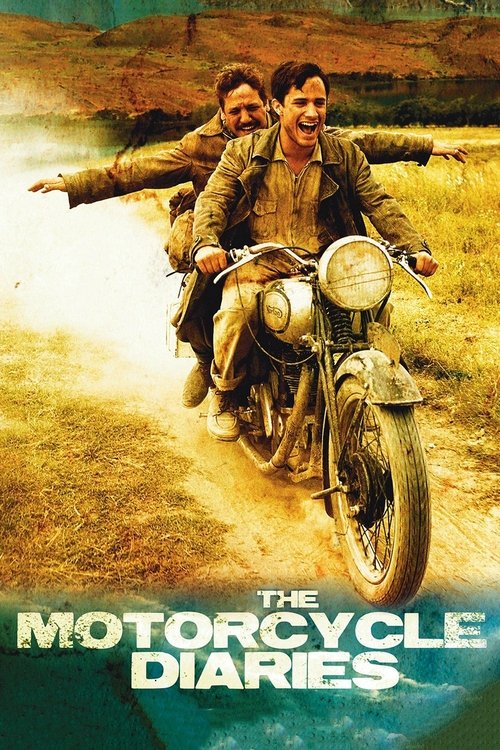
The Motorcycle Diaries (2004)
Directed by Walter Salles
Partly — The Motorcycle Diaries is somewhat woke, scoring 55 out of 100 on our wokeness meter.
A 2004 road picture in which two young Argentines ride a failing Norton through the continent and discover that the continent is poor.
Consciousness Markers
The central political turn is seeing the 'haves' and the 'have-nots': the anti-communist persecution of a penniless couple, the imperial plunder of the Chuquicamata mine, and Ernesto's embrace of a socialist solidarity that culminates in an explicitly revolutionary toast.
The film's moral spine is Ernesto's awakening to the exploitation of indigenous and mestizo peasantry, the brutality visited on copper miners at Chuquicamata, and his final call for the unity of the Mestizo people of South America.
An overwhelmingly Latin American cast of Argentine, Mexican, and South American actors plays Latin American characters, a naturalistic and authentic piece of representation that predates the modern casting-debate era but still foregrounds a demographic rarely centered in Western cinema.
The political message is largely absorbed through observation and scenic epiphany, though Ernesto's closing birthday toast lands as an overt piece of on-screen sermonizing.
The film offers an idealized, selectively heroic portrait of the young Che, omitting his later revolutionary violence; some critics called this a morally sanitized glorification rather than a modern reframing of history.
Machu Picchu prompts a musing about how Incan beauty was succeeded by the 'polluted urban decay' of Lima, but environmental concern is a passing reflection rather than a thesis.
No LGBTQ+ characters, themes, or subtext appear at any point in the journey.
The narrative is a two-hander about men; women are peripheral and Granado's stated goal is to bed as many as possible. No feminist argument is made.
No body-positivity themes or body-image discourse is present.
Ernesto's asthma is a physical ailment portrayed as a plot obstacle, not a neurodivergent identity or neurological condition.
Why it received this score
A 2004 road picture in which two young Argentines ride a failing Norton through the continent and discover that the continent is poor. Walter Salles keeps the camera wide and the politics observational, letting the poverty of the indigenous peasantry arrive as scenery before it arrives as argument. The cast is entirely Latin American, playing Latin Americans, which in 2004 was apparently a novelty worth remarking upon and in 2024 remains one. The film does not announce this. It simply casts well and moves on, which is the most dignified thing it does all runtime.
The moral spine is economic. A persecuted couple is driven onto the road for their communist sympathies. The copper mine at Chuquicamata is rendered as imperial extraction, and the leper colony is a tidy diagram of the river that separates the comfortable from the afflicted. Our hero shakes bare hands with the patients, declines the rubber gloves, and later swims across at night, an act of solidarity with a body count of zero. The closing birthday toast is the one moment the film stops observing and starts speechifying, and it lands with the subtlety of a lecture delivered through a megaphone at a wedding.
What the film omits is as studied as what it includes. This is the young Ernesto before the legend, sanitized into a lovable rogue with good hair and a nascent conscience. There is no feminism here, no queer presence, no environmental thesis beyond a passing sigh about Lima's urban decay, and asthma is treated as a plot obstacle rather than an identity. It is a handsome, sincere, faintly self-congratulatory travelogue about a man who would later become a T-shirt.
Analysis generated by our Consciousness Algorithm


Synopsis
Based on the journals of Che Guevara, leader of the Cuban Revolution. In his memoirs, Guevara recounts adventures he and best friend Alberto Granado had while crossing South America by motorcycle in the early 1950s.
Questions about The Motorcycle Diaries
Is The Motorcycle Diaries woke?
Partly — The Motorcycle Diaries is somewhat woke, scoring 55 out of 100 on our wokeness meter. That earns it a verdict of Woke-Adjacent.
What makes The Motorcycle Diaries woke?
4 of the 10 markers register at 30 or above, led by Eat the Rich (78), Racial Consciousness (68) and Representation Casting (60). On Eat the Rich: The central political turn is seeing the 'haves' and the 'have-nots': the anti-communist persecution of a penniless couple, the imperial plunder of the Chuquicamata mine, and Ernesto's embrace of a socialist solidarity that culminates in an explicitly revolutionary toast.
How does The Motorcycle Diaries compare to other 2004 movies?
It ranks #6 of the 178 films from 2004 we've scored; their average is 12. The wokest is Tropical Malady (62).
How is the Woke Score calculated?
An AI-assisted process researches the film and its reception, scores it 0–100 on ten markers, then combines those into one 0–100 Woke Score. It measures a specific set of 2020s cultural themes, not film quality.