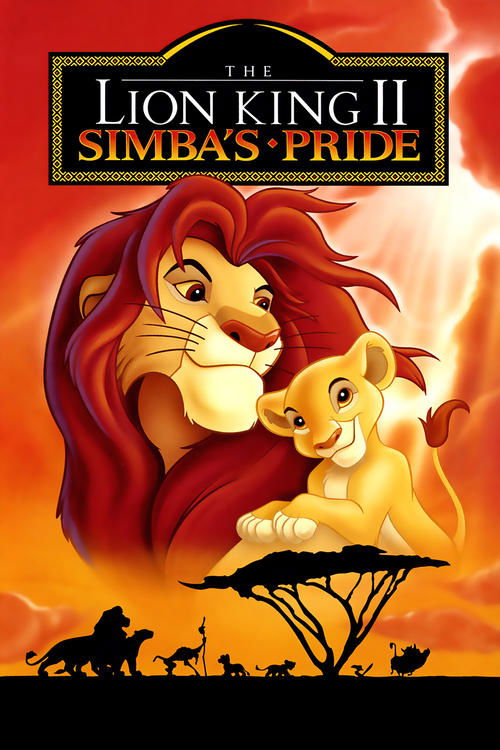
The Lion King II: Simba's Pride (1998)
Directed by Darrell Rooney
No · Ultra Based
How we score movies →Consciousness Markers
Kiara is an active protagonist who rebels against parental authority and pursues her own desires, but her arc resolves through romantic union rather than independence or institutional change.
The film contains some moral messaging about breaking cycles of hatred and the possibility of redemption, but these themes are integrated into the dramatic narrative rather than presented as heavy-handed preachiness.
The film features entirely anthropomorphic animals with no human characters. While voice cast includes James Earl Jones and Robert Guillaume, the characters themselves are not human and raise no representation issues.
No LGBTQ+ characters, themes, or subtext appear in the film. The central romance is entirely heteronormative between Kiara and Kovu.
The film does not engage with racial themes or consciousness. It is set in a fictional animal kingdom without human racial categories or dynamics.
No environmental messaging, climate activism, or ecological consciousness appears in the narrative or themes.
The film contains no critique of capitalism, wealth inequality, or systemic economic oppression. The conflict centers on personal and familial revenge.
No body image, disability representation, or body acceptance themes are present in the film.
No neurodivergent characters or mental health themes related to autism, ADHD, or similar conditions appear in the narrative.
As a fantasy animal film, it does not engage with historical events or revisionist historical narratives.

Synopsis
The circle of life continues for Simba, now fully grown and in his rightful place as the king of Pride Rock. Simba and Nala have given birth to a daughter, Kiara who's as rebellious as her father was. But Kiara drives her parents to distraction when she catches the eye of Kovu, the son of the evil lioness, Zira. Will Kovu steal Kiara's heart?
Why it received this score
The Lion King II: Simba's Pride is a creature of its time, arriving in 1998 when the specific constellation of progressive cultural markers we now associate with modern social consciousness had not yet coalesced into a recognizable force. This direct-to-video sequel follows Kiara, the rebellious daughter of the Pride Lands' monarch, as she develops feelings for Kovu, a lion raised by the villainous Zira. The film trades in themes of redemption, family obligation, and the possibility of breaking cycles of inherited hatred, but these are woven into the narrative fabric rather than foregrounded as moral imperatives.
Kiara functions as an active protagonist with genuine agency and a willingness to defy her father's authority. She drives much of the plot through her choices and desires rather than serving as a passive reward for male heroics. However, her character arc ultimately finds resolution through romantic union with Kovu, which represents a traditional narrative closure that predates contemporary feminist interrogation of such endings. The film does not critique gender hierarchies or challenge the patriarchal structures of Pride Rock, nor does it position Kiara's journey as one of independence or institutional change.
The film contains no engagement with LGBTQ+ themes, racial consciousness, climate concerns, anti-capitalist messaging, body positivity, neurodivergent representation, revisionist history, or sustained moral lecturing. It is, in essence, a conventional late-1990s animated adventure film that operates entirely outside the frameworks we use to measure contemporary progressive sensibility. The modest score reflects only minor traces of female agency and light moral instruction, a baseline that reflects the era in which it was made rather than any deliberate engagement with modern social consciousness.
Analysis generated by our Consciousness Algorithm