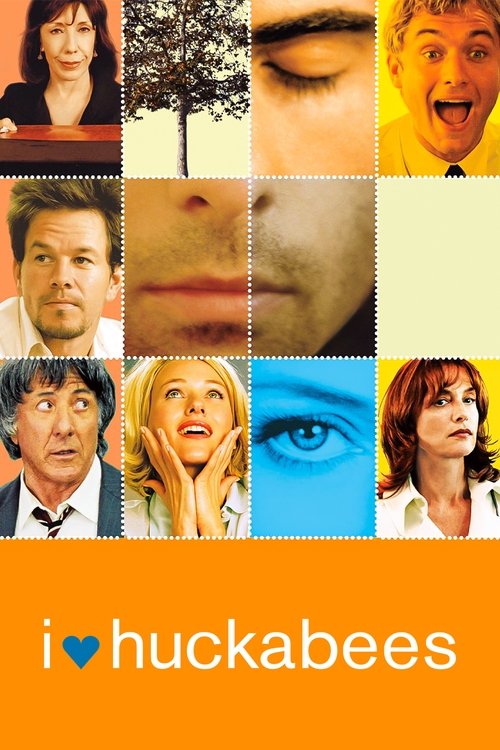
I ♥ Huckabees (2004)
Directed by David O. Russell
Partly — I ♥ Huckabees is somewhat woke, scoring 59 out of 100 on our wokeness meter.
I Heart Huckabees arrived in 2004, a year when a philosophical comedy could still be greenlit on the strength of a director's dream about a metaphysical detective agency.
Consciousness Markers
The entire premise relies on dense, abstract, and highly philosophical debates delivered by the existential detectives and Caterine Vauban.
The film heavily critiques the emptiness of corporate success and the destructive nature of consumerism (Huckabees).
The central conflict pits an environmental group against a big-box corporate entity, providing a clear, if stylized, climate crusade.
The film features strong female characters who reject corporate conformity, but it does not engage in a modern feminist critique of systemic patriarchy.
The cast is diverse in talent, but the focus remains on philosophical archetypes rather than specific representation mandates.
Dawn Campbell rejects the modeling world, which is a minor nod to body autonomy, but it is not a central theme of body positivity.
No evidence of LGBTQ+ themes or representation in the provided summary.
The narrative focuses on existential and corporate conflicts, showing no specific engagement with racial dynamics.
No characters are presented with specific neurodivergent traits or conditions.
The film is a philosophical comedy and does not attempt to challenge established historical narratives.
Why it received this score
I Heart Huckabees arrived in 2004, a year when a philosophical comedy could still be greenlit on the strength of a director's dream about a metaphysical detective agency. David O. Russell assembled Dustin Hoffman, Lily Tomlin, Jude Law, Jason Schwartzman, Mark Wahlberg, Naomi Watts and Isabelle Huppert, then handed them a screenplay in which the plot is largely an excuse for arguments about the nature of the universe. The nominal conflict sets an environmental coalition against a big-box retailer, which supplies the film with a usable crusade and a steady supply of contempt for consumerism. The marshland is worth saving. The store is a hollow monument to acquisitiveness. The movie does not pretend otherwise.
Where the film works hardest is in its talk. Bernard and Vivian Jaffe peddle universal interconnectivity. Caterine Vauban counters with a cheerful nihilism, and the clients ricochet between the two positions for ninety minutes. The dialogue is dense, abstract, and relentless, a seminar with a soundtrack. Tomlin and Huppert give the sermonizing a sharp edge, and Watts gets to abandon the modeling industry for something she hopes is real, a gesture toward autonomy the script never develops into a thesis. Wahlberg's fireman, furious about petroleum, carries the ecological grievance like a man holding a live wire.
What the film does not contain is just as legible. Race goes unmentioned. Queerness is absent. No character is diagnosed, accommodated, or labeled. History is not revised, because history is not the subject. This is a pre-2010 comedy of ideas, and its politics are the older, scattershot kind: suspicious of corporations, fond of trees, indifferent to the categories that would later organize such suspicion into a program. It failed at the box office, which seems fitting. A film this committed to talking itself in circles was never going to become a franchise.
Analysis generated by our Consciousness Algorithm
Part of


Synopsis
A husband-and-wife team play detective, but not in the traditional sense. Instead, the happy duo helps others solve their existential issues, the kind that keep you up at night, wondering what it all means.
Questions about I ♥ Huckabees
Is I ♥ Huckabees woke?
Partly — I ♥ Huckabees is somewhat woke, scoring 59 out of 100 on our wokeness meter. That earns it a verdict of Woke-Adjacent.
What makes I ♥ Huckabees woke?
3 of the 10 markers register at 30 or above, led by Lecture Energy (80), Eat the Rich (75) and Climate Crusade (65). On Lecture Energy: The entire premise relies on dense, abstract, and highly philosophical debates delivered by the existential detectives and Caterine Vauban.
How does I ♥ Huckabees compare to other 2004 movies?
It ranks #5 of the 178 films from 2004 we've scored; their average is 12. The wokest is Tropical Malady (62).
How is the Woke Score calculated?
An AI-assisted process researches the film and its reception, scores it 0–100 on ten markers, then combines those into one 0–100 Woke Score. It measures a specific set of 2020s cultural themes, not film quality.