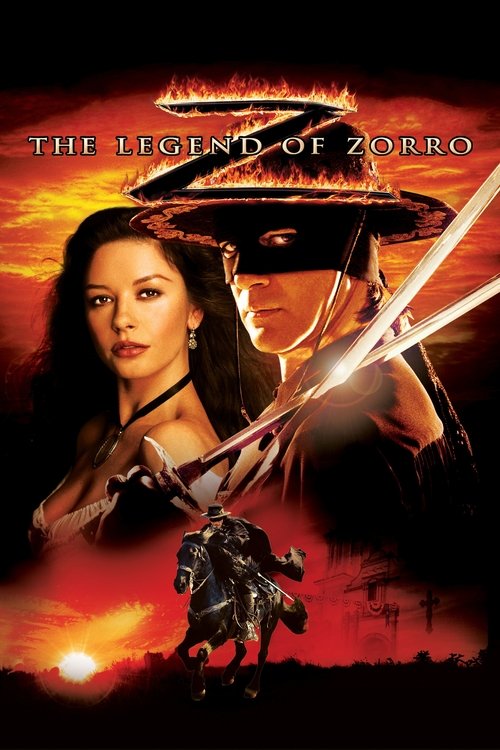
The Legend of Zorro (2005)
Directed by Martin Campbell
No — The Legend of Zorro is not especially woke, scoring 21 out of 100 on our wokeness meter.
The Legend of Zorro arrives eleven years after the original as a sequel nobody demanded and conducts itself with the weary professionalism of a hired carriage.
Consciousness Markers
The film centers on a Latino Californio hero and Mexican setting with Antonio Banderas and a largely Hispanic supporting cast, but the casting is story-driven rather than a modern inclusive statement.
Elena is given agency as a spy, fighter, and co-lead, but the film frames this within a conventional 2000s action-adventure marriage plot rather than a feminist agenda.
The California statehood plot and Confederate villainy touch on ethnic and national identity, yet the film does not explore racial justice or systemic prejudice in a modern consciousness-raising way.
No LGBTQ+ characters, themes, or subtext are present.
No environmental or climate themes are present.
The villain is an aristocratic conspirator seeking power, not a target of anti-capitalist or eat-the-rich critique.
No body-positivity themes, messaging, or casting emphasis are present.
No neurodivergent characters or themes are present.
It uses an alternate-history secret society around California statehood, but this is genre fiction rather than progressive historical revisionism.
The film delivers standard swashbuckling family morals without a preachy social-justice lecture.
Why it received this score
The Legend of Zorro arrives eleven years after the original as a sequel nobody demanded and conducts itself with the weary professionalism of a hired carriage. Antonio Banderas returns as the Californio hero, swishing and grinning through a plot about a secret society of European aristocrats scheming to sell nitroglycerin to the Confederate army. The cast is overwhelmingly Hispanic, which in 2005 reflected a story set in Mexican California instead of a studio directive. Catherine Zeta-Jones gives Elena genuine agency: she spies, she fights, she throws a man off a moving train. Her independence sits inside a marriage-crisis plot, so it plays as sturdy adventure screenwriting rather than a statement of principle.
Where the film might have sermonized, it declines. The villain is a count, an aristocrat nursing a grudge against the American experiment, which is not the same as a critique of capital. No climate anxiety intrudes on the vineyard. Nobody lectures about bodies, about neurology, about the constructed nature of the historical record. The Knights of Aragon are a pulp invention, not a revisionist argument about who really won the West, and the treatment of California statehood carries only faint ethnic texture. The Confederates are villains because they are Confederates, a position available to any studio since 1865.
The result is a film with modest cultural fingerprints and no agenda to speak of. It gestures toward Latino representation by the simple act of existing in its own setting. It gives its heroine a sword. Then it settles into domestic reconciliation and rides off. Critics mauled it, audiences shrugged at an A minus, and the whole enterprise has the mild, inoffensive character of a heritage tourism brochure with better stunts. We have classified stranger vintages, but rarely ones this forgettable.
Analysis generated by our Consciousness Algorithm


Synopsis
Despite trying to keep his swashbuckling to a minimum, a threat to California's pending statehood causes the adventure-loving Don Alejandro de la Vega and his wife, Elena, to take action.
Questions about The Legend of Zorro
Is The Legend of Zorro woke?
No — The Legend of Zorro is not especially woke, scoring 21 out of 100 on our wokeness meter. That earns it a verdict of Based.
Does The Legend of Zorro have any woke elements?
2 of the 10 markers register at 30 or above, led by Representation Casting (40) and Feminist Agenda (30). On Representation Casting: The film centers on a Latino Californio hero and Mexican setting with Antonio Banderas and a largely Hispanic supporting cast, but the casting is story-driven rather than a modern inclusive statement.
How does The Legend of Zorro compare to other 2005 movies?
It ranks #34 of the 181 films from 2005 we've scored; their average is 13. The wokest is The Constant Gardener (72).
How is the Woke Score calculated?
An AI-assisted process researches the film and its reception, scores it 0–100 on ten markers, then combines those into one 0–100 Woke Score. It measures a specific set of 2020s cultural themes, not film quality.