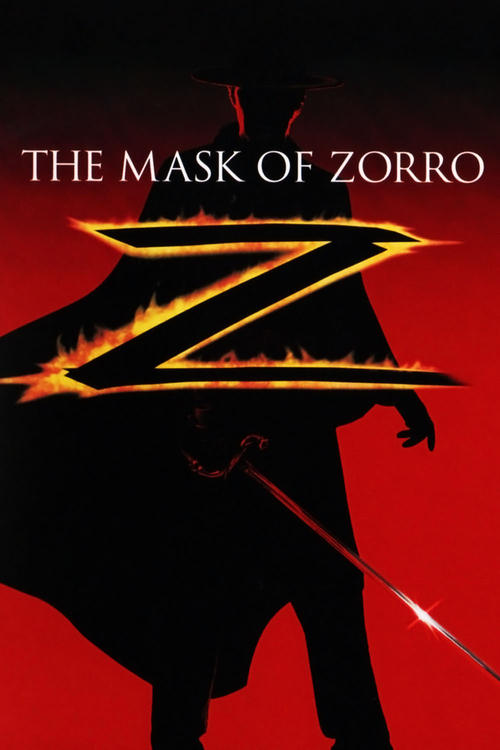
The Mask of Zorro (1998)
Directed by Martin Campbell
No — The Mask of Zorro is not woke, scoring 19 out of 100 on our wokeness meter.
The Mask of Zorro arrives from 1998, a year when a swashbuckler could still simply be a swashbuckler.
Consciousness Markers
The production deliberately cast Hispanic and Latino actors in the lead roles, with Antonio Banderas as Zorro and a supporting cast largely of Mexican and Spanish performers, a notable choice for 1998 blockbuster cinema.
The plot engages with Spanish colonial oppression of Californian commoners, Mexican identity, and the exploitation of peasant and prisoner labor, though framed as classic swashbuckling rather than modern racial commentary.
Elena is given a measure of agency, including a sword duel with Zorro, but she functions primarily as a love interest and long-lost daughter within a male-driven revenge narrative.
The villain Montero enriches himself through a slave-labor gold mine and schemes to purchase California, offering a mild critique of aristocratic greed and exploitation.
The film is a crowd-pleasing adventure romp with little interest in preaching; any moralizing about tyranny is delivered through action rather than sermon.
No LGBTQ+ characters, themes, or subtext appear anywhere in the film.
No environmental or climate themes are present.
No body-positivity themes or messaging.
No neurodivergent characters or themes.
The film is a fictional adventure set against a period backdrop, weaving in real figures like Joaquin Murrieta and Santa Anna without any revisionist historical argument.
Why it received this score
The Mask of Zorro arrives from 1998, a year when a swashbuckler could still simply be a swashbuckler. The production made a genuine and deliberate choice to populate its cast with Hispanic and Latino performers, with Antonio Banderas inheriting the mantle and a supporting roster drawn largely from Mexican and Spanish stages. For a studio blockbuster of its era, this was not nothing. Anthony Hopkins supplies the weary gravitas of the original Zorro, and Catherine Zeta-Jones, Welsh by birth and Spanish by accent, completes the triangle. The film wears its heritage lightly, which is both its charm and its limitation.
Beneath the swordplay sits a plot about Spanish colonial authority grinding down Californian commoners, with a villain who enriches himself through a slave-labor gold mine and dreams of purchasing a province outright. A critique of aristocratic greed is present, delivered through action beats. Elena gets a blade, a duel, and a measure of defiance, though the story keeps steering her toward daughterhood and romance. The film treats its Mexican and Californio textures as setting, not argument. Nobody stops the adventure to explain the moral.
On the remaining fronts, the cupboard is bare. No environmental theme stirs. No body-positive messaging. No neurodivergent characters. No queer subtext of any kind. The historical frame is decorative, weaving in Joaquin Murrieta and Santa Anna without advancing a thesis about either. The sermonizing is minimal, since tyranny here is condemned by having the hero stab it. This is a crowd-pleasing romp that wants your ticket, not your conscience. It succeeds on those modest terms.
Analysis generated by our Consciousness Algorithm


Synopsis
It has been twenty years since Don Diego de la Vega fought Spanish oppression in Alta California as the legendary romantic hero, Zorro. Having escaped from prison he transforms troubled bandit Alejandro into his successor, in order to foil the plans of the tyrannical Don Rafael Montero who robbed him of his freedom, his wife and his precious daughter.
Questions about The Mask of Zorro
Is The Mask of Zorro woke?
No — The Mask of Zorro is not woke, scoring 19 out of 100 on our wokeness meter. That earns it a verdict of Ultra Based.
Does The Mask of Zorro have any woke elements?
1 of the 10 markers register at 30 or above, led by Representation Casting (50). On Representation Casting: The production deliberately cast Hispanic and Latino actors in the lead roles, with Antonio Banderas as Zorro and a supporting cast largely of Mexican and Spanish performers, a notable choice for 1998 blockbuster cinema.
How does The Mask of Zorro compare to other 1998 movies?
It ranks #19 of the 118 films from 1998 we've scored; their average is 12. The wokest is Show Me Love (60).
How is the Woke Score calculated?
An AI-assisted process researches the film and its reception, scores it 0–100 on ten markers, then combines those into one 0–100 Woke Score. It measures a specific set of 2020s cultural themes, not film quality.