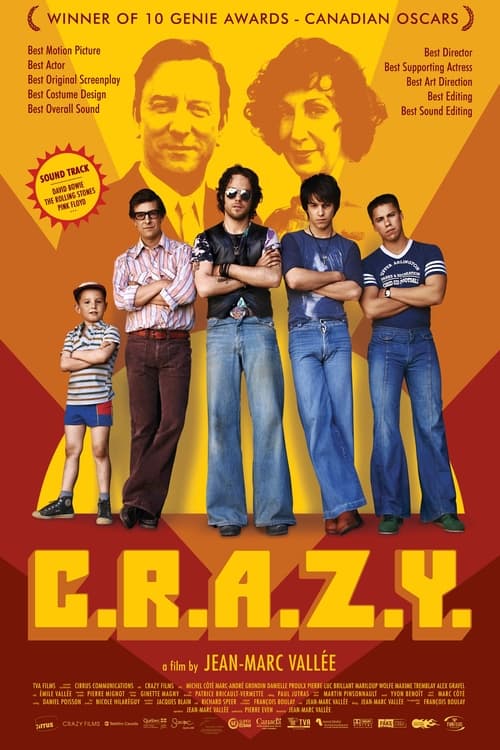
C.R.A.Z.Y. (2005)
Directed by Jean-Marc Vallée
Yes — C.R.A.Z.Y. is woke, scoring 60 out of 100 on our wokeness meter.
Jean-Marc Vallée's C.R.A.Z.Y. arrives with a soundtrack budget that could fund a small provincial film industry and a preoccupation that, by 2005 standards, is unusually single-minded.
Consciousness Markers
The narrative is fundamentally about a young man's struggle with his sexual orientation and the societal pressures of homophobia, making it a core LGBTQ+ text.
The film centers on a gay protagonist navigating a highly conservative, traditional family structure, providing significant representation for its time.
While the film deals with heavy themes, it is presented through narrative and emotion rather than didactic, lecture-style exposition.
The narrative focus remains squarely on Zac's male identity and family conflict, with no significant feminist agenda or central female empowerment theme.
Racial issues are not a central theme; the film focuses on cultural and sexual identity, with only a brief inclusion of a Bedouin character.
The film contains no commentary or plot elements related to environmentalism or climate change.
The conflict is rooted in personal and familial values, not in critiques of economic systems or capitalism.
The film does not address body image, diverse body types, or related social movements.
There is no depiction or discussion of neurodivergent characters or experiences.
The film is a character study set in a specific historical period, not an attempt to revise established historical facts.
Why it received this score
Jean-Marc Vallée's C.R.A.Z.Y. arrives with a soundtrack budget that could fund a small provincial film industry and a preoccupation that, by 2005 standards, is unusually single-minded. Zac, the fourth of five brothers in a Quebec household running on Patsy Cline and paternal expectation, spends two decades discovering that he is gay and that his father cannot accommodate the news. The film treats this as the whole of its business. There is no subplot demanding applause, no character wheeled in to carry a message. Zac's sexual orientation is the engine, the wound, and the eventual reconciliation. For a mainstream Canadian drama of its moment, that amounts to a genuine act of representation, and the film does not flinch from the ugliness: the therapist enlisted to cure him, the rain-soaked confrontation, the exile to Jerusalem and the desert beyond it.
The film declines to lecture. Vallée lets period music and domestic clutter do the arguing. The father's Aznavour, the Bowie on the stereo, the Christmas dinners that curdle: these carry the meaning, and the audience is trusted to keep pace. There is no feminist program here, and the women orbit the men's grievances. Racial questions barely register, beyond a Bedouin who offers water to a collapsed Zac and then vanishes from the narrative. Nobody mentions capitalism, the climate, body image, or neurodivergence. History is not revised. It is simply lived in, with accurate wallpaper and terrible haircuts.
The result earns its emotional finale through patience. Gervais hugging his son after a funeral lands precisely because nothing was explained to us beforehand. Weary as this critic is of cinema that mistakes a position paper for a screenplay, there is something bracing about a coming-of-age story that tells its story plainly and trusts the audience to feel it. The sermon is absent. The feeling remains. It is a modest miracle of restraint, and it holds up better than most of its louder contemporaries.
{"thematic_tags": []}
Analysis generated by our Consciousness Algorithm


Synopsis
A young French Canadian, one of five boys in a conservative family in the 1960s and 1970s, struggles to reconcile his emerging identity with his father's values.
Questions about C.R.A.Z.Y.
Is C.R.A.Z.Y. woke?
Yes — C.R.A.Z.Y. is woke, scoring 60 out of 100 on our wokeness meter. That earns it a verdict of Woke.
What makes C.R.A.Z.Y. woke?
2 of the 10 markers register at 30 or above, led by LGBTQ+ Themes (90) and Representation Casting (75). On LGBTQ+ Themes: The narrative is fundamentally about a young man's struggle with his sexual orientation and the societal pressures of homophobia, making it a core LGBTQ+ text.
How does C.R.A.Z.Y. compare to other 2005 movies?
It ranks #5 of the 181 films from 2005 we've scored; their average is 13. The wokest is The Constant Gardener (72).
How is the Woke Score calculated?
An AI-assisted process researches the film and its reception, scores it 0–100 on ten markers, then combines those into one 0–100 Woke Score. It measures a specific set of 2020s cultural themes, not film quality.