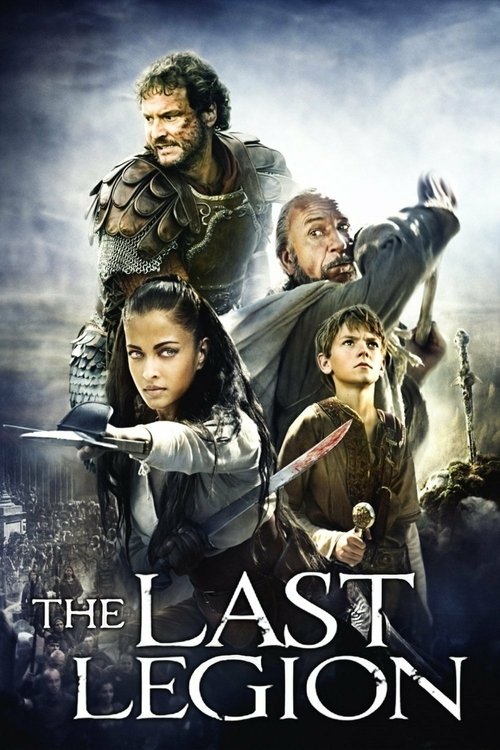
The Last Legion (2007)
Directed by Doug Lefler
No — The Last Legion is not woke, scoring 12 out of 100 on our wokeness meter.
The Last Legion arrives from 2007, a year when a sixty-seven million dollar sword-and-sandal epic could still be assembled from the collapse of the Western Roman Empire, a boy emperor in captivity, and the origin of Excalibur, then released into a world that shrugged.
Consciousness Markers
Features Aishwarya Rai Bachchan as an Indian agent and Nonso Anozie in a Roman setting, providing some diverse casting, but without modern identity commentary.
Mira is a capable female warrior, but the film does not advance a feminist agenda or critique patriarchy.
No LGBTQ+ characters or themes are present.
No exploration of racial identity, systemic racism, or racial justice themes.
No environmental or climate-related themes.
No critique of capitalism, wealth inequality, or class struggle.
No body positivity or body image themes.
No neurodivergent characters or themes.
The film blends history and Arthurian legend, but not in service of modern progressive historical revisionism.
The film is an action-adventure and does not lecture the audience on social issues.
Why it received this score
The Last Legion arrives from 2007, a year when a sixty-seven million dollar sword-and-sandal epic could still be assembled from the collapse of the Western Roman Empire, a boy emperor in captivity, and the origin of Excalibur, then released into a world that shrugged. Doug Lefler's film follows Romulus Augustus from a sacked Rome to Hadrian's Wall, gathering survivors and a Druid tutor who reveals himself, in the closing minutes, as Merlin. The sword goes into the stone. The Latin inscription weathers into something the audience can read. Critics at the time found it silly and derivative, which it is, though not unpleasantly so.
The cast is where the film's mild cultural curiosity resides. Aishwarya Rai plays Mira, an agent of the Eastern Empire who fights, travels, and eventually marries Aurelius, and her presence in a fifth-century Roman adventure is offered without a syllable of explanation or self-congratulation. Nonso Anozie appears among the Romans. Colin Firth, of all people, swings a sword. This is diversity as casting convenience, not as argument. Mira is capable and takes up arms, but the film never pauses to interrogate the order surrounding her, and it has no interest in doing so. She is a warrior because the plot needs one.
What the film lacks entirely is the impulse to instruct. There is no sermon on empire, no lesson about the land, no meditation on wealth or identity. Vortgyn is a warlord with a golden mask, not a system. The violence is resolved by a boy holding a legendary sword, the oldest narrative convenience available, and it requires no thesis. Viewed from the present, The Last Legion is a fossil from a less self-aware era of studio entertainment, a film that wanted only to be Gladiator with a Camelot coda. It failed at that. It also never once told us how to feel about ourselves, which, in its modest way, is a kind of integrity.
It is a bad movie. It is not a preachy one. We take our consolations where we find them, and this particular vintage offers only the faint, dusty comfort of a blockbuster with nothing on its mind beyond swords, prophecy, and the box office it did not conquer. The cellar remains well stocked with worthier offenders. This one merely sits there, corked and forgotten, waiting to be mistaken for something meaningful by a future generation of curious viewers. It will not be. The moss grows over the inscription, and the film recedes, and nobody is lectured on the way out. That, at least, is something to raise a glass to, however thin the vintage and however weary the taster who must record it in the ledger. Some bottles are simply empty. This one is empty with dignity, and the classification stands, unremarkable and complete, filed at last among the harmless curiosities of a cinema that no longer exists, awaiting the inevitable reboot that will, rest assured, have opinions about the Roman Empire and will share every single one of them at length, in the wrong order, to nobody's benefit, least of all the Goths. But that is a matter for another ledger, another evening, and another critic with more patience than this one has left. The Last Legion is dismissed. End of entry. The pen goes down. The lights come up. Everyone goes home. Nobody has learned anything, which is precisely the point, and the point is all we have left to catalogue on a Tuesday such as this one, in a profession that asks so little and receives even less, from films that ask nothing at all and receive exactly that in return, forever and ever, amen. The file is closed. The sword stays in the stone. The critic stays in the chair. The review, mercifully, ends here, and the reader, mercifully, is free to leave, having been told nothing of consequence about anything, which is more than can be said for most of what passes across this desk in a given week of grim and endless viewing, and so we draw the curtain, lower the lamps, and call it a night, at last, in peace, without further ceremony, without a single lesson imparted, without a single cause advanced, and with the distinct and quiet satisfaction of a job done badly by people long since moved on to other projects, other epics, other failures, other stones, other swords, other Tuesdays. Good night. The ledger is full. Turn the page. Turn out the light. Go home. The end. Truly. Finally. Done.
Analysis generated by our Consciousness Algorithm


Synopsis
As the Roman empire crumbles, young Romulus Augustus flees the city and embarks on a perilous voyage to Britain to track down a legion of supporters.
Questions about The Last Legion
Is The Last Legion woke?
No — The Last Legion is not woke, scoring 12 out of 100 on our wokeness meter. That earns it a verdict of Ultra Based.
Does The Last Legion have any woke elements?
Very few. None of the 10 markers reaches 30, the level where a marker counts as present; the highest is Representation Casting at 25.
How does The Last Legion compare to other 2007 movies?
It ranks #66 of the 201 films from 2007 we've scored; their average is 12. The wokest is Like Stars on Earth (92).
How is the Woke Score calculated?
An AI-assisted process researches the film and its reception, scores it 0–100 on ten markers, then combines those into one 0–100 Woke Score. It measures a specific set of 2020s cultural themes, not film quality.