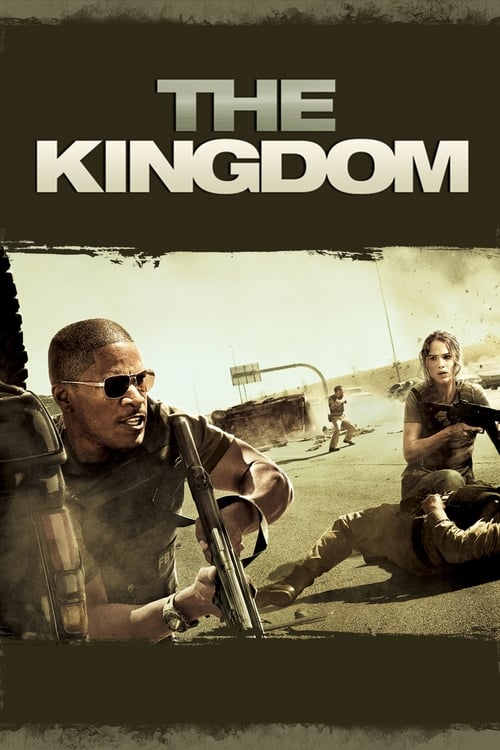
The Kingdom (2007)
Directed by Peter Berg
No — The Kingdom is not especially woke, scoring 25 out of 100 on our wokeness meter.
Peter Berg's The Kingdom arrives with the sober bearing of a procedural and the temperament of a blunt instrument.
Consciousness Markers
A Black lead (Jamie Foxx) heads the FBI team, with a woman and Arab actors in significant roles, but the diversity is largely organic to the ensemble rather than a self-conscious representational statement.
The film engages Arab and American racial dynamics, but critics (Bayoumi, Nashashibi) argue it reinforces stereotypes rather than advancing any progressive racial consciousness.
Jennifer Garner's forensic examiner is competent and gets an action beat, but the film offers no feminist framing or commentary on gender.
The film carries a jingoistic 'kill 'em all' message rather than a preachy progressive one, with only mild political framing.
The film fictionalizes real bombings (Khobar Towers, Riyadh) into a wish-fulfillment revenge scenario, which some critics called a revisionist fantasy, though not for ideological-woke purposes.
No LGBTQ+ characters, themes, or subtext appear anywhere in the film.
No environmental or climate themes are present.
An American oil company compound is the target, but the film has no anti-capitalist critique; it is a law-enforcement procedural.
No body positivity themes or messaging.
No neurodivergent characters or themes.
Why it received this score
Peter Berg's The Kingdom arrives with the sober bearing of a procedural and the temperament of a blunt instrument. A team of FBI agents flies to Riyadh to investigate the bombing of an American oil company compound, and the film spends its first hour on forensics, jurisdictional squabbles, and the slow, grudging courtship between Jamie Foxx's agent and Ashraf Barhom's Saudi colonel. The ensemble is notably integrated for 2007: a Black lead, a woman running the morgue, Arab actors handed scenes of genuine texture. None of it announces itself. The diversity sits in the frame without a press release attached, which is its own modest virtue and also its ceiling.
The politics are another matter. Critics at the time observed that the film folds the Khobar Towers bombing, the Riyadh compound attacks, and the 2004 Khobar massacre into a single wish-fulfillment engine, then drives it toward a closing line about killing everyone. Moustafa Bayoumi and Sharif Nashashibi both argued that the Arab characters exist mainly as obstacles or corpses, with one sympathetic Saudi permitted to carry the burden of proving the film is not what it plainly is. The message is martial, not progressive. There is no sermon here about carbon footprints or the gender wage gap. There is only a rifle.
We are left with a competent thriller that mistakes escalation for resolution. It has no interest in queer lives, body politics, neurodivergence, or the sins of capital, though it does blow up a facility belonging to an oil company, which is not the same as a critique of one. The film's cultural awareness extends to hiring well and then pointing a gun at the horizon. We classify it accordingly, and we move on to the next screening.
Analysis generated by our Consciousness Algorithm
Part of


Synopsis
A team of U.S. government agents is sent to investigate the bombing of an American facility in the Middle East.
Questions about The Kingdom
Is The Kingdom woke?
No — The Kingdom is not especially woke, scoring 25 out of 100 on our wokeness meter. That earns it a verdict of Based.
Does The Kingdom have any woke elements?
1 of the 10 markers register at 30 or above, led by Representation Casting (42). On Representation Casting: A Black lead (Jamie Foxx) heads the FBI team, with a woman and Arab actors in significant roles, but the diversity is largely organic to the ensemble rather than a self-conscious representational statement.
How does The Kingdom compare to other 2007 movies?
It ranks #23 of the 201 films from 2007 we've scored; their average is 12. The wokest is Like Stars on Earth (92).
How is the Woke Score calculated?
An AI-assisted process researches the film and its reception, scores it 0–100 on ten markers, then combines those into one 0–100 Woke Score. It measures a specific set of 2020s cultural themes, not film quality.