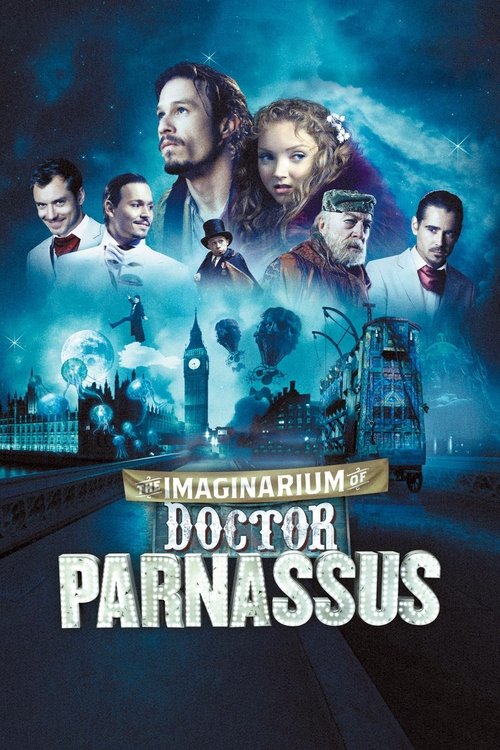
The Imaginarium of Doctor Parnassus (2009)
Directed by Terry Gilliam
No — The Imaginarium of Doctor Parnassus is not especially woke, scoring 25 out of 100 on our wokeness meter.
Terry Gilliam's The Imaginarium of Doctor Parnassus arrives bearing the melancholy weight of being Heath Ledger's final performance, a fact the film wears with a dignified, slightly haunted air.
Consciousness Markers
The story satirizes a disgraced philanthropist who stole organs from orphans in developing countries and sold them to wealthy Westerners, and it mocks charity galas and the affluent. This gives it a noticeable eat-the-rich streak, though it is not a systemic anti-capitalist manifesto.
The film explicitly stages a choice between self-fulfilling enlightenment and gratifying ignorance, and its director framed it as a lesson about imagination. That didacticism is mild and not tied to social justice preaching.
The cast is overwhelmingly white and the few non-traditional elements, such as Verne Troyer's dwarf character, are presented without any modern representation commentary. No deliberate diverse casting agenda is evident.
No LGBTQ+ characters, themes, or subtext appear; the romantic and sexual dynamics are entirely heterosexual.
Valentina is central but functions largely as a pawn in a bet between men; the film offers no feminist critique or empowerment narrative.
Race is not a theme; the critique of organ trafficking from developing countries is framed as class exploitation, not racial consciousness.
The film has no environmental or climate change themes.
No body positivity themes or plus-size representation are present.
No neurodivergent characters or themes are explored.
The film is an original fantasy; its Tony Blair-inspired villain is contemporary satire, not historical revisionism.
Why it received this score
Terry Gilliam's The Imaginarium of Doctor Parnassus arrives bearing the melancholy weight of being Heath Ledger's final performance, a fact the film wears with a dignified, slightly haunted air. The premise concerns an ancient showman who wagered his daughter's soul against the Devil and now tours a shabby carnival in search of five fresh souls to settle the debt. Immortality, magic mirrors, and a travelling theatre troupe of dubious hygiene all follow. The recasting of Ledger with Johnny Depp, Jude Law, and Colin Farrell inside the dream world is handled with more grace than the premise deserves. The result is a curious, uneven artifact of grief and whimsy.
Where the film shows a flicker of modern social consciousness, it is in its treatment of Tony Shepard, the hanging philanthropist modeled on Tony Blair. He is a fraud who lifted organs from orphans in developing nations and sold them to wealthy Westerners, and the film stages a charity gala only so an angry mob of benefactors can tear it apart. The satire lands as a broad swipe at performative charity and the affluent, a mild eat-the-rich gesture that never hardens into a coherent economic argument. Elsewhere the ledger stays empty. The women exist to be bargained over. Race, sexuality, the climate, and the body are absent from the conversation. The film has no interest in any of it.
The philosophical spine concerns imagination itself, and Gilliam has been candid that he intended a lesson about wonder in a world that no longer listens. The Imaginarium offers each visitor a choice between difficult self-fulfillment and easy ignorance, a moral scheme that is not a socially conscious one. Parnassus is an autobiographical stand-in for a director aging out of relevance, and the film's sermonizing is confined to that private lament. The result is a visually inventive fantasy with a negligible cultural agenda, a relic from an era when a filmmaker could chase souls and mirrors without answering to the present moment.
Classification: a sober, well-mannered piece of fantasia that mostly minds its own business. It scores low across the board, with only a faint whiff of class resentment and a whisper of moral instruction to its name. We file it under harmless curiosities, the kind a sommelier might pour for a guest who asked for something strange and slightly sad. The vintage is 2009. It has not aged into anything more urgent since. A dedicated Oscar campaign it did not win, a franchise it is not, and a true story it never claimed to be, which leaves the shelf bare and the ledger clean. We move on to the next bottle.
{"thematic_tags": []}
Analysis generated by our Consciousness Algorithm


Synopsis
After a carnival troupe saves his life, a man agrees to help its immortal leader collect five souls and win a bet with the devil.
Questions about The Imaginarium of Doctor Parnassus
Is The Imaginarium of Doctor Parnassus woke?
No — The Imaginarium of Doctor Parnassus is not especially woke, scoring 25 out of 100 on our wokeness meter. That earns it a verdict of Based.
Does The Imaginarium of Doctor Parnassus have any woke elements?
1 of the 10 markers register at 30 or above, led by Eat the Rich (35). On Eat the Rich: The story satirizes a disgraced philanthropist who stole organs from orphans in developing countries and sold them to wealthy Westerners, and it mocks charity galas and the affluent.
How does The Imaginarium of Doctor Parnassus compare to other 2009 movies?
It ranks #32 of the 230 films from 2009 we've scored; their average is 14. The wokest is Home (79).
How is the Woke Score calculated?
An AI-assisted process researches the film and its reception, scores it 0–100 on ten markers, then combines those into one 0–100 Woke Score. It measures a specific set of 2020s cultural themes, not film quality.