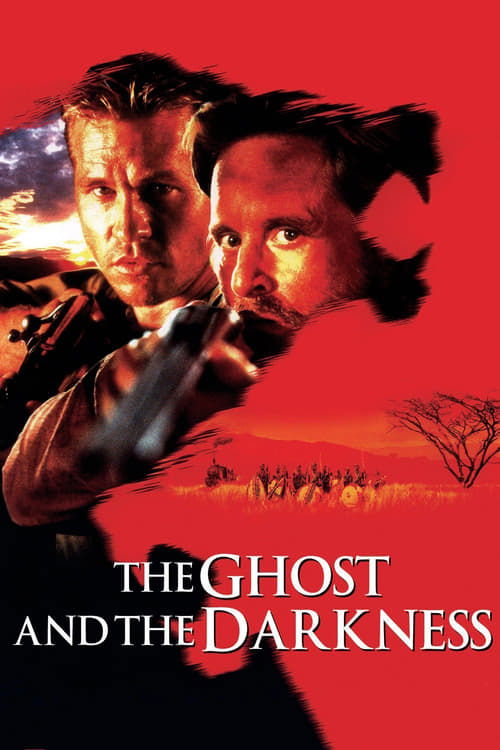
The Ghost and the Darkness (1996)
Directed by Stephen Hopkins
No — The Ghost and the Darkness is not woke, scoring 16 out of 100 on our wokeness meter.
The Ghost and the Darkness arrives from 1996, a year when a studio could still release a colonial adventure picture about a British engineer shooting lions in Kenya and file it under history.
Consciousness Markers
The cast includes John Kani, Om Puri, Henry Cele, and real Maasai warriors, but these are period-appropriate roles for a colonial Kenya setting rather than modern representation casting; the leads remain white.
The film depicts the British colonial railway project and its Indian and African laborers, and the Maasai are treated with some dignity, but it is an adventure thriller centered on white protagonists rather than a work of racial consciousness.
Financier Beaumont is portrayed as a profit-obsessed taskmaster who threatens Patterson's reputation over the schedule, offering a mild critique of colonial capitalist enterprise, but it is incidental to the man-eater plot.
The film is a fictionalized account of the Tsavo man-eaters, inventing the character of Remington and inflating the death toll, but this is dramatic license rather than a modern progressive reinterpretation of history.
The film is a suspenseful adventure thriller that never pauses to deliver social or political sermons to the audience.
No LGBTQ+ characters or themes of any kind appear in the film.
Emily Mortimer's Helena is a brief, supportive wife figure with no feminist framing or agency-driven arc.
No environmental or climate themes are present.
No body positivity themes or messaging.
No neurodivergent characters or themes.
Why it received this score
The Ghost and the Darkness arrives from 1996, a year when a studio could still release a colonial adventure picture about a British engineer shooting lions in Kenya and file it under history. Stephen Hopkins directs with a straight face, Val Kilmer broods handsomely as John Henry Patterson, and Michael Douglas appears as a fictional American hunter invented for the express purpose of being eaten. The lions, we are told, are not merely hungry. They are evil. The film treats this proposition with the gravity of scripture.
On the matter of cultural consciousness, the picture is a curious artifact. It stocks its Kenyan setting with John Kani, Om Puri, Henry Cele, and a contingent of actual Maasai warriors, and it grants the Maasai a certain dignity. Yet the machinery of the plot belongs to the white leads, and the African and Indian laborers exist chiefly to be counted among the dead. The railway project is depicted as an enterprise of sweat and profit, and the financier Beaumont is drawn as a taskmaster who cares only for the schedule. This registers as a faint critique of empire, delivered almost by accident while the camera waits for something to pounce.
What the film does not do is lecture. There are no speeches about the dignity of labor, no climactic monologues on the evils of colonialism, no lessons on identity or the environment. It wants to frighten us with a pair of lions, and it largely succeeds. Emily Mortimer appears briefly as a wife who waits in London, and the film asks nothing more of her. The historical record is massaged for spectacle, the death toll inflated, a character conjured from whole cloth. This is dramatic license, not reinterpretation. The result is an old-fashioned creature feature wearing a pith helmet, and it is content to remain exactly that.
Analysis generated by our Consciousness Algorithm
Part of


Synopsis
Sir Robert Beaumont is behind schedule on a railroad in Africa. Enlisting noted engineer John Henry Patterson to right the ship, Beaumont expects results. Everything seems great until the crew discovers the mutilated corpse of the project's foreman, seemingly killed by a lion. After several more attacks, Patterson calls in famed hunter Charles Remington, who has finally met his match in the bloodthirsty lions.
Questions about The Ghost and the Darkness
Is The Ghost and the Darkness woke?
No — The Ghost and the Darkness is not woke, scoring 16 out of 100 on our wokeness meter. That earns it a verdict of Ultra Based.
Does The Ghost and the Darkness have any woke elements?
2 of the 10 markers register at 30 or above, led by Representation Casting (40) and Racial Consciousness (30). On Representation Casting: The cast includes John Kani, Om Puri, Henry Cele, and real Maasai warriors, but these are period-appropriate roles for a colonial Kenya setting rather than modern representation casting; the leads remain white.
How does The Ghost and the Darkness compare to other 1996 movies?
It ranks #18 of the 93 films from 1996 we've scored; their average is 11. The wokest is Bound (60).
How is the Woke Score calculated?
An AI-assisted process researches the film and its reception, scores it 0–100 on ten markers, then combines those into one 0–100 Woke Score. It measures a specific set of 2020s cultural themes, not film quality.