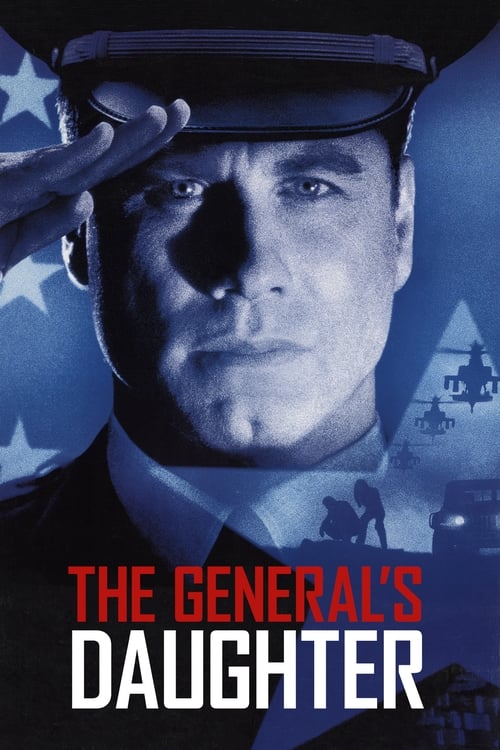
The General's Daughter (1999)
Directed by Simon West
No — The General's Daughter is not woke, scoring 18 out of 100 on our wokeness meter.
The General's Daughter arrives at the end of the 1990s as a murder mystery set on a Georgia army base, where Captain Elisabeth Campbell is found staked naked on the training ground in a pose the film regards with the reverence normally reserved for fine china.
Consciousness Markers
The plot hinges on sex discrimination in the military and a cover-up of a gang rape rationalized as protecting the cause of women in uniform, but critics noted the film wallows in misogynistic exploitation rather than advancing a feminist argument.
A female co-lead (Madeleine Stowe) and a few Black supporting actors (Clarence Williams III, John Beasley) appear, but the cast is overwhelmingly white and no casting choices are framed as representative gestures.
The finale gestures at a moral indictment of military cronyism and sexism, but critics found it offered no real solutions and preferred lurid spectacle over preaching.
No LGBTQ+ characters or themes appear; the BDSM material is heterosexual and used for titillation rather than identity commentary.
Race is never a subject of the narrative; Black cast members exist as ordinary characters with no commentary on racial dynamics.
No environmental or climate themes whatsoever.
The villain is military institutional cover-up, not wealth or capitalism; no eat-the-rich sentiment.
The film's treatment of the female body is lurid and objectifying, the opposite of body-positivity messaging.
PTSD and psychological trauma are plot devices tied to the crime, not framed as neurodivergent identity or advocacy.
A fictional story with no historical revisionism; the military setting is contemporary and invented.
Why it received this score
The General's Daughter arrives at the end of the 1990s as a murder mystery set on a Georgia army base, where Captain Elisabeth Campbell is found staked naked on the training ground in a pose the film regards with the reverence normally reserved for fine china. Two warrant officers are dispatched to investigate. The procedural that follows keeps mistaking titillation for gravity, and it does so at length.
There is a real argument buried in here about sex discrimination in the ranks. Several generals persuaded a gang-raped cadet to stay silent because publicity would damage the cause of women in uniform, and the cover-up that follows is genuinely damning. The film also lingers on the same material with a leering camera, fetish videotapes, and a strangling scene that left Roger Ebert feeling unclean. The indictment and the exploitation occupy the same frame, and the exploitation wins on points.
Elsewhere the picture keeps its head down. Race is never a subject; the Black supporting players appear as ordinary soldiers with no comment attached. There is no environmental conscience, no eat-the-rich sentiment, since the villain is the institution and not the portfolio. The body is treated as evidence and as scenery, never as anything to affirm. Trauma drives the plot without being framed as identity. A female co-lead and a few minority faces give the cast a mild breadth that the film never advertises. The finale reaches for a moral reckoning over military cronyism, then proposes nothing beyond a court-martial and a plane ride. The last word belongs to spectacle. Ebert's instinct was sound.
That is the correct response to this material: a sincere grievance, dressed up and then undressed again, sold as a thriller and remembered mostly for the undressing. The classification is straightforward, though not flattering. A serious subject does not a serious film make, and this one has the nerve to raise a genuine injustice while keeping its eye trained firmly on the corpse.
Analysis generated by our Consciousness Algorithm
Part of


Synopsis
When the body of Army Capt. Elisabeth Campbell is found on a Georgia military base, two investigators, Warrant Officers Paul Brenner and Sara Sunhill, are ordered to solve her murder. What they uncover is anything but clear-cut. Unseemly details emerge about Campbell's life, leading to allegations of a possible military coverup of her death and the involvement of her father, Lt. Gen. Joseph Campbell.
Questions about The General's Daughter
Is The General's Daughter woke?
No — The General's Daughter is not woke, scoring 18 out of 100 on our wokeness meter. That earns it a verdict of Ultra Based.
Does The General's Daughter have any woke elements?
1 of the 10 markers register at 30 or above, led by Feminist Agenda (35). On Feminist Agenda: The plot hinges on sex discrimination in the military and a cover-up of a gang rape rationalized as protecting the cause of women in uniform, but critics noted the film wallows in misogynistic exploitation rather than advancing a feminist argument.
How does The General's Daughter compare to other 1999 movies?
It ranks #28 of the 103 films from 1999 we've scored; their average is 14. The wokest is Boys Don't Cry (60).
How is the Woke Score calculated?
An AI-assisted process researches the film and its reception, scores it 0–100 on ten markers, then combines those into one 0–100 Woke Score. It measures a specific set of 2020s cultural themes, not film quality.