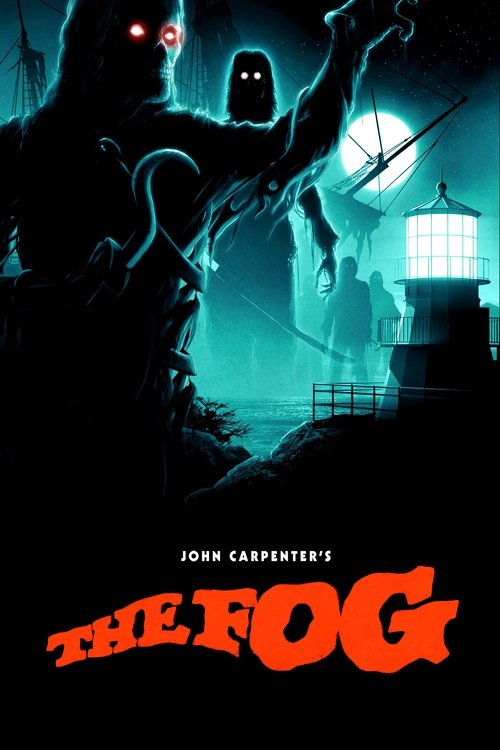
The Fog (1980)
Directed by John Carpenter
No — The Fog is not woke, scoring 7 out of 100 on our wokeness meter.
John Carpenter's The Fog arrives from 1980, a year when a coastal town could still be menaced by the vengeful dead without anyone feeling obliged to explain what it all meant.
Consciousness Markers
The town of Antonio Bay was founded on gold plundered from a deliberately wrecked ship, and the revenants return to punish a community that prospered from theft and murder. This is a theme of greed and corrupt founding wealth, but it is framed as ghost-story morality rather than any systemic anti-capitalist argument.
Adrienne Barbeau's radio DJ Stevie Wayne is a capable, resourceful female lead, and Jamie Lee Curtis and Janet Leigh appear prominently, but this reflects standard genre casting rather than any articulated feminist thesis or commentary.
Carpenter is more interested in atmosphere and dread than in preaching; the theme of buried guilt is implicit and never delivered as a lecture.
The cast is entirely white, led by Adrienne Barbeau, Jamie Lee Curtis, Janet Leigh, and Hal Holbrook. No diverse or representative casting choices are present or remarked upon.
There are no LGBTQ+ characters, themes, or subtext of any kind in the film.
Race is entirely absent as a subject; the film's conflict is supernatural and historical, not racial.
The titular fog is a supernatural manifestation of vengeful revenants, not an environmental or climate allegory.
No body-positive themes or messaging are present.
No neurodivergent characters or themes appear.
While the film concerns a repressed historical crime resurfacing, this is a fictional ghost narrative, not a reinterpretation or revision of real historical events along ideological lines.
Why it received this score
John Carpenter's The Fog arrives from 1980, a year when a coastal town could still be menaced by the vengeful dead without anyone feeling obliged to explain what it all meant. Antonio Bay prepares its centennial while a glowing fog rolls in bearing the revenants of a clipper crew deliberately wrecked a century earlier so the founders could pocket their gold and avoid a leper colony. The cast is uniformly white, led by Adrienne Barbeau behind a radio microphone, with Jamie Lee Curtis and Janet Leigh along for the ride. Nobody in the production appears to have given the matter a thought, and the film is content to let the demographic chips fall where they may.
The buried crime at the town's founding gives the picture a faint whiff of class resentment. Prosperity purchased with plundered gold, a mayor who shrugs off the centennial's dark origins, a priest offering his ancestor's stolen cross in atonement. This is greed as ghost-story morality, not a systemic indictment, and Carpenter never pauses to lecture us about it. Barbeau's Stevie Wayne is resourceful and commanding, though her competence reads as standard genre casting instead of any articulated thesis about the place of women in broadcasting. The film has no interest in the body, the climate, the mind's varied wiring, or the reinterpretation of real history. It wants to scare us, and it mostly does.
Carpenter conjures atmosphere the way a sommelier decants a difficult vintage: patiently, with dread, and without a single sermon. The guilt here is implicit, never preached. For a film preoccupied with a town that prospered from murder, it is remarkably uninterested in making anyone feel bad about it. We can respect that.
Analysis generated by our Consciousness Algorithm


Synopsis
Strange things begin to occur as a tiny California coastal town prepares to commemorate its centenary. Inanimate objects spring eerily to life; Rev. Malone stumbles upon a dark secret about the town's founding; radio announcer Stevie witnesses a mystical fire; and hitchhiker Elizabeth discovers the mutilated corpse of a fisherman. Then a mysterious iridescent fog descends upon the village, and more people start to die.
Questions about The Fog
Is The Fog woke?
No — The Fog is not woke, scoring 7 out of 100 on our wokeness meter. That earns it a verdict of Ultra Based.
Does The Fog have any woke elements?
Very few. None of the 10 markers reaches 30, the level where a marker counts as present; the highest is Eat the Rich at 15.
How does The Fog compare to other 1980 movies?
It ranks #17 of the 37 films from 1980 we've scored; their average is 10. The wokest is Nine to Five (42).
How is the Woke Score calculated?
An AI-assisted process researches the film and its reception, scores it 0–100 on ten markers, then combines those into one 0–100 Woke Score. It measures a specific set of 2020s cultural themes, not film quality.