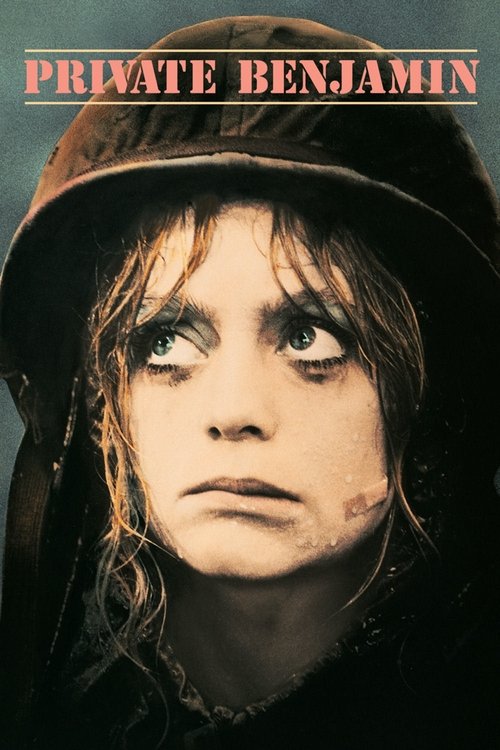
Private Benjamin (1980)
Directed by Howard Zieff
No · Based
How we score movies →Consciousness Markers
The film presents a woman succeeding in a male-dominated military environment, which carries some progressive weight for 1980. However, her competence is constantly undermined by comedy that relies on her femininity and materialism as the source of humor. The narrative ultimately privileges romance over professional achievement.
The film centers a female protagonist and includes women in positions of authority, particularly Eileen Brennan's commanding officer. However, the supporting cast remains predominantly white and male, with no meaningful representation of racial or ethnic diversity beyond stereotypical roles.
While the film contains some implicit messaging about gender roles and female capability, it does not lecture the audience. The comedy is relatively gentle and the film avoids heavy-handed moralizing, though it occasionally tips into simplistic messaging about women's strength and resilience.
While the film does not actively shame bodies, it relies heavily on physical comedy and the joke of Judy's struggle with military physical demands. Her body is presented as a source of humor rather than as something deserving of acceptance or celebration.
The film does not critique capitalism or wealth. Judy's upper-class background and materialism are presented as character flaws to be overcome through discipline, not as symptoms of systemic inequality. There is no examination of class privilege or economic exploitation.
Private Benjamin shows no awareness of racial dynamics or the specific experiences of Black servicemembers or other minorities in the military. The cast is overwhelmingly white, and when minorities appear, they are background characters without agency or development.
The film does not attempt to revise historical narratives about the military or women's service. It presents a largely conventional view of the U.S. Army and military life without questioning historical injustices or offering alternative perspectives on military history.
There are no LGBTQ themes, representation, or acknowledgment in Private Benjamin. The film's entire romantic and social structure is heteronormative and taken for granted.
There is no climate consciousness or environmental awareness in this 1980 military comedy. The film is entirely unconcerned with ecological or environmental themes.
There is no representation of or engagement with neurodivergence in Private Benjamin. No characters display or discuss neurodivergent traits, and there is no awareness of neurodiversity as a concept.


Synopsis
A sheltered young high society woman joins the US Army on a whim and finds herself in a more difficult situation than she ever expected.
Why it received this score
Private Benjamin remains a curious artifact of 1980, a film that traffics in progressive gender politics without quite understanding what it means to actually interrogate them. Goldie Hawn's Judy Benjamin is the film's great contradiction: she is simultaneously celebrated for her toughness and military competence, yet the comedy hinges almost entirely on jokes about her femininity, materialism, and shallowness. The film wants to have it both ways, presenting her transformation as empowering while never quite letting her escape the role of punchline. Her intelligence, resourcefulness, and physical capability are treated as charming aberrations rather than logical extensions of her character. This is not feminism so much as it is a comedy that permits a woman to be competent in a male-dominated space, provided we all understand she remains fundamentally frivolous at heart.
The military setting allows the film to explore power dynamics and institutional authority, but only in the most surface-level manner. There is no real critique of militarism or masculinity, merely an acknowledgment that women can endure the same absurd indignities as men. Eileen Brennan's Captain Doreen Lewis offers a more complex portrait of female military authority, yet even this is undermined by the film's ultimate reluctance to fully embrace its own implications. The narrative arc requires Judy to choose between personal happiness and military duty, a false choice that suggests her real fulfillment lies not in professional achievement but in romantic partnership. For a film released in 1980, this represents a certain liberal consciousness, but it is the pre-2015 variety: generally sympathetic to women's advancement without engaging in the systematic examination of institutional power that would mark genuinely contemporary progressive sensibility.
The film's representation remains largely white, heterosexual, and upper-middle-class. Albert Brooks and other supporting players provide comic relief in ways that require no interrogation of their privilege or position. The film is not hostile to women or to the idea of female capability, but it is incurious about the structures that constrain women or the ways power operates beyond individual charm and determination. It is a film that believes in equality as a matter of individual effort rather than systemic change.
Analysis generated by our Consciousness Algorithm
Critic Reviews
“Private Benjamin is refreshing and fun. Goldie Hawn, who is a true comic actress, makes an original, appealing character out of Judy Benjamin, and so the movie feels alive, not just an exercise in gags and situations.”
“Mr. Zieff demonstrates great skill in keeping the gags aloft and in finding new ways by which to free the laughs trapped inside old routines about latrine duty, war games, forced marches and calisthenics. [10 Oct 1980, p.C6]”
“Even when the film capitulates to its predictable feminist battle cry, director Howard Zieff maintains his poise, demonstrating the gift for light comic timing he showed in Hearts of the West. But the best reason for seeing Private Benjamin is Goldie Hawn, who proves herself a comic leading lady of the first order, a Cinderella in reverse who could charm the brass off the Joint Chiefs of Staff. [20 Oct 1980, p.84] ”
“Private Benjamin seems coarse, sluggish and interminable as a comedy scenario.”