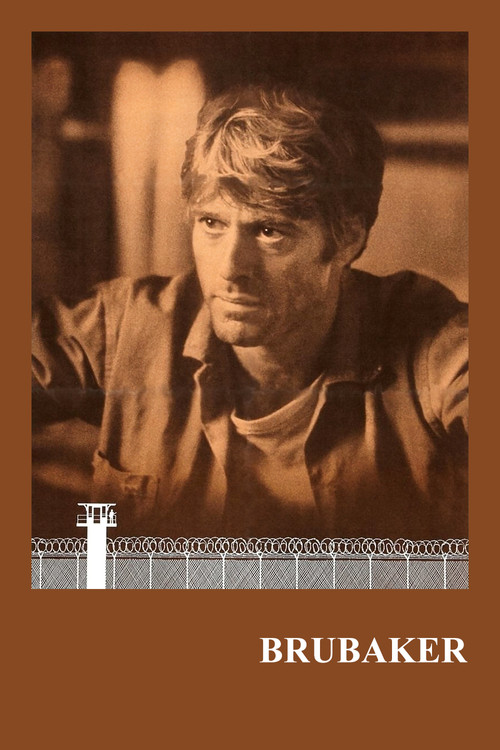
Brubaker (1980)
Directed by Stuart Rosenberg
No — Brubaker is not especially woke, scoring 30 out of 100 on our wokeness meter.
Stuart Rosenberg's Brubaker arrives with the weary authority of a director who already made Cool Hand Luke and knows his way around a cell block.
Consciousness Markers
Ebert noted that half of Redford's speeches 'could have come out of newspaper editorials'; the film is openly didactic about prison reform and human rights.
The film's core is the exposure of graft, profiteering officials, and prisoners used as slave labor for private contractors — a sustained indictment of exploitation for profit.
The cast features Black actors (Yaphet Kotto, Morgan Freeman, Richard Ward) in substantial roles, but this reflects natural 1980 ensemble casting rather than a deliberate diversity mandate.
The prison population and trusty system carry racial dimensions, and an elderly Black inmate is a victim of brutality, but the film frames this as general human-rights abuse rather than racial consciousness.
Jane Alexander's Lillian Gray is a PR operative with a modest role; the film has no feminist framework or gender-conscious critique.
No LGBTQ+ characters or themes appear anywhere in the film.
No environmental or climate themes are present.
No body-positivity themes or messaging.
A deranged prisoner in solitary appears, but mental illness is depicted as a plot device, not as neurodivergent advocacy.
The film is a fictionalized account of real events, but it does not revise or reframe history in service of a modern ideological narrative.
Why it received this score
Stuart Rosenberg's Brubaker arrives with the weary authority of a director who already made Cool Hand Luke and knows his way around a cell block. Robert Redford plays Henry Brubaker, a warden who enters Wakefield State Prison disguised as an inmate, witnesses the routine savagery of the place, then stands in a crowded room and announces that he is the new management. It is a handsome dramatic hinge. The film that follows is less a character study than an audit.
The engine here is money. A lumber salesman named Woodward has been using prisoners as slave labor, pocketing contract funds, and building a roof that caves in. A bookkeeper sells the inmates' food for profit. The doctor bills men for medical care. Board members defraud the state through fake insurance policies on uninsured buildings. Brubaker's crusade is aimed squarely at graft, and the film treats profit extracted from human beings as the root of the rot. Ebert observed that half of Redford's speeches could have come out of newspaper editorials, which is a polite way of saying the screenplay sermonizes. It sermonizes about prison reform and constitutional rights, and it does so without apology.
The supporting cast includes Yaphet Kotto, Morgan Freeman, and Richard Ward in substantial roles, presented as ordinary inhabitants of a Southern prison, with no diversity mandate in sight. Jane Alexander's public relations operative gets one almost subliminal moment of private feeling, and the film hurries past it; gender critique is not on the agenda. There is no LGBTQ material, no environmental concern, no body positivity, no neurodivergent advocacy. The deranged prisoner in solitary exists to trigger a plot turn. An elderly Black inmate is tortured and murdered, and the film processes the horror as general human rights abuse, which was the idiom of 1980. A closing title card reports that the courts ordered reform and the governor lost his election. Conscience salved, credits roll.
Analysis generated by our Consciousness Algorithm


Synopsis
The new warden of a small prison farm in Arkansas tries to clean it up of corruption after initially posing as an inmate.
Questions about Brubaker
Is Brubaker woke?
No — Brubaker is not especially woke, scoring 30 out of 100 on our wokeness meter. That earns it a verdict of Based.
Does Brubaker have any woke elements?
3 of the 10 markers register at 30 or above, led by Lecture Energy (55), Eat the Rich (50) and Representation Casting (30). On Lecture Energy: Ebert noted that half of Redford's speeches 'could have come out of newspaper editorials'; the film is openly didactic about prison reform and human rights.
How does Brubaker compare to other 1980 movies?
It ranks #2 of the 37 films from 1980 we've scored; their average is 10. The wokest is Nine to Five (42).
How is the Woke Score calculated?
An AI-assisted process researches the film and its reception, scores it 0–100 on ten markers, then combines those into one 0–100 Woke Score. It measures a specific set of 2020s cultural themes, not film quality.