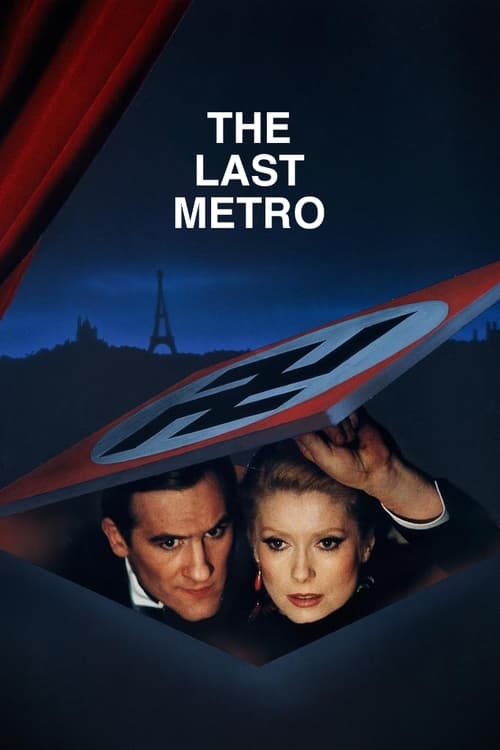
The Last Metro (1980)
Directed by François Truffaut
No — The Last Metro is not woke, scoring 19 out of 100 on our wokeness meter.
François Truffaut's The Last Metro arrives in 1980 with the calm assurance of a director who has stopped trying to shock anyone.
Consciousness Markers
Jewish persecution and antisemitism are central to the plot, including the hidden Jewish husband and the anti-Semitic review, though the film frames this as historical intolerance rather than modern racial consciousness.
A lesbian production designer and a homosexual director are present and treated with tolerance, but their queerness is supporting texture rather than a central thematic engine.
Marion is a strong female lead who runs the theater and covers for her husband, but the film does not articulate a feminist critique or agenda.
The film carries a humanist moral about tolerance and resistance, but it dramatizes rather than lectures; any message is embedded in the period story.
The cast is entirely white European; there is no inclusive or nontraditional casting that would register on this marker.
There is no environmental or climate-related theme in the film.
The antagonist force is the Nazi occupation and collaboration, not capitalism or economic hierarchy.
There is no engagement with body positivity or body-image politics.
There is no depiction or discussion of neurodivergence.
The film is a historical period drama, not a revisionist or counter-narrative rewriting of history.
Why it received this score
François Truffaut's The Last Metro arrives in 1980 with the calm assurance of a director who has stopped trying to shock anyone. Occupied Paris, 1942. A Montmartre theatre keeps its doors open, its sets painted, its curtain rising, while its Jewish director hides in the cellar and the woman who owns the building does his job and hers. The film is warm, well-lit, and unmistakably the work of a man who loves actors more than arguments. Catherine Deneuve runs the theatre with a clenched elegance that reads as strength; the screenplay never bothers to frame this as a statement about women, which is why it lands as character instead of thesis.
The supporting cast includes a lesbian set designer and a homosexual director, both handled with the gentle tolerance of a filmmaker who considered bigotry a general failing rather than a specific one. Jewish persecution sits at the center of the plot, from the hidden husband to the collaborationist review branding the play Jewish, and the film treats this as historical cruelty rather than a modern conversation about identity. There is no economic critique here, no environmental conscience, no interest in bodies or brains that deviate from the norm. The Resistance subplot exists to give Depardieu somewhere to go when the romance stalls, not to indict a system.
What we have, then, is a period drama that dramatizes its moral instead of announcing it. Truffaut said the film concerned intolerance in general, and the restraint shows. The picture wants us to feel the weight of a curfew, the small courage of rehearsal, the last train home. It is handsome, humane, and entirely content to let history do the talking. A respectable vintage. Nothing in it will raise anyone's temperature, and Truffaut would have considered that a compliment.
Analysis generated by our Consciousness Algorithm


Synopsis
In occupied Paris, an actress wed to a Jewish theater owner must keep him hidden from the Nazis while doing both of their jobs.
Questions about The Last Metro
Is The Last Metro woke?
No — The Last Metro is not woke, scoring 19 out of 100 on our wokeness meter. That earns it a verdict of Ultra Based.
Does The Last Metro have any woke elements?
1 of the 10 markers register at 30 or above, led by Racial Consciousness (35). On Racial Consciousness: Jewish persecution and antisemitism are central to the plot, including the hidden Jewish husband and the anti-Semitic review, though the film frames this as historical intolerance rather than modern racial consciousness.
How does The Last Metro compare to other 1980 movies?
It ranks #7 of the 37 films from 1980 we've scored; their average is 10. The wokest is Nine to Five (42).
How is the Woke Score calculated?
An AI-assisted process researches the film and its reception, scores it 0–100 on ten markers, then combines those into one 0–100 Woke Score. It measures a specific set of 2020s cultural themes, not film quality.