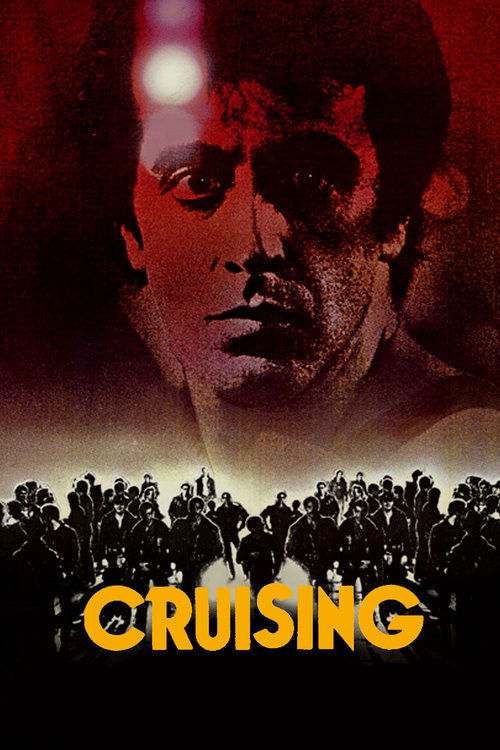
Cruising (1980)
Directed by William Friedkin
No — Cruising is not especially woke, scoring 21 out of 100 on our wokeness meter.
Cruising arrives as a sweaty, leather-bound procedural about an undercover cop in New York's gay S&M bars.
Consciousness Markers
The film is saturated with gay themes and the leather/S&M subculture, but it is the opposite of affirming: gay activists protested it as homophobic and stigmatizing, and Pacino himself later called it exploitative.
The opening disclaimer ('not intended as an indictment of the homosexual world') is a defensive apology rather than a progressive sermon; the film otherwise avoids preaching.
The cast is overwhelmingly white and male, with no meaningful diverse representation; the film's minority presence is incidental at best and largely absent.
Karen Allen's Nancy is a marginal girlfriend figure with no agency or thematic weight; there is no feminist agenda whatsoever.
No engagement with race or racial consciousness; the film operates entirely within a white milieu.
No environmental or climate themes present.
No critique of capitalism or wealth; the film is a police procedural thriller with no economic commentary.
No body positivity themes; the film's physicality is deployed for shock and menace, not affirmation.
The killer is noted to show 'signs of schizophrenia,' but this is used as a stigmatizing marker of monstrosity rather than affirming neurodivergent representation.
Loosely adapted from a novel and inspired by real 1970s murders, but it makes no revisionist historical argument.
Why it received this score
Cruising arrives as a sweaty, leather-bound procedural about an undercover cop in New York's gay S&M bars. It is a film saturated with gay life, but saturation is not affirmation. The community on screen is framed as a pathology to be investigated, and the real-world protests that greeted its production remain the most articulate review. Al Pacino later called it exploitative. That admission carries more weight than any disclaimer. The disclaimer itself is a defensive apology, not a sermon. It asks for exemption, not understanding. So the film's cultural awareness is largely a negative quantity: it notices a subculture only to use it as atmosphere and shock.
The film has no interest in the progressive markers that define our current moment. Its cast is white and male, and Karen Allen's girlfriend is a placeholder who waits at home while the men descend into the underworld. Race does not enter the frame. Neither does climate, economic justice, or body positivity. The body here is a site of menace, restraint, and stabbing. The killer's schizophrenia is invoked as a stamp of monstrosity, which is the opposite of sensitive neurodivergent portraiture. There is no revisionist history, just a loose adaptation of a novel and some 1970s murders used for pulp. The film's only lecture is the opening card, a nervous hedge that admits the material may be taken as an indictment. It is an apology, not a lesson.
What remains is a nasty, ambiguous thriller with genuine craft and almost no social virtue as we now define it. It belongs to a pre-2015 mode of liberal transgression, where exposing a marginalized world could still mean exploiting it. The camera lingers, the leather gleams, and the politics are a mess. The film has aged into a cult object, but cult status is not redemption. It is a document of what a major studio could release when nobody was keeping score. On the scale of modern cultural consciousness, Cruising scores low, and it earns that low score with conviction. It does not want to teach us anything. It wants discomfort, and it succeeds.
Analysis generated by our Consciousness Algorithm


Synopsis
When New York is caught in the grip of a sadistic serial killer who preys on patrons of the city's underground bars, rookie cop Steve Burns infiltrates the gay S&M subculture to try and lure him out of the shadows.
Questions about Cruising
Is Cruising woke?
No — Cruising is not especially woke, scoring 21 out of 100 on our wokeness meter. That earns it a verdict of Based.
Does Cruising have any woke elements?
1 of the 10 markers register at 30 or above, led by LGBTQ+ Themes (35). On LGBTQ+ Themes: The film is saturated with gay themes and the leather/S&M subculture, but it is the opposite of affirming: gay activists protested it as homophobic and stigmatizing, and Pacino himself later called it exploitative.
How does Cruising compare to other 1980 movies?
It ranks #6 of the 37 films from 1980 we've scored; their average is 10. The wokest is Nine to Five (42).
How is the Woke Score calculated?
An AI-assisted process researches the film and its reception, scores it 0–100 on ten markers, then combines those into one 0–100 Woke Score. It measures a specific set of 2020s cultural themes, not film quality.