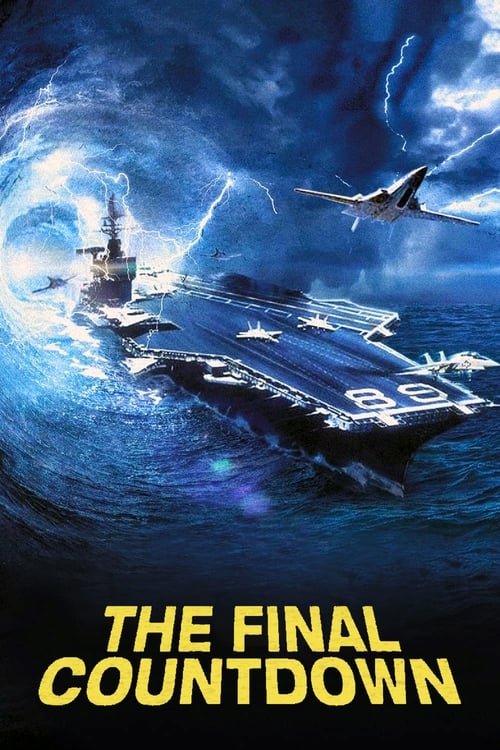
The Final Countdown (1980)
Directed by Don Taylor
No — The Final Countdown is not woke, scoring 2 out of 100 on our wokeness meter.
The Final Countdown arrives from 1980 with the bearing of a film that has no interest in being asked what it means.
Consciousness Markers
The cast includes a Black naval officer and Japanese pilots, but they are presented naturally within the story without any modern inclusive-casting framing or commentary.
No LGBTQ+ characters, themes, or subtext are present.
Katharine Ross has a significant role, but the film contains no feminist agenda or gender-conscious commentary.
The Japanese are depicted as historical combatants in the Pearl Harbor setting, with no racial-consciousness framing or critique.
No environmental or climate-related themes appear.
The defense-contractor angle is plot machinery, not an anti-capitalist or eat-the-rich statement.
No body-positivity themes or messaging are present.
No neurodivergence themes or representation are present.
The time-travel premise toys with changing Pearl Harbor, but the film ultimately preserves the historical timeline and offers no revisionist historical thesis.
The film is a military sci-fi thriller with no social or political lecturing.
Why it received this score
The Final Countdown arrives from 1980 with the bearing of a film that has no interest in being asked what it means. A nuclear carrier, the USS Nimitz, sails into a storm and surfaces in December of 1941, hours before the Japanese fleet strikes Pearl Harbor. Kirk Douglas commands. Martin Sheen observes. Katharine Ross survives a sinking yacht. The picture spends its first hour as a documentary about flight deck operations, which is fortunate, because the story is mostly men staring at radar screens and concluding, repeatedly, that they have traveled through time.
The film declines to lecture. There is a Black commander, Owens, played by Ron O'Neal, and he is simply an officer doing his job, an amateur historian whose knowledge of the coming attack becomes a tactical asset. The Japanese pilots are combatants, not symbols. Ross has real screen time and no speech about her place in the world. A defense contractor's efficiency expert rides along as plot machinery, and nobody proposes that the military-industrial complex be dismantled. The film's one flirtation with altering the historical record resolves into a restoration of the timeline, so the past stays where the audience left it.
This is a picture about hardware and hesitation. The Navy lent its carrier, its jets, and its sailors, and the result plays like a recruitment brochure with a philosophical shrug. Roger Ebert gave it two stars and complained that the story made little sense, which is fair and also beside the point. Nothing here is pressed into service for a message. It is a time-travel thriller that refuses to tell us what to think about time travel, about Pearl Harbor, or about anything else. We are left with the vortex, the aircraft, and the distinct impression that the filmmakers regarded an argument as a failure of nerve.
Analysis generated by our Consciousness Algorithm


Synopsis
During routine manoeuvres near Hawaii in 1980, the aircraft-carrier USS Nimitz is caught in a strange vortex-like storm, throwing the ship back in time to 1941—mere hours before the Japanese attack on Pearl Harbor.
Questions about The Final Countdown
Is The Final Countdown woke?
No — The Final Countdown is not woke, scoring 2 out of 100 on our wokeness meter. That earns it a verdict of Ultra Based.
Does The Final Countdown have any woke elements?
No. All 10 markers score zero.
How does The Final Countdown compare to other 1980 movies?
It ranks #29 of the 37 films from 1980 we've scored; their average is 10. The wokest is Nine to Five (42).
How is the Woke Score calculated?
An AI-assisted process researches the film and its reception, scores it 0–100 on ten markers, then combines those into one 0–100 Woke Score. It measures a specific set of 2020s cultural themes, not film quality.