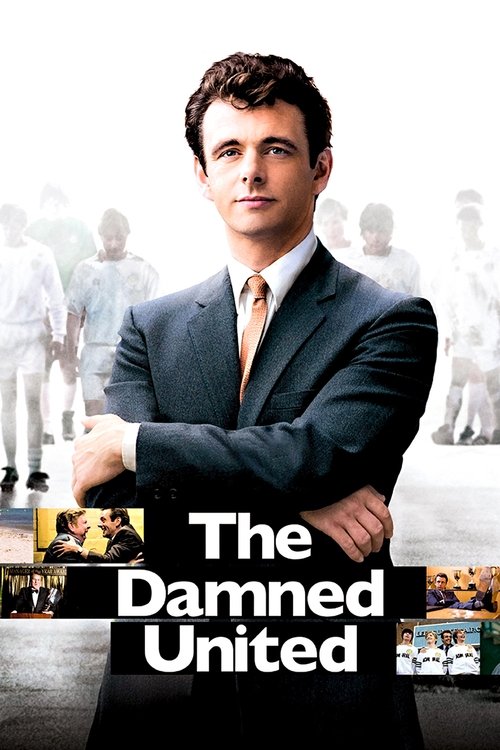
The Damned United (2009)
Directed by Tom Hooper
No — The Damned United is not woke, scoring 0 out of 100 on our wokeness meter.
Tom Hooper's The Damned United concerns Brian Clough's forty-four-day tenure at Leeds United in 1974, and the long, sour friendship with Peter Taylor that preceded and outlasted it.
Consciousness Markers
The cast is overwhelmingly white and male, reflecting the historical 1970s English football milieu without any deliberate diversity casting.
There are no LGBTQ+ characters, themes, or subtext in the film.
The film is a male-dominated sports drama with virtually no feminist perspective or critique.
Race is not a theme; the story takes place in an all-white football context without racial commentary.
There is no environmental or climate-related content.
Conflicts with club chairmen are personal and managerial, not framed as a systemic anti-capitalist critique.
The film does not engage with body positivity or related themes.
Clough's drinking and self-destructive behavior are portrayed as personal flaws, not as neurodivergence.
Although the film contains historical inaccuracies, it does not reinterpret history through a modern progressive social-justice lens.
The film is a character-driven sports drama and does not deliver preachy social or political lectures.
Why it received this score
Tom Hooper's The Damned United concerns Brian Clough's forty-four-day tenure at Leeds United in 1974, and the long, sour friendship with Peter Taylor that preceded and outlasted it. Michael Sheen does the uncanny-impersonation thing he does, all jutted jaw and wounded vanity. The film is adapted from David Peace's novel, itself a fever dream of the period, and the production has taken the wise precaution of being about football instead of about anything else. Reviewing it for contemporary markers is like inspecting a coal cellar for solar panels. The coal is very good coal.
The cast is white, male, and Northern, which is less a casting decision than a description of English football in 1974. The film has no interest in the bodies on screen, the politics of the boardroom, or the inner weather of anyone who is not Brian Clough. His drinking is treated as a flaw of character, never as a condition to be named and accommodated. Where the modern sports picture might locate a lesson, this one locates only grievance. The fights with Sam Longson and the Leeds board are personal and petty, driven by ego, and at no point does anyone suggest the arrangement of capital is the problem. It is a film about a man who wanted to be loved by the right people and was not.
The historical record, meanwhile, has been rearranged with some enthusiasm. Dave Mackay sued and received an apology and damages. Johnny Giles had already sued the book. A journalist who knew Clough personally catalogued seventeen inaccuracies. None of this amounts to revisionism in the contemporary sense, because the errors serve drama and not doctrine, and the film's final verdict arrives in an epilogue: Revie failed abroad, Clough and Taylor won two European Cups. There is no sermon here, no invitation to examine our own complicity in anything. It is a sports picture with a bruised ego at its center, and it goes about its business. The cellar remains a cellar.
Analysis generated by our Consciousness Algorithm


Synopsis
Taking over Leeds United, Brian Clough's abrasive approach and his clear dislike of the players' dirty style of play make it certain there is going to be friction. Glimpses of his earlier career help explain both his hostility to previous manager Don Revie and how much he is missing right-hand man Peter Taylor.
Questions about The Damned United
Is The Damned United woke?
No — The Damned United is not woke, scoring 0 out of 100 on our wokeness meter. That earns it a verdict of Ultra Based.
Does The Damned United have any woke elements?
No. All 10 markers score zero.
How does The Damned United compare to other 2009 movies?
It ranks #208 of the 230 films from 2009 we've scored; their average is 14. The wokest is Home (79).
How is the Woke Score calculated?
An AI-assisted process researches the film and its reception, scores it 0–100 on ten markers, then combines those into one 0–100 Woke Score. It measures a specific set of 2020s cultural themes, not film quality.