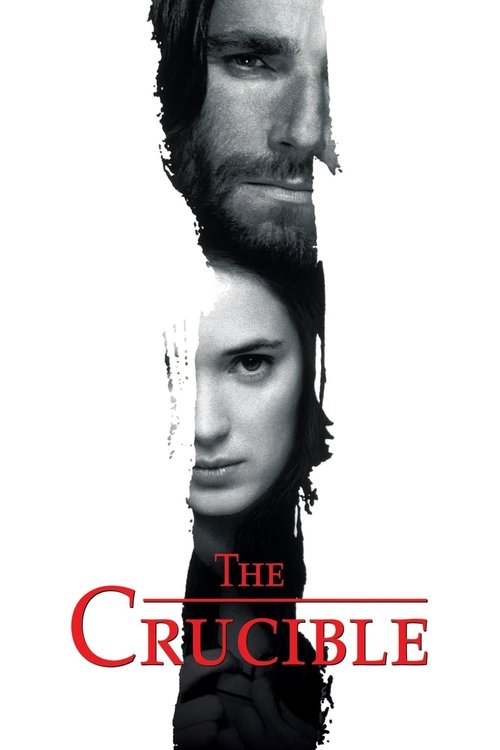
The Crucible (1996)
Directed by Nicholas Hytner
No — The Crucible is not woke, scoring 7 out of 100 on our wokeness meter.
Nicholas Hytner's 1996 screen version of The Crucible arrives with the gravity of a monument and the pacing of a court transcript.
Consciousness Markers
Arthur Miller's allegory carries clear moral lessons about hysteria and false accusation, delivered with theatrical speeches, but it is not a modern social-justice sermon.
Charlayne Woodard appears as Tituba, a historically plausible non-white role, but the cast is otherwise uniformly white and the film makes no modern inclusive-casting statement.
The Putnam land-grab subplot offers a mild critique of property greed, but it is not a modern eat-the-rich manifesto.
No LGBTQ+ characters, themes, or subtext.
Female characters drive the plot as accusers and accused, but the film frames this as hysteria and manipulation, not a feminist agenda.
Tituba is enslaved and scapegoated, but her race is not used to comment on racial justice; it is a natural historical detail.
No climate or environmental themes.
No body-positivity themes.
No neurodivergence themes.
The film takes dramatic liberties with the Salem trials, but not in service of modern ideological revisionism.
Why it received this score
Nicholas Hytner's 1996 screen version of The Crucible arrives with the gravity of a monument and the pacing of a court transcript. Arthur Miller adapted his own 1953 play, itself a glancing blow at the House Un-American Activities Committee, and the film retains the playwright's conviction that a village gone mad is a lesson for all seasons. Daniel Day-Lewis broods as John Proctor, Winona Ryder schemes as Abigail Williams, and Paul Scofield presides as Judge Danforth with the serene menace of a man who has never once doubted himself. It is a handsome production. It is also a deeply earnest one.
On the matter of modern social consciousness, the film is largely innocent. Charlayne Woodard plays Tituba, the enslaved woman who becomes the first convenient scapegoat, and the role is historically sensible without functioning as any kind of casting statement; the rest of Salem is uniformly pale. The girls wield genuine power over the town, yet the film reads their testimony as hysteria and spite, not as commentary on women and authority. The Putnams angle for confiscated land, which offers a faint grumble about property and greed and nothing more. There is no environmental sermon, no body politics, no neurological vocabulary, no reordering of history to suit present tastes.
What remains is the sermonizing, and Miller's allegory delivers it in theatrical bursts. The cry that God is dead lands as a thesis statement, and the closing gallows scene is built to instruct. The lessons concern false accusation, reputation, and cowardice, all durable and none of them especially contemporary. The film means well. It has meant well since 1953. We can respect that without pretending it is anything other than a sturdy, self-important adaptation of a sturdy, self-important play.
Analysis generated by our Consciousness Algorithm


Synopsis
A Salem resident attempts to frame her ex-lover's wife for being a witch in the middle of the 1692 witchcraft trials.
Questions about The Crucible
Is The Crucible woke?
No — The Crucible is not woke, scoring 7 out of 100 on our wokeness meter. That earns it a verdict of Ultra Based.
Does The Crucible have any woke elements?
Very few. None of the 10 markers reaches 30, the level where a marker counts as present; the highest is Lecture Energy at 20.
How does The Crucible compare to other 1996 movies?
It ranks #46 of the 93 films from 1996 we've scored; their average is 11. The wokest is Bound (60).
How is the Woke Score calculated?
An AI-assisted process researches the film and its reception, scores it 0–100 on ten markers, then combines those into one 0–100 Woke Score. It measures a specific set of 2020s cultural themes, not film quality.