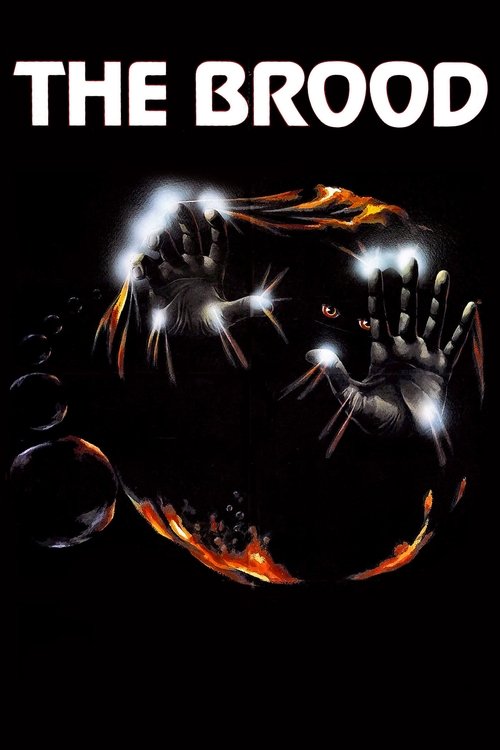
The Brood (1979)
Directed by David Cronenberg
No — The Brood is not woke, scoring 6 out of 100 on our wokeness meter.
The Brood arrives at the tasting table as a 1979 Canadian body horror picture, written and directed by David Cronenberg in the bitter aftermath of his own divorce.
Consciousness Markers
The film centers on a woman's rage, motherhood, and the 'monstrous feminine,' which has drawn feminist scholarly analysis, but it presents feminine power as horrifying rather than advancing any feminist agenda; Robin Wood read it as reactionary.
There is expositional dialogue about psychoplasmics and therapy, but the film aims to disturb rather than to lecture the audience on social issues.
The cast is entirely white, predominantly Canadian actors with no deliberate emphasis on diverse or underrepresented casting. There is no marker of representational intent here.
There are no LGBTQ+ characters, themes, or subtext of any kind in the film.
Race is entirely absent as a theme or concern in the film.
There is no environmental or climate-related content whatsoever.
The film contains no critique of capitalism or wealth; its conflicts are domestic and psychological.
This is a body horror film fixated on the body as a site of deformity, mutation, and revulsion — the precise antithesis of body positivity.
Mental illness appears as a source of horror and monstrosity (the institutionalized Nola, psychoplasmics), not as an affirming depiction of neurodivergent identity.
The film is a fictional horror narrative and makes no revisionist claims about historical events.
Why it received this score
The Brood arrives at the tasting table as a 1979 Canadian body horror picture, written and directed by David Cronenberg in the bitter aftermath of his own divorce. It concerns a man, his institutionalized ex-wife, a psychotherapist with unconventional methods, and a brood of parthenogenetically born dwarf children who bludgeon grandparents and schoolteachers to death with mallets. Cronenberg considered it his most classic horror film, a claim we can accept without reservation, provided we understand classic to mean unpleasant and profitable.
On the matter of contemporary social consciousness, the vintage is thin. The cast is uniformly white, the relationships uniformly heterosexual, and the psychology on offer treats mental illness as a wellspring of monstrosity, not an identity to be affirmed. Race does not appear. Climate does not appear. Capital does not appear. The body is a site of wheals, lesions, external wombs, and other departures from the standard arrangement, which places the film at some distance from the body positivity movement. Nobody lectures us about anything. The creatures simply arrive, and people die.
What scholarship has found here, and it has looked hard, is a woman's rage, motherhood, and the monstrous feminine. Barbara Creed reads Nola's births as a demonstration of the horrors of unbridled maternal power. Robin Wood read the whole affair as reactionary. Carrie Rickey defended it on the grounds that the women are not bad, merely drawn that way by male scientists. We note the debate and record it as a faint trace of feminist interest, present in the criticism more than in the text. The dialogue does spend some minutes explaining psychoplasmics, but it explains a fictional therapy, not a social grievance. We score accordingly, and we move on to the next bottle.
Analysis generated by our Consciousness Algorithm


Synopsis
A man tries to uncover an unconventional psychologist's therapy techniques on his institutionalised wife, amidst a series of brutal murders.
Questions about The Brood
Is The Brood woke?
No — The Brood is not woke, scoring 6 out of 100 on our wokeness meter. That earns it a verdict of Ultra Based.
Does The Brood have any woke elements?
Very few. None of the 10 markers reaches 30, the level where a marker counts as present; the highest is Feminist Agenda at 10.
How does The Brood compare to other 1979 movies?
It ranks #15 of the 33 films from 1979 we've scored; their average is 6. The wokest is Hair (30).
How is the Woke Score calculated?
An AI-assisted process researches the film and its reception, scores it 0–100 on ten markers, then combines those into one 0–100 Woke Score. It measures a specific set of 2020s cultural themes, not film quality.