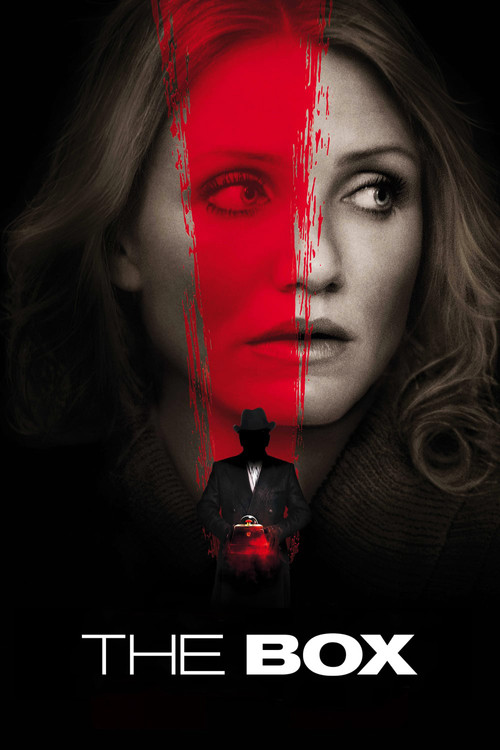
The Box (2009)
Directed by Richard Kelly
No — The Box is not woke, scoring 9 out of 100 on our wokeness meter.
The Box arrives in 2009 with Richard Kelly at the wheel, Cameron Diaz and James Marsden in the front seat, and Frank Langella's ruined face peering through the windshield.
Consciousness Markers
The film gestures at Sartre, moral philosophy, and humanity's 'worthiness of extinction,' giving it a modest sermonizing streak, though it remains a suspense-driven thriller rather than an explicit lecture.
The premise turns on the corrupting pull of a $1 million payout for a stranger's death, offering a faint indictment of greed and transactional morality, but it is a personal-ethics parable rather than a systemic anti-capitalist critique.
Norma is a co-lead with agency who makes the fateful choice and reflects on her own disfigurement, but the film advances no feminist thesis; she is ultimately sacrificed by the plot.
Both Norma's disfigured foot and Steward's burned face are treated with some dignity — she reveals her foot during a class discussion — but disfigurement is chiefly deployed as eerie plot texture rather than body-acceptance messaging.
The cast is entirely white with no deliberate diversity casting; the leads (Diaz, Marsden, Langella) are conventional star vehicles with no representation-driven intent.
No LGBTQ+ characters, relationships, or themes appear anywhere in the film.
Race is entirely absent as a subject; the suburban Virginia setting and cast are uniformly white with no racial commentary.
No environmental or climate themes are present in this morality-play science fiction.
No neurodivergent characters or themes are present; the psychological exam failure is a plot point, not a depiction of neurodivergence.
The 1976 setting is nostalgic period detail rather than a revisionist re-reading of history; no historical narrative is contested or reinterpreted.
Why it received this score
The Box arrives in 2009 with Richard Kelly at the wheel, Cameron Diaz and James Marsden in the front seat, and Frank Langella's ruined face peering through the windshield. A wooden box, a glass dome, a button, one million dollars, and a stranger's death somewhere unspecified. It is a morality play dressed as a thriller, and it wants us to know it is a morality play. Kelly, who previously gave us a rabbit and a jet engine, works familiar ground here: suburbia, conspiracy, and the queasy suspicion that someone upstairs is keeping score.
The cultural ledger, when we run it, comes back mostly blank. The cast is white, the setting is 1976 suburban Virginia, and nothing in the film asks us to think about race, sexuality, or the climate. There is no representation agenda, no LGBTQ presence, no neurodivergent character, and no attempt to reread history. What flickers, faintly, are other things. Norma Lewis teaches Sartre to a private school class and later bares her disfigured foot before them, a moment of quiet dignity the film handles without mockery. Langella's burns are treated as texture, not carnival. The million-dollar payoff carries a soft rebuke of greed, though the film cares about personal ethics, not systems. And the talk of humanity's worthiness of extinction gives the enterprise a mild sermonizing hum.
None of this amounts to a program. The film is a puzzle box, not a pamphlet, and its most sustained commitment is to its own gloom. What we are left with is a sincere, overstuffed curiosity that flatters the viewer for enduring it. Grade the doctrine and the ledger is nearly empty. Grade the ambition and there is something here, still faintly humming, like a struck bell nobody bothered to answer.
Analysis generated by our Consciousness Algorithm


Synopsis
Norma and Arthur Lewis, a suburban couple with a young child, receive a simple wooden box as a gift, which bears fatal and irrevocable consequences. A mysterious stranger delivers the message that the box promises to bestow upon its owner $1 million with the press of a button. However pressing this button will simultaneously cause the death of another human being somewhere in the world; someone they don't know. With just 24 hours to have the box in their possession, Norma and Arthur find themselves in the cross-hairs of a startling moral dilemma and must face the true nature of their humanity.
Questions about The Box
Is The Box woke?
No — The Box is not woke, scoring 9 out of 100 on our wokeness meter. That earns it a verdict of Ultra Based.
Does The Box have any woke elements?
Very few. None of the 10 markers reaches 30, the level where a marker counts as present; the highest is Lecture Energy at 22.
How does The Box compare to other 2009 movies?
It ranks #111 of the 230 films from 2009 we've scored; their average is 14. The wokest is Home (79).
How is the Woke Score calculated?
An AI-assisted process researches the film and its reception, scores it 0–100 on ten markers, then combines those into one 0–100 Woke Score. It measures a specific set of 2020s cultural themes, not film quality.