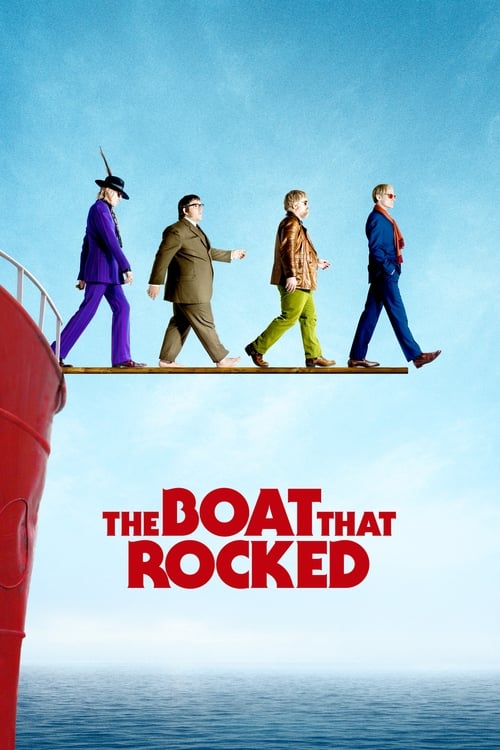
The Boat That Rocked (2009)
Directed by Richard Curtis
No — The Boat That Rocked is not woke, scoring 6 out of 100 on our wokeness meter.
Richard Curtis, a man who has made a handsome career out of mistaking geniality for insight, here turns his attention to the pirate radio ships of 1966.
Consciousness Markers
The ensemble is overwhelmingly white, male, and British, with women relegated to groupie, mother, or romantic-interest roles; there is no meaningful casting diversity.
The freedom-of-rock-versus-the-stuffy-state theme is present but delivered as genial period romp rather than sermon; critics noted Curtis 'has nothing really to say.'
A single fleeting background note identifies Olivia Llewellyn's Margaret as 'Felicity's love interest,' but no LGBTQ+ theme is developed or acknowledged on screen.
Women exist as objects of pursuit, groupies, or prizes — Elenore marries Simon only to be near Gavin, and the crew cheerfully broadcasts Carl's coupling with Marianne to the nation. The film's ethos is thoroughly laddish.
The government's stated objections to pirate radio are commercialism and immorality, meaning the film actually defends commercial broadcasting against a censorious state; only a diffuse anti-authority streak is present.
The cast and story are entirely white and the film engages with no racial themes whatsoever.
No environmental or climate content of any kind.
Women are presented decoratively (including a cut sequence of thirty naked fans), the opposite of body-positive messaging.
The reclusive 'Smooth' Bob is played for eccentric comedy, not framed through any neurodivergence lens.
The film is openly a work of historical fiction inspired by 1960s pirate radio, not a revisionist re-reading of history in the contemporary sense.
Why it received this score
Richard Curtis, a man who has made a handsome career out of mistaking geniality for insight, here turns his attention to the pirate radio ships of 1966. The resulting vessel is crewed by an ensemble of British character actors doing their practiced business, and it sails on a tide of jukebox standards toward a climax borrowed from a more famous maritime disaster. The picture was a commercial disappointment at home and was cut by twenty minutes for American audiences, which tells us something about the ruthlessness of distributors and rather less about the film itself.
The cultural inventory aboard is thin. The crew is white, male, and loudly heterosexual, and the women who drift through the frame are groupies, mothers, or prizes to be won and broadcast about. A single name in the supporting cast list gestures toward a same-sex attachment, and the film does nothing with it. The government men who oppose the station are censorious prudes, not capitalists, so the picture's rebellious streak amounts to a fondness for loud music and unmarried men. Nobody lectures us. Curtis has never been a preacher; he is a host, and hosts do not scold their guests.
We are left with a shaggy, amiable thing that wants to be loved and mostly succeeds at being tolerated. The jokes land softly, the soundtrack does the heavy lifting, and the politics extend no further than a raised eyebrow at the establishment. It is a period romp with a period romp's conscience, which is to say none worth measuring. Charming, weightless, and entirely of its moment, though not in the way its makers intended. The needle drops and the ship sinks, and we are no wiser about anything.
Analysis generated by our Consciousness Algorithm
Part of


Synopsis
When a group of rebellious deejays decides to defy the ban on government-censored music, they take to the seas to broadcast music and mayhem to millions of adoring fans.
Questions about The Boat That Rocked
Is The Boat That Rocked woke?
No — The Boat That Rocked is not woke, scoring 6 out of 100 on our wokeness meter. That earns it a verdict of Ultra Based.
Does The Boat That Rocked have any woke elements?
Very few. None of the 10 markers reaches 30, the level where a marker counts as present; the highest is Representation Casting at 12.
How does The Boat That Rocked compare to other 2009 movies?
It ranks #144 of the 230 films from 2009 we've scored; their average is 14. The wokest is Home (79).
How is the Woke Score calculated?
An AI-assisted process researches the film and its reception, scores it 0–100 on ten markers, then combines those into one 0–100 Woke Score. It measures a specific set of 2020s cultural themes, not film quality.