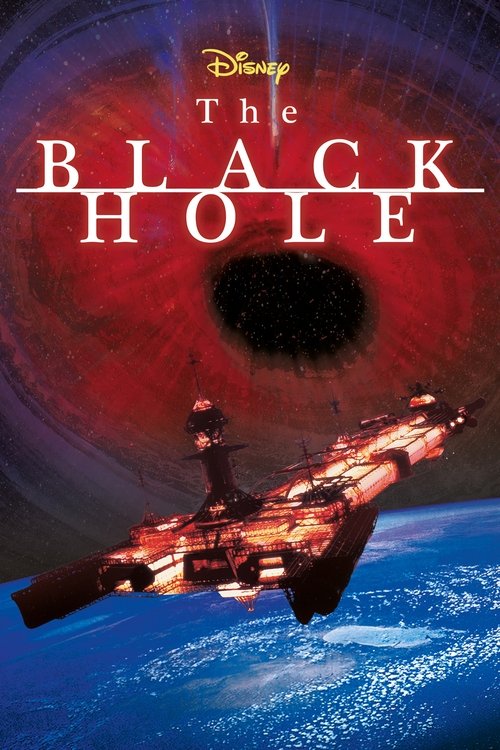
The Black Hole (1979)
Directed by Gary Nelson
No — The Black Hole is not woke, scoring 3 out of 100 on our wokeness meter.
Disney's most expensive picture of 1979 arrives with the grim determination of a studio attempting to purchase gravity itself.
Consciousness Markers
Dr. Kate McCrae is a competent female scientist with ESP, but she is largely a damsel who must be rescued and the film makes no feminist argument. The casting drama (Sigourney Weaver rejected, Jennifer O'Neill forced to cut her hair) reflects the era's industry norms rather than any agenda.
The entire principal cast is white (Schell, Perkins, Forster, Bottoms, Mimieux, Borgnine) with no non-white characters or conscious diversity casting. Race is entirely absent from the film's construction.
No LGBTQ+ characters, relationships, or subtext of any kind appear in the film.
The film engages no racial themes or commentary whatsoever.
No environmental or climate themes; the black hole is a physics and metaphysics device, not an ecological allegory.
Reinhardt is a megalomaniacal mad scientist, not a capitalist villain; there is no critique of wealth, greed, or economic systems.
No body-positivity themes present; the lobotomized drones are horror imagery, not representation.
No neurodivergence themes or characters; ESP is treated as a sci-fi ability, not a neurodivergent identity.
The film is set in a fictional 2130 and makes no historical claims to revise.
The film has metaphysical and religious imagery (the angelic figure, the hellish landscape) but delivers no moralizing lecture to the audience.
Why it received this score
Disney's most expensive picture of 1979 arrives with the grim determination of a studio attempting to purchase gravity itself. The Black Hole concerns the USS Palomino, a crew of white men, one white woman, a journalist, and a chirpy robot, all of whom stumble upon the long-lost Cygnus and its master, Dr. Hans Reinhardt. What follows is a haunted-house picture in vacuum-sealed packaging: lobotomized crew members, a silent red robot named Maximilian, and a climax that detours into a burning hellscape and a crystal cathedral. The film's ambitions are metaphysical, not social. It has no interest in the world it left behind, which spares us the customary sermonizing.
The cast is uniformly white and the film never once notices. Race does not enter the frame, nor does sexuality, nor class, nor the climate. Reinhardt is a mad scientist, not a plutocrat, so there is no economic critique to be extracted from his drones. The lobotomized crew is horror imagery, not a metaphor for anything we are meant to applaud. Dr. Kate McCrae holds a doctorate and possesses extrasensory perception, which is more than most of her contemporaries were permitted, yet the screenplay promptly reduces her to cargo: she is nearly lobotomized, then rescued, then escorted to the probe ship. Her competence is set dressing. The production history offers its own small tragedy, with Sigourney Weaver passed over because a casting director disliked her name, and Jennifer O'Neill losing the part after a haircut, a glass of wine, and a car.
What remains is craft. The matte paintings, the ACES camera system, the digitally recorded John Barry score, and an overture, which is the most old-fashioned thing here. The film was nominated for two Academy Awards and won neither. It is a beautiful, humorless, strangely solemn vessel drifting toward nothing in particular, and it asks nothing of us but awe. That is not a small thing. It is merely a quiet one.
Analysis generated by our Consciousness Algorithm
Part of


Synopsis
The explorer craft USS Palomino is returning to Earth after a fruitless 18-month search for extra-terrestrial life when the crew comes upon a supposedly lost ship, the USS Cygnus, hovering near a black hole. The ship is controlled by Dr. Hans Reinhardt and his monstrous robot companion, but the initial wonderment and awe the Palomino crew feel for the ship and its resistance to the power of the black hole turn to horror as they uncover Reinhardt's plans.
Questions about The Black Hole
Is The Black Hole woke?
No — The Black Hole is not woke, scoring 3 out of 100 on our wokeness meter. That earns it a verdict of Ultra Based.
Does The Black Hole have any woke elements?
Very few. None of the 10 markers reaches 30, the level where a marker counts as present; the highest is Feminist Agenda at 5.
How does The Black Hole compare to other 1979 movies?
It ranks #22 of the 33 films from 1979 we've scored; their average is 6. The wokest is Hair (30).
How is the Woke Score calculated?
An AI-assisted process researches the film and its reception, scores it 0–100 on ten markers, then combines those into one 0–100 Woke Score. It measures a specific set of 2020s cultural themes, not film quality.