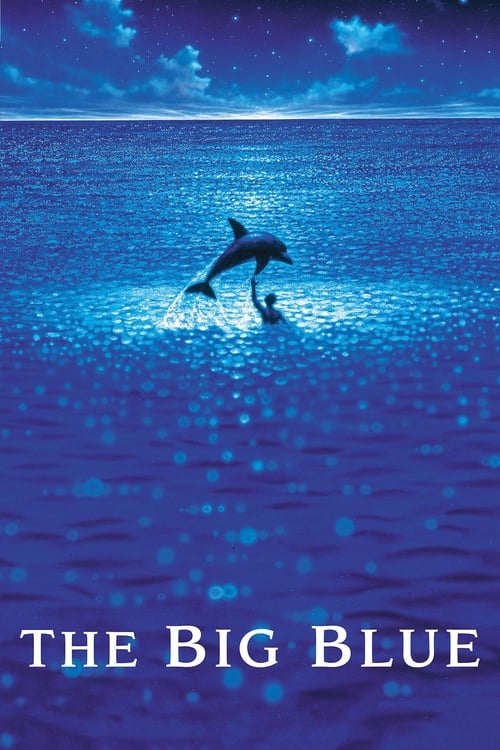
The Big Blue (1988)
Directed by Luc Besson
No — The Big Blue is not woke, scoring 4 out of 100 on our wokeness meter.
The Big Blue arrives from 1988 with a reputation for beauty and a runtime that has outlasted several of its admirers.
Consciousness Markers
Johana is given some interiority and a career, but she is ultimately defined by her devotion to Jacques and her role as the woman who must let him go; the film's gaze is squarely on male rivalry and obsession.
The cast is almost entirely white European and American performers, with no deliberate effort toward diverse or inclusive casting; the international mix reflects production logistics rather than any representational agenda.
The film is languid, introspective, and lyrical rather than preachy; it offers no explicit moral instruction to the audience.
There are no LGBTQ+ characters, themes, or subtext anywhere in the film.
Race is entirely absent as a theme; the story concerns white European divers and their personal obsessions.
The ocean is a mystical and personal realm, not a site of environmental advocacy; the dolphin-liberation scene is animal-welfare sentiment, not a climate crusade.
The film has no economic or class critique; commerce appears only incidentally through Johana's insurance job.
There is no body-positivity messaging; the film idealizes a hyper-fit athletic physique without commentary.
Jacques is portrayed as otherworldly and dolphin-like, but this is mystical romanticism rather than any depiction of neurodivergence.
The film heavily fictionalizes the real divers Mayol and Maiorca, but this is dramatic license in a romance, not the modern reframing of history through a social-justice lens.
Why it received this score
The Big Blue arrives from 1988 with a reputation for beauty and a runtime that has outlasted several of its admirers. Luc Besson's study of two free divers, Jacques and Enzo, is a Cinema du look artifact: blue water, blue moods, Eric Serra's synthesizers sighing over both. The cast is European and American and entirely white, assembled by availability and the Atlantic rather than by any representational ambition. Race does not figure. Neither does class, labor, or the climate, though the ocean fills nearly every frame. The sea here is a private mysticism, a place where a man's heartbeat slows to match a dolphin's, not a battleground for policy.
The film's one woman, Johana, is played by Rosanna Arquette with a career and an interior life that the screenplay steadily strips away. She is an insurance broker who lies to chase a man across an ocean, gets fired for it, then devotes herself to waiting for him to choose her over the water. She is handed the final act's hardest task, releasing the cord that sends him down, and the camera stays with his descent. The gaze rests on male rivalry and male oblivion. A nighttime raid to free a homesick dolphin offers animal-welfare sentiment, not environmental argument. The bodies on display are athletic and ideal, presented without editorial comment of any kind. Nobody lectures. Nobody explains.
What the film does with its real-life sources is pure romantic license. Jacques Mayol and Enzo Maiorca were contemporaries who never competed directly, never touched four hundred feet, and did not die in the manner shown. Besson dramatizes freely, and the result is melodrama, not historical argument. There is no social thesis tucked beneath the surface, no instruction for the audience, no reforming impulse. It is a long, gorgeous, damp mood piece about men who prefer depth to company. We classify it without enthusiasm and without objection. The water wins.
Analysis generated by our Consciousness Algorithm


Synopsis
Childhood friends Jacques and Enzo share a passion for the danger of free diving. Jacques, following in the footsteps of his father, who died at sea when Jacques was a boy, harbors a remarkable ability to adjust his heart rate and breathing patterns in the water, with his vital signs more closely resembling those of dolphins than men.
Questions about The Big Blue
Is The Big Blue woke?
No — The Big Blue is not woke, scoring 4 out of 100 on our wokeness meter. That earns it a verdict of Ultra Based.
Does The Big Blue have any woke elements?
Very few. None of the 10 markers reaches 30, the level where a marker counts as present; the highest is Feminist Agenda at 8.
How does The Big Blue compare to other 1988 movies?
It ranks #41 of the 73 films from 1988 we've scored; their average is 10. The wokest is Stand and Deliver (58).
How is the Woke Score calculated?
An AI-assisted process researches the film and its reception, scores it 0–100 on ten markers, then combines those into one 0–100 Woke Score. It measures a specific set of 2020s cultural themes, not film quality.