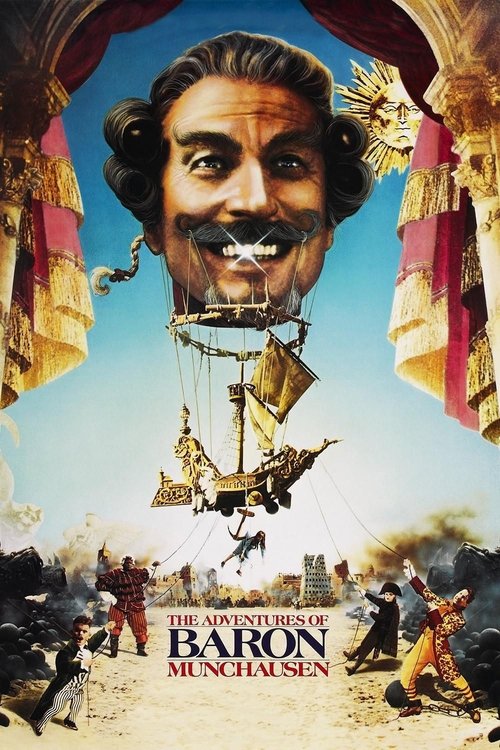
The Adventures of Baron Munchausen (1988)
Directed by Terry Gilliam
No — The Adventures of Baron Munchausen is not woke, scoring 0 out of 100 on our wokeness meter.
Terry Gilliam's 1988 fantasia opens in a nameless walled city under Ottoman siege, where the local magistrate, styling himself The Right Ordinary Horatio Jackson, has just executed a soldier for the crime of performing an act of conspicuous bravery.
Consciousness Markers
The cast is a standard late-1980s British/European ensemble; no modern diversity casting agenda is present.
No LGBTQ+ characters, themes, or subtext.
Female characters exist, including Sally and Venus, but the film advances no feminist agenda.
No engagement with race or racial politics.
No environmental or climate themes.
Satirizes militarism, bureaucracy, and the Age of Reason, not capitalism or wealth inequality.
No body-positivity themes.
The King of the Moon's split mind and body is surreal fantasy, not neurodivergence representation.
Based on tall tales, not a revisionist historical narrative.
The film's themes about imagination versus reason are playful and fantastical, not preachy modern lecture.
Why it received this score
Terry Gilliam's 1988 fantasia opens in a nameless walled city under Ottoman siege, where the local magistrate, styling himself The Right Ordinary Horatio Jackson, has just executed a soldier for the crime of performing an act of conspicuous bravery. The film's target is the Age of Reason itself: the tyranny of the sensible, the accountant's view of heroism. It is the third panel of Gilliam's Trilogy of Imagination, and it argues that a well-told lie is a form of survival. None of this constitutes a social program. The villain is a bureaucrat, not a landlord, and the film's contempt is reserved for rationalism, not for private property.
Then comes the tour of the absurd: a balloon stitched from women's undergarments, a voyage to the Moon, a king with two minds in one body, Vulcan's volcanic workshop, Venus waltzing in the air, a sea monster expelling the cast through its blowhole. Robin Williams appears as the lunar monarch under a pseudonym, and the production itself became a cautionary tale of studio politics and a budget that doubled. Sarah Polley, nine years old during the shoot, has since described conditions that no contemporary set would tolerate. The film's women exist as romantic memory or as pluck, and no argument is made about it. The surrealism is not a delivery system for a message about how we should live now. It is a delivery system for spectacle.
We are left with a picture that scores nothing on any contemporary index of social consciousness. No casting agenda, no identity themes, no climate anxiety, no anti-capitalist sermon, no body politics, no neurodivergent reading of the King of the Moon, no revised history, no lecture. It was nominated for four Academy Awards and won none, and it lost millions. Its moral concerns imagination, which is a moral about art, not about society at large. The film asks whether the city was saved by a story. It does not ask who was excluded from the city. On the current scale, that silence reads as a perfect zero.
Analysis generated by our Consciousness Algorithm


Synopsis
An account of Baron Munchausen's supposed travels and fantastical experiences with his band of misfits.
Questions about The Adventures of Baron Munchausen
Is The Adventures of Baron Munchausen woke?
No — The Adventures of Baron Munchausen is not woke, scoring 0 out of 100 on our wokeness meter. That earns it a verdict of Ultra Based.
Does The Adventures of Baron Munchausen have any woke elements?
No. All 10 markers score zero.
How does The Adventures of Baron Munchausen compare to other 1988 movies?
It ranks #59 of the 73 films from 1988 we've scored; their average is 10. The wokest is Stand and Deliver (58).
How is the Woke Score calculated?
An AI-assisted process researches the film and its reception, scores it 0–100 on ten markers, then combines those into one 0–100 Woke Score. It measures a specific set of 2020s cultural themes, not film quality.