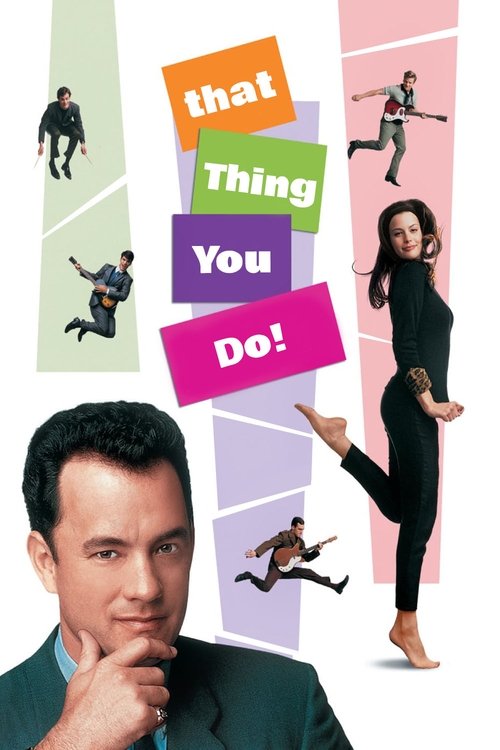
That Thing You Do! (1996)
Directed by Tom Hanks
No — That Thing You Do! is not woke, scoring 12 out of 100 on our wokeness meter.
Tom Hanks made his directing debut with a small, warm film about a Pennsylvania bar band that stumbles into a hit in 1964 and stumbles back out again.
Consciousness Markers
The film mildly critiques the music industry's star-making machinery, contracts, and label control over artists, but it is a showbiz cautionary tale rather than a systemic anti-capitalist statement.
The cast is overwhelmingly white and the lone Black supporting player exists naturally in the story without any representational commentary; no deliberate diversity casting agenda is present.
The theatrical cut contains no LGBTQ+ themes or characters; a deleted-scene implication about Mr. White does not count for the released film.
Faye is largely a supportive girlfriend and wardrobe helper, and the film offers no feminist critique or female-empowerment framing.
The film has no racial themes, commentary, or consciousness; it is a white 1960s rock-band nostalgia piece.
There is no environmental or climate-related content whatsoever.
No body-positivity themes or messaging are present.
No neurodivergence themes or characters are present.
The film is a fictional period piece set in the 1960s and does not revise or reinterpret historical events.
The film is deliberately light and breezy, with no preachy or lecture-like energy; critics noted it lacks deep meanings.
Why it received this score
Tom Hanks made his directing debut with a small, warm film about a Pennsylvania bar band that stumbles into a hit in 1964 and stumbles back out again. The Wonders are four young men, a girlfriend who handles their stage clothes, and a song that will not leave the radio. Nothing in the picture is angry. Nothing in it is trying to teach us anything, which is precisely the quality that made reviewers reach for the word inconsequential and mean it as a compliment.
Where the film permits itself a sliver of social critique, it concerns the machinery of the music business. Mr. White, the Play-Tone representative with the reassuring smile, renames the band, dresses it, books it, and eventually hands it material the label has already approved. Jimmy, the songwriter, quits rather than record someone else's tune. That is a cautionary tale about contracts and corporate control, delivered with a shrug. It stops short of systemic indictment. The label is not the villain; it is merely the weather. The film proposes no alternative economy, and the epilogue hands Jimmy a successful career anyway.
The rest of the ledger is bare. The cast is white, the lone Black supporting player drifts through without comment, and the film asks nothing of him. Faye exists to fold shirts and absorb Jimmy's temper, and no feminist framing rescues her from that function. There is no environmental content, no body politics, no neurodivergent character, no reinterpretation of the 1960s, and no lecture. A deleted scene implies something about Mr. White's private life, but a deleted scene is not the film. The film leaves us with a pleasant period piece about luck, timing, and the brevity of fame. It has no agenda to advance. It has a song, and the song is good.
Analysis generated by our Consciousness Algorithm


Synopsis
A Pennsylvania band scores a hit in 1964 and rides the star-making machinery as long as it can, with lots of help from its manager. But behind the scenes, the group’s sudden fame tests their strength, their maturity and responsibility, and their ability to resist the temptations that money and notoriety always make possible.
Questions about That Thing You Do!
Is That Thing You Do! woke?
No — That Thing You Do! is not woke, scoring 12 out of 100 on our wokeness meter. That earns it a verdict of Ultra Based.
Does That Thing You Do! have any woke elements?
Very few. None of the 10 markers reaches 30, the level where a marker counts as present; the highest is Eat the Rich at 20.
How does That Thing You Do! compare to other 1996 movies?
It ranks #31 of the 93 films from 1996 we've scored; their average is 11. The wokest is Bound (60).
How is the Woke Score calculated?
An AI-assisted process researches the film and its reception, scores it 0–100 on ten markers, then combines those into one 0–100 Woke Score. It measures a specific set of 2020s cultural themes, not film quality.