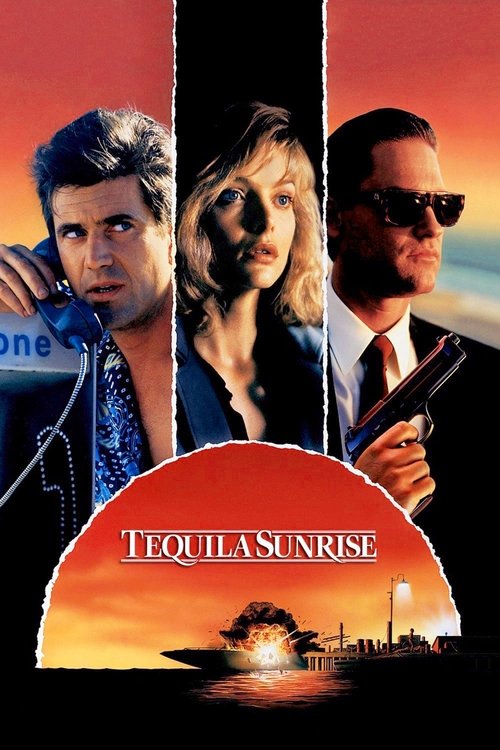
Tequila Sunrise (1988)
Directed by Robert Towne
No — Tequila Sunrise is not woke, scoring 4 out of 100 on our wokeness meter.
Robert Towne wrote and directed this 1988 romantic crime picture, and it arrives with the pedigree of a man who once penned Chinatown.
Consciousness Markers
The cast includes Raúl Juliá and a handful of Latino actors in drug-trade roles, but this is standard genre casting for a 1988 crime film rather than any deliberate diversity initiative.
Michelle Pfeiffer's Jo Ann is a self-possessed restaurateur with some professional agency, but she functions primarily as the woman caught between two men in a conventional love triangle.
Mexican cartel figures and DEA agents populate the plot, but the film engages no racial themes or commentary; the Latino characters are stock drug-lord antagonists.
The film is a slick, tangled crime romance that never pauses to deliver social or political sermons.
No LGBTQ+ characters, themes, or subtext appear anywhere in the film.
No environmental or climate themes are present.
The drug trade is treated as a crime-thriller backdrop, not as a critique of wealth or capitalism.
No body-positivity themes or messaging.
No neurodivergent characters or themes.
The film is a contemporary fictional crime story with no historical revisionism.
Why it received this score
Robert Towne wrote and directed this 1988 romantic crime picture, and it arrives with the pedigree of a man who once penned Chinatown. What we get is a California noir about a retired drug dealer, his detective best friend, and the restaurateur lodged between them like an olive in a very expensive martini. The plot is dense enough to require a diagram. Three attractive people orbit one another for two hours, a Mexican kingpin named Carlos lurks offscreen, and everyone speaks in the clipped, knowing tones of people who have read the screenplay and found it pleasing. It looks immaculate. Conrad Hall shot it, and the Academy noticed, though it lost. The film itself was nominated and won nothing.
On the matter of social consciousness, the ledger is thin. Raul Julia and a scattering of Latino performers fill the cartel roles, which is the standard furniture of the era's drug thrillers, not a statement of any kind. Michelle Pfeiffer's Jo Ann runs her own restaurant and carries herself with a chilly competence that the camera admires, but she exists to be fought over, and the fighting is the point. Race is present as casting texture and nothing more. No ecology, no class grievance, no bodies to be celebrated, no minds to be understood, no history to be corrected. The movie wants to be Casablanca for the cocaine decade, and it says so in its own advertising.
What saves it from sermonizing is that it has no sermon. It is a tangled, glossy romance that never once stops to instruct us on how to live. That restraint now reads as almost archaic. We are left with three movie stars, a hot tub, and a boat that explodes with millions aboard. The cocktail has little kick, as one contemporary critic observed, but it goes down smoothly and asks nothing of the conscience. A modest vintage. Not a challenging one.
Analysis generated by our Consciousness Algorithm
Part of


Synopsis
In a seaside California town, best friends Mac and Nick are on opposite sides of the law. Mac is a former drug dealer trying to clean up his act, while Nick is a high-profile detective trying to take down a Mexican drug lord named Carlos. Soon Nick's loyalties are put to the test when he begins an affair with restaurateur Jo Ann -- a love interest of Mac's -- unwittingly leading his friend into a police-orchestrated trap.
Questions about Tequila Sunrise
Is Tequila Sunrise woke?
No — Tequila Sunrise is not woke, scoring 4 out of 100 on our wokeness meter. That earns it a verdict of Ultra Based.
Does Tequila Sunrise have any woke elements?
Very few. None of the 10 markers reaches 30, the level where a marker counts as present; the highest is Representation Casting at 12.
How does Tequila Sunrise compare to other 1988 movies?
It ranks #41 of the 73 films from 1988 we've scored; their average is 10. The wokest is Stand and Deliver (58).
How is the Woke Score calculated?
An AI-assisted process researches the film and its reception, scores it 0–100 on ten markers, then combines those into one 0–100 Woke Score. It measures a specific set of 2020s cultural themes, not film quality.