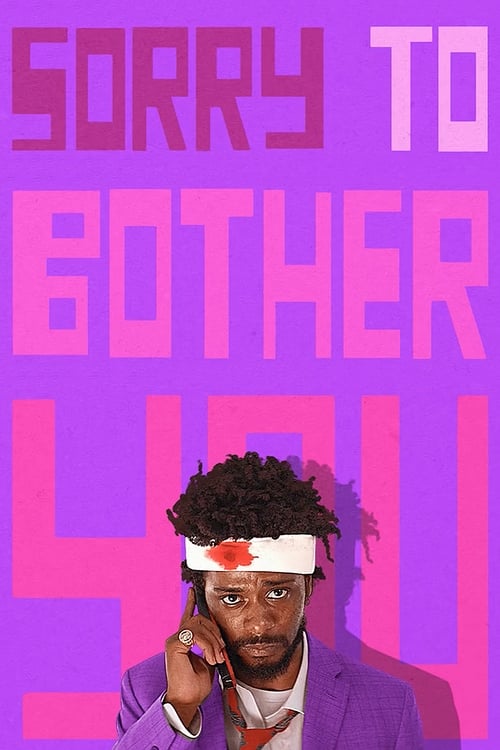
Sorry to Bother You (2018)
Directed by Boots Riley
Yes — Sorry to Bother You is very woke, scoring 90 out of 100 on our wokeness meter.
Boots Riley's directorial debut arrives with the confidence of a man who has been holding a grudge for a decade and has finally found a microphone.
Consciousness Markers
The entire plot is built around code-switching, the 'white voice,' corporate exploitation of Black labor, and race relations in a dystopian Oakland.
Explicitly a radical class analysis of capitalism: unionization, WorryFree slave labor, corporate greed, and the Equisapien conspiracy.
The film centers a Black protagonist and a predominantly Black ensemble, with a Black writer-director, making representation integral rather than incidental.
The film wears its anti-capitalist and racial critique on its sleeve, delivering its message through satirical but unmistakable political argument.
Tessa Thompson's Detroit is a politically active artist with agency, but the film's critique is primarily racial and economic rather than feminist.
No LGBTQ+ characters, relationships, or themes are present.
No environmental or climate-related themes are present.
No body-positivity themes or messaging are present.
No neurodivergence themes or characters are present.
No historical revisionism; the film is an absurdist alternate-present satire.
Why it received this score
Boots Riley's directorial debut arrives with the confidence of a man who has been holding a grudge for a decade and has finally found a microphone. LaKeith Stanfield plays Cassius Green, an Oakland telemarketer who discovers that a "white voice" unlocks the door to professional advancement, and the film tracks his ascent through a corporate hierarchy built on arms dealing and something adjacent to slavery. The ensemble is Black by design, not by accident, and the film's racial argument is inseparable from its plot. Code-switching is not a subplot here. It is the engine.
Where the picture truly plants its flag is in its economic sermonizing. Riley has described the project as a radical class analysis of capitalism, and the film never lets us forget it. WorryFree offers lifetime contracts that are slavery with better branding. The union drive, the picket line, the Equisapien conspiracy, all of it builds toward a single argument about labor and ownership. The messaging is loud enough to be heard from the back row. Subtlety was never invited to the party.
Tessa Thompson's Detroit is a politically engaged artist with genuine agency, though the film's lens stays fixed on race and class, leaving gender as a side concern. The absurdist flourishes, including the horse-human hybrids that arrive in the final act, are audacious and occasionally ungainly. The film is a mess in places, and a committed one. It lectures, it hectors, and it means every word. We have seen many films that want to change the world. This one wants to organize it.
Analysis generated by our Consciousness Algorithm


Synopsis
In an alternate present-day version of Oakland, black telemarketer Cassius Green discovers a magical key to professional success – which propels him into a macabre universe.
Questions about Sorry to Bother You
Is Sorry to Bother You woke?
Yes — Sorry to Bother You is very woke, scoring 90 out of 100 on our wokeness meter. That earns it a verdict of Peak Woke.
What makes Sorry to Bother You woke?
4 of the 10 markers register at 30 or above, led by Eat the Rich (95), Racial Consciousness (95) and Lecture Energy (80). On Eat the Rich: Explicitly a radical class analysis of capitalism: unionization, WorryFree slave labor, corporate greed, and the Equisapien conspiracy.
How does Sorry to Bother You compare to other 2018 movies?
It ranks #2 of the 325 films from 2018 we've scored; their average is 20. The wokest is Return (92).
How is the Woke Score calculated?
An AI-assisted process researches the film and its reception, scores it 0–100 on ten markers, then combines those into one 0–100 Woke Score. It measures a specific set of 2020s cultural themes, not film quality.