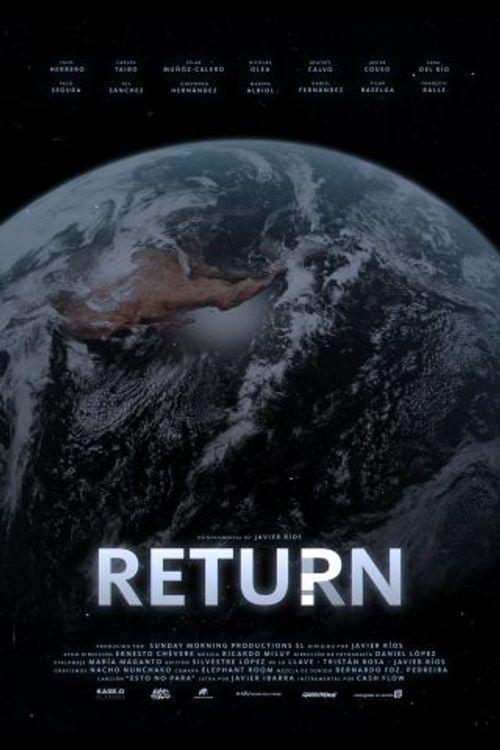
Return (2018)
Directed by Javier Ríos
Yes — Return is very woke, scoring 92 out of 100 on our wokeness meter.
Return, a 2018 documentary from Javier Ríos, arrives with a thesis tucked under its arm and a PowerPoint in its heart.
Consciousness Markers
The documentary explicitly links ecological problems to political and corporate power, centering environmental destruction.
It argues that multinational earnings and politicians' profits have been prioritized over the planet.
The documentary is explicitly thesis-driven, stating that the problem is worldwide and needs to be addressed.
No cast is listed, and the documentary does not foreground identity-based casting or representation.
No LGBTQ+ themes are indicated in the overview or research.
No feminist agenda or gender-focused content is indicated.
The film addresses global inequality and the third world, but not racial consciousness as a distinct theme.
No body positivity themes are present.
No neurodivergence themes are present.
No revisionist history elements are indicated.
Why it received this score
Return, a 2018 documentary from Javier Ríos, arrives with a thesis tucked under its arm and a PowerPoint in its heart. The film argues that the planet has been subordinated to multinational earnings and the personal profits of politicians, an arrangement it finds both catastrophic and insufficiently discussed. There is no cast to speak of, no characters to follow, and no interest in the small human dramas that usually keep an audience awake. Instead we get a montage of ecological ruin and political complicity, narrated with the urgency of a man who has just read the executive summary of a very long report.
The environmental argument here is not subtle. Forests fall, rivers choke, and the camera lingers on the wreckage while the voiceover explains who benefits. The film connects climate destruction to corporate power with the directness of a billboard. Multinationals and their political allies are named as the villains, and the third world is presented as a victim of a system that treats the atmosphere as a free dump. This is environmentalism as class warfare, and it makes no attempt to hide its sympathies. The result is a documentary that preaches to the choir with genuine conviction, though the choir may already know the hymn.
What Return does not do is broaden its concerns into the identity-based territory that defines so much contemporary nonfiction. There is no focus on representation in casting, no LGBTQ+ narrative, no feminist framework, no racial consciousness as a distinct subject, no body positivity, no neurodivergence, and no revisionist history. The film has a single global grievance and it repeats that grievance until the credits. That narrowness is both its limitation and its purity. As a piece of sermonizing about capital and climate, it is effective enough. As a portrait of human complexity, it is a pamphlet with a soundtrack.
Analysis generated by our Consciousness Algorithm
Synopsis
This is a documentary linking ecological and political problems. The planet has come to be less important than the multinational earnings, and with it politicians earnings as well. With this project we bring foreward this problem, witch not only affects the third world, but is a worldwide situation witch needs to be adressed.
Questions about Return
Is Return woke?
Yes — Return is very woke, scoring 92 out of 100 on our wokeness meter. That earns it a verdict of Peak Woke.
What makes Return woke?
3 of the 10 markers register at 30 or above, led by Climate Crusade (90), Eat the Rich (85) and Lecture Energy (85). On Climate Crusade: The documentary explicitly links ecological problems to political and corporate power, centering environmental destruction.
How does Return compare to other 2018 movies?
It is the wokest of the 325 films from 2018 we've scored; their average is 20.
How is the Woke Score calculated?
An AI-assisted process researches the film and its reception, scores it 0–100 on ten markers, then combines those into one 0–100 Woke Score. It measures a specific set of 2020s cultural themes, not film quality.