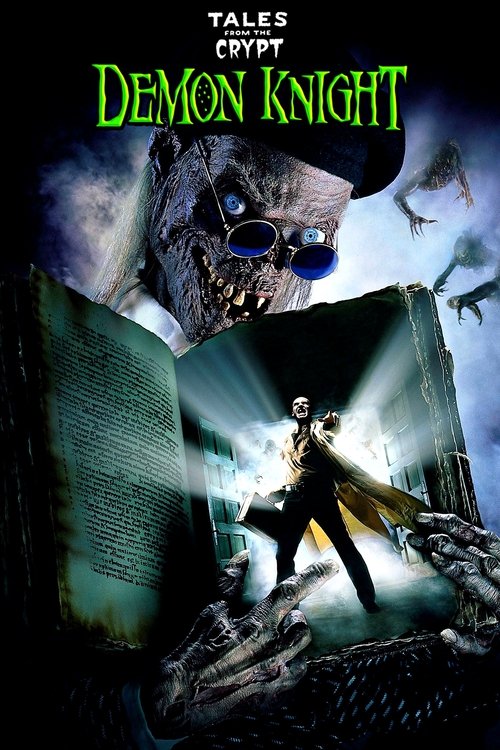
Tales from the Crypt: Demon Knight (1995)
Directed by Ernest R. Dickerson
No — Tales from the Crypt: Demon Knight is not woke, scoring 11 out of 100 on our wokeness meter.
Tales from the Crypt: Demon Knight arrives in 1995 wearing the skin of an HBO anthology, and it does so with a straight face and a bucket of latex.
Consciousness Markers
Jada Pinkett is cast as Jeryline, the convict-turned-final-girl who survives and becomes the new guardian of the key, with CCH Pounder as the boarding house proprietor — a notably diverse ensemble for a mid-90s horror programmer, but the film never comments on race and the casting plays naturally.
Jeryline graduates from convict to the last guardian standing and destroys the Collector by spitting the key's blood in his face; it's a capable female lead but standard-issue final-girl mechanics rather than a thesis.
The demon is ultimately dispatched by a Black woman and an interracial cast shares the siege, but the film has no racial statement or commentary — the abandoned Mary Lambert idea of an African American Brayker never made it to screen.
A bare-knuckle siege movie with essentially no messaging; exposition about the seven keys exists to fuel the plot, not to instruct the audience.
No LGBTQ+ characters, themes, or subtext of any kind.
No environmental content whatsoever.
No economic critique; the Collector is a literal demon, not a metaphor for capital.
No body-image themes; bodies are present only in the interest of gore and prosthetics.
No neurodivergent characters or themes.
Uses Christian iconography (the blood of Christ as a weapon) but treats it as pulp mythology rather than rewriting history.
Why it received this score
Tales from the Crypt: Demon Knight arrives in 1995 wearing the skin of an HBO anthology, and it does so with a straight face and a bucket of latex. Ernest Dickerson, a cinematographer of real pedigree, directs a siege picture in which a drifter named Brayker guards the last of seven cosmic keys inside a decommissioned New Mexico church that now rents rooms. Billy Zane plays the Collector with a leer that suggests a man who read the script and decided to enjoy it anyway. The cast around him is unusually varied for a mid-decade horror programmer: Jada Pinkett as Jeryline, a convict on work release; C.C.H. Pounder as the boarding house proprietor; Gary Farmer and Dick Miller filling out the pews. None of this is remarked upon. The film casts well and moves on, which is its own quiet achievement.
That ensemble gives the film a mild forward lean its mechanics do not fully earn. Jeryline survives, inherits the guardianship, and dispatches the demon by spitting the key's blood into his face, a final girl graduation ceremony executed with efficiency and no thesis attached. The screenplay passed through Mary Lambert's hands at an earlier stage, where it carried a notion about the oppressed of the earth also being its saviors. That notion did not survive the trip to the screen. A capable heroine and a diverse group of people dying in a house are all that is left, which is not a statement so much as a decent night at the movies.
The blood of Christ here is a rechargeable battery, not a sermon. The seven keys exist to justify the running, the wards, and the corpses. A viewer hoping to be instructed on economics, climate, or the human body will leave empty. It is a bare-knuckle siege with prosthetics and a heavy metal soundtrack, and it asks nothing of anyone except attention.
Analysis generated by our Consciousness Algorithm
Part of


Synopsis
Ex-soldier Frank Brayker is the guardian of an ancient key that can unlock tremendous evil; the sinister Collector is a demon who wants the key so he can initiate the apocalypse. On the run from wicked mercenaries for almost 90 years, Brayker finally stops in at a boarding house in New Mexico where — with the help of its residents — he plans to face off against the Collector and his band of ghouls, preventing them from ever seizing the key.
Questions about Tales from the Crypt: Demon Knight
Is Tales from the Crypt: Demon Knight woke?
No — Tales from the Crypt: Demon Knight is not woke, scoring 11 out of 100 on our wokeness meter. That earns it a verdict of Ultra Based.
Does Tales from the Crypt: Demon Knight have any woke elements?
1 of the 10 markers register at 30 or above, led by Representation Casting (40). On Representation Casting: Jada Pinkett is cast as Jeryline, the convict-turned-final-girl who survives and becomes the new guardian of the key, with CCH Pounder as the boarding house proprietor — a notably diverse ensemble for a mid-90s horror programmer, but the film never comments on race and the casting plays naturally.
How does Tales from the Crypt: Demon Knight compare to other 1995 movies?
It ranks #33 of the 108 films from 1995 we've scored; their average is 12. The wokest is Total Eclipse (60).
How is the Woke Score calculated?
An AI-assisted process researches the film and its reception, scores it 0–100 on ten markers, then combines those into one 0–100 Woke Score. It measures a specific set of 2020s cultural themes, not film quality.