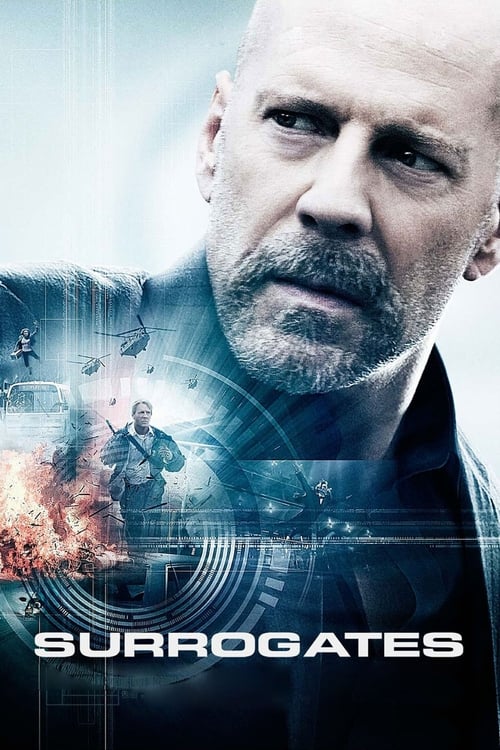
Surrogates (2009)
Directed by Jonathan Mostow
No — Surrogates is not woke, scoring 13 out of 100 on our wokeness meter.
Surrogates arrives from 2009, a studio science fiction thriller with Bruce Willis, a comic book pedigree, and an eighty million dollar budget that bought sleek robots and very little ideological trouble.
Consciousness Markers
The villain's motive hinges on VSI having 'capitalized on surrogacy for profit' after firing its idealistic inventor, giving the film a mild eat-the-rich, corporate-greed undercurrent.
The cast is led by Bruce Willis and features Black actors Ving Rhames and Boris Kodjoe in supporting roles, but the film makes no comment on their presence and centers a predominantly white ensemble.
The film gestures at philosophical ideas about identity and isolation but, as critics noted, quickly settles into formulaic action rather than preaching a message.
The premise critiques society's preference for idealized, attractive surrogate bodies over real ones, but it is framed as a cautionary sci-fi conceit rather than a body-positivity message.
Radha Mitchell plays a capable FBI partner and Rosamund Pike a dissatisfied wife, but neither role advances any feminist argument; the women exist to service the male protagonist's arc.
There are no LGBTQ+ characters, themes, or subtext anywhere in the film.
The film engages no racial themes, commentary, or consciousness whatsoever.
No environmental or climate themes appear; the dystopia is technological and social, not ecological.
No neurodivergent characters or themes are present.
The film is set in a speculative near-future and makes no revisionist claims about real history.
Why it received this score
Surrogates arrives from 2009, a studio science fiction thriller with Bruce Willis, a comic book pedigree, and an eighty million dollar budget that bought sleek robots and very little ideological trouble. The premise imagines a near future in which citizens stay home and send idealized androids into the world. That setup could support a sharp satire of vanity, isolation, and consumer culture. The film, however, keeps its gaze on chase scenes and conspiracy mechanics. It has no LGBTQ characters or themes, no racial consciousness, no climate crusade, no neurodivergent representation, and no revisionist claims about real history. The progressive checklist finds almost nothing to work with.
The one area where the film shows a pulse is its mild suspicion of corporate power. The villain's grievance involves Virtual Self Industries capitalizing on surrogacy for profit after pushing out its idealistic inventor. That gives the story a faint eat-the-rich undercurrent, though the screenplay never builds it into a sustained argument. The premise also glances at body image by contrasting flawless surrogate bodies with messy real ones, but the treatment is a cautionary science fiction conceit, not a body positivity platform. Radha Mitchell's FBI partner and Rosamund Pike's unhappy wife are competent presences, yet neither role advances a feminist case. They exist to support Willis and his emotional thaw.
On the lecturing front, the film gestures at identity and isolation before surrendering to formula. Critics at the time noted that it settles too soon for action, and they were right. The casting is mainstream for its era: Ving Rhames and Boris Kodjoe appear in supporting parts, but the film makes no comment on their presence and centers a white lead. What remains is a cautious product, culturally safe, mildly skeptical of corporate greed, and uninterested in most modern social questions. It is the cinematic equivalent of a well-polished surrogate: attractive, functional, and lacking a pulse.
Analysis generated by our Consciousness Algorithm


Synopsis
Set in a futuristic world where humans live in isolation and interact through surrogate robots, a cop is forced to leave his home for the first time in years in order to investigate the murders of others' surrogates.
Questions about Surrogates
Is Surrogates woke?
No — Surrogates is not woke, scoring 13 out of 100 on our wokeness meter. That earns it a verdict of Ultra Based.
Does Surrogates have any woke elements?
Very few. None of the 10 markers reaches 30, the level where a marker counts as present; the highest is Eat the Rich at 28.
How does Surrogates compare to other 2009 movies?
It ranks #82 of the 230 films from 2009 we've scored; their average is 14. The wokest is Home (79).
How is the Woke Score calculated?
An AI-assisted process researches the film and its reception, scores it 0–100 on ten markers, then combines those into one 0–100 Woke Score. It measures a specific set of 2020s cultural themes, not film quality.