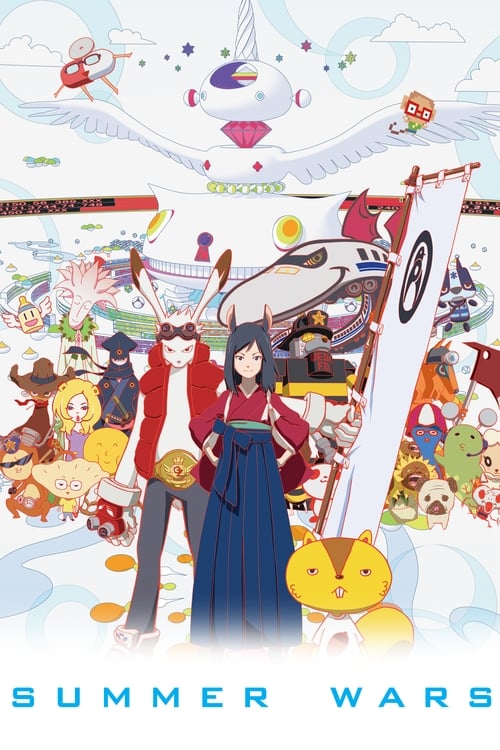
Summer Wars (2009)
Directed by Mamoru Hosoda
No — Summer Wars is not woke, scoring 11 out of 100 on our wokeness meter.
Summer Wars arrives from 2009 with a backpack full of Hanafuda cards and a family reunion.
Consciousness Markers
Natsuki is a co-protagonist who wins the decisive Koi-Koi duel, and matriarch Sakae commands the family, but the film frames this as family drama rather than explicit feminist critique.
The film carries a warm family/community moral and a mild message about online cooperation, but it is delivered through plot rather than preachy exposition.
The cast and characters are naturally Japanese for a Japanese production; there is no modern inclusive-casting agenda or commentary.
There are no LGBTQ+ characters, themes, or subtext in the film.
The film touches on samurai ancestry and family tradition, but it has no modern racial-justice or racial-consciousness framing.
There is no climate-change theme or environmental crusading in the story.
The film includes a rogue AI and military misuse of technology, but it does not advance an anti-capitalist or eat-the-rich message.
There is no body-positivity theme or body-image commentary.
Kenji is a shy math prodigy, but the film does not frame him through neurodivergence or disability representation.
The historical samurai-family background is used as local color and heritage, not as revisionist history.
Why it received this score
Summer Wars arrives from 2009 with a backpack full of Hanafuda cards and a family reunion. Mamoru Hosoda's film divides its time between a Nagano estate and the vast virtual world OZ, where a rogue AI named Love Machine wreaks havoc. The cultural inventory is Japanese and traditional: a large Jinnouchi clan, a commanding matriarch, samurai ancestry, and a summer wedding-style gathering. The casting is natural for a Japanese production, not an inclusive-casting statement. There are no LGBTQ characters or themes. Racial consciousness in the modern sense does not appear. Climate concerns do not appear. The rogue AI and military misuse of technology never become an anti-capitalist parable. Body image and neurodivergence are absent, even if Kenji is a shy math prodigy. The samurai heritage is local color, not revisionist history.
The few progressive notes are quiet. Natsuki is a co-protagonist who wins the decisive Koi-Koi duel, and Sakae commands the household with formidable authority. The film frames these facts as family drama, not feminist argument. Its moral instruction is mild: cooperation online and across generations can save the day. That lesson arrives through plot mechanics, card games, and a geyser, not through speeches. The result is a film with almost no lecture energy. It would rather show a hundred relatives bickering than tell us how to think.
For a classifier, Summer Wars is a sober vintage. It has warmth, craft, and a sentimental streak, but its social consciousness is inherited and domestic. The AI crisis is a adventure problem, not a systemic critique. The military contractor is a plot device, not a villain class. The ending kiss is heterosexual and unexamined. This is not a film that preaches. It celebrates family, duty, and the stubborn utility of a grandmother's connections. The modern cultural markers are largely absent, and the film seems content to remain a summer entertainment about saving the world from the porch.
Analysis generated by our Consciousness Algorithm


Synopsis
Teenage math whiz Kenji Koiso agrees to take a summer job at the Nagano hometown of his crush, Natsuki. When he arrives, he finds that her family have reunited to celebrate the 90th birthday of their matriarch. His job: pretend to be Natsuki's fiancé. Meanwhile, his attempt to solve a mathematical equation causes a parallel world's collision with Earth.
Questions about Summer Wars
Is Summer Wars woke?
No — Summer Wars is not woke, scoring 11 out of 100 on our wokeness meter. That earns it a verdict of Ultra Based.
Does Summer Wars have any woke elements?
Very few. None of the 10 markers reaches 30, the level where a marker counts as present; the highest is Feminist Agenda at 15.
How does Summer Wars compare to other 2009 movies?
It ranks #94 of the 230 films from 2009 we've scored; their average is 14. The wokest is Home (79).
How is the Woke Score calculated?
An AI-assisted process researches the film and its reception, scores it 0–100 on ten markers, then combines those into one 0–100 Woke Score. It measures a specific set of 2020s cultural themes, not film quality.